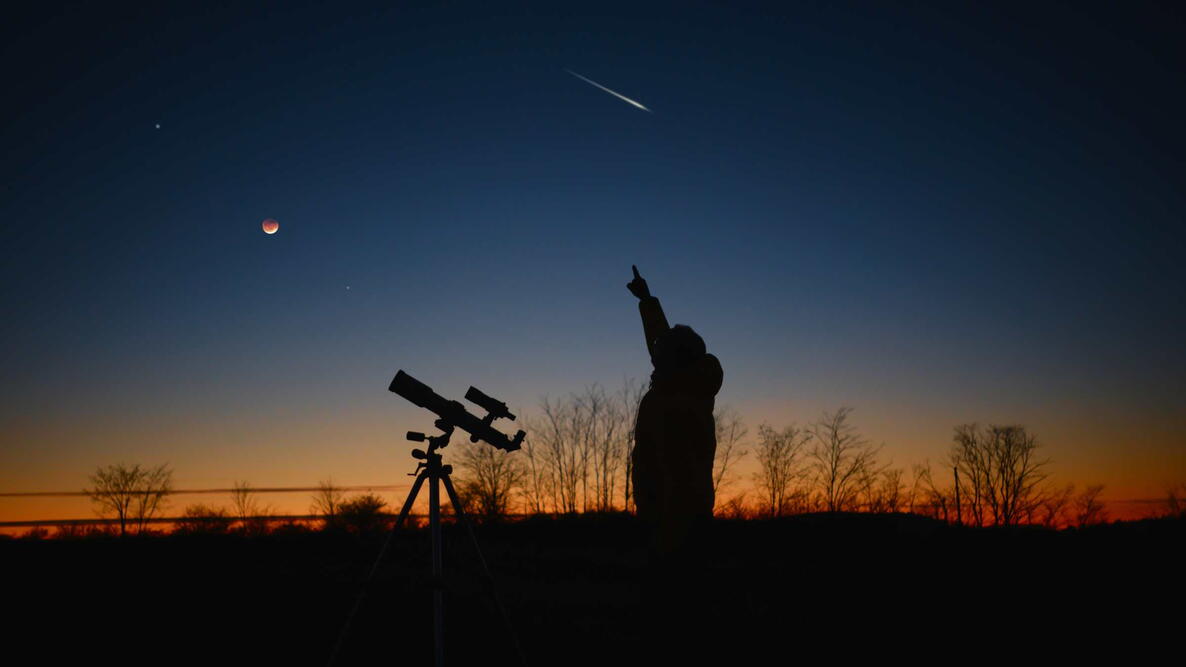

September is a skywatcher’s dream month. Planets line up before dawn, the Moon drifts gracefully past Venus and Jupiter, and Saturn takes center stage with its golden rings. Add the Full Corn Moon, Neptune’s elusive opposition, and the equinox tipping us into autumn, and you’ve got a front-row seat to cosmic theater—all without leaving your backyard.
Early Morning Planets
The predawn Eastern sky in September offers an amazing view of a very bright Mercury far below blazing Venus and brilliant Jupiter. Set your alarm clock and grab a cup of Joe; early risers will be rewarded with an incredible view of Venus, Jupiter, and eight 0- and 1st-magnitude stars lighting up the eastern sky.
On September 17-18, the Crescent Moon will float between Venus and Jupiter. Then, a predawn conjunction will occur on September 19, when the Moon closely meets up with Venus and Leo’s bright blue star Regulus.
September 7: Full Corn Moon
The Full Corn Moon peaks on September 7 at 2:09 P.M. We love this last gorgeous Moon of summer! Learn more about the Full Corn Moon and the history behind it. For a brief period, a penumbral eclipse will be visible from Hawaii and very western Alaska before the Moon sets.
September 21: Saturn Sighting
Saturn, the ringed planet, is easy to locate this evening. You can observe the golden planet as it comes into opposition. With a telescope, the rings can be observed almost as a straight line, more edgewise than will be seen again until 2040.
September 22: Autumnal Equinox
Sunday morning, September 22, brings the autumnal equinox—at 2:29 A.M. EDT. This marks the start of fall in the Northern Hemisphere and the start of spring in the Southern Hemisphere. Learn more about the first day of fall!
September 23: Neptune in Opposition
The other blue planet, Neptune, comes into opposition this evening. This means that the Earth is directly between the planet and the sun. However, if you want to look at this tiny, blue, 7.8-magnitude disk, you will need to employ your trusty telescope to bring it into view.

Pegasus Shines in September
Watch for Pegasus, the Winged Horse, in the southeastern sky this month! A helpful guide to this asterism (unofficial star pattern) is the Great Square, which outlines Pegasus’ body. See our star chart and how to find Pegasus.

More Like This

Comments