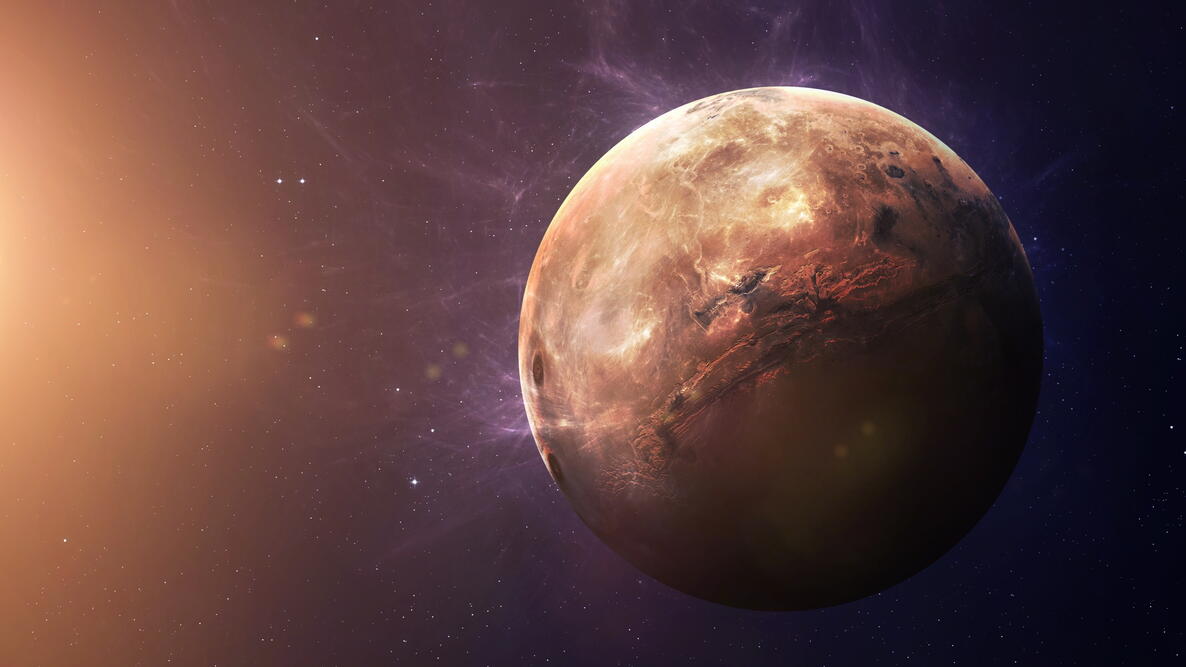

Planet Mercury is odd in so many ways; it’s hard to find aspects that aren’t strange. What color is Mercury, really? And does it have the hottest surface temperature? See 10 fun facts about the smallest planet in our solar system.
| Feature | Mercury |
|---|---|
| Distance from Sun | 36 million miles (58 million km) |
| Orbit Duration | 88 Earth days |
| Rotation Period | 59 Earth days |
| Surface Temperature | -280°F to 801°F |
| Color | Dark gray |
| Moons | 0 |
10 Facts about Planet Mercury
- Mercury’s orbit may be nearest to the Sun, so you’d think it was also the hottest planet. Nope! It’s the second-hottest planet. The “hottest of them all” title is claimed by our neighbor Venus, thanks to its dense atmosphere. Learn more about Venus, the planet of paradox.
- Mercury is a planet of extremes. During the day, Mercury’s temperatures reach highs of 801°F (427°C) thanks to its proximity to the Sun. This is hot enough to melt lead! At night, temperatures fall as low as -280°F (-180°C) because the planet does not have an atmosphere to trap heat.
- Named for the swift messenger of the Gods, Mercury takes only 88 Earth days to zip around the Sun, so it’s the fastest of the planets. However, it takes a full 59 days to rotate one round on its own axis; that’s a very long workday!
- Mercury has the most lopsided, out-of-round orbit of any planet. Thanks to tugs from Jupiter, of all unlikely villains, the Mercury orbit wildly changes shape. In the future, its orbit may stretch all the way out and let it collide with Venus, destroying both worlds in the next 5 billion years.
- Mercury alters its brightness more than any other planet, varying a thousandfold. And while Venus looks brightest when it’s near to us, Mercury shines brightest when it’s farthest from us.
- Often, we think of Mercury as red. However, Mercury is dark gray and covered with rock and dust. Venus is bright white. Mars is a rust-orange color. Mercury has been a cooled molten rock for billions of years, and it is the only planet in our Solar System that is bare rock.
- Planet Mercury is named after the Roman god Mercury because he is the “messenger” god who can fly, wearing a winged hat and sandals.
- Mercury does have the most craters, which may sound strange. However, this is because there is no weather to erode the craters, as you will find on other planets. Mercury has no volcanoes, no tectonic activity, and no storms or wind or rain. There’s very little atmosphere at all.
- As Mercury spins, it has no axial tilt. At its polar depressions, the Sun is always below the horizon, so these regions are packed with ice. They offer winter sports in a world badly needing them.
- And even that isn’t the end of Mercurian strangeness. It has a region called The Weird Terrain. (I’m not making that up.) It’s located at the precise opposite point on Mercury from its most famous impact crater, the enormous Caloris Basin. Apparently, debris or else shock waves from the impacting meteor traveled around the planet and collided in midair at the antipodal point—to wreak havoc there.
How to Find Mercury
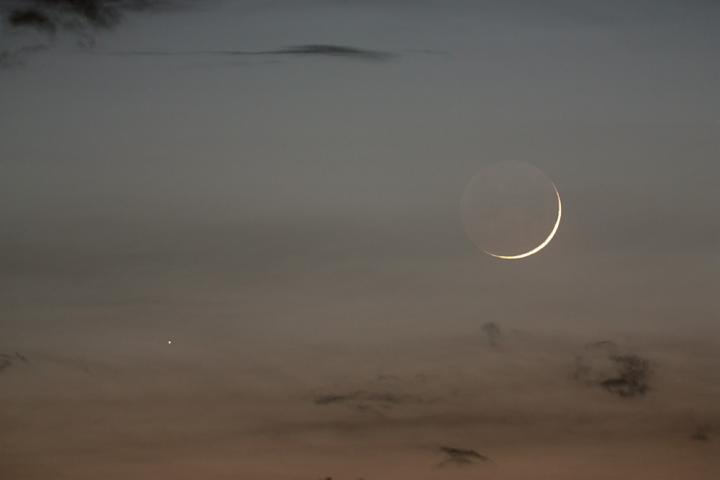
As Mercury is so near the Sun, it’s often difficult to see. It’s best observed in the spring (April and May) and in the late autumn (October and November) in the Northern Hemisphere.
In addition, the small planet is most visible about 90 minutes after sunset. You’ll need to consult the Almanac’s Planet Rise and Set Calculator.

More Like This
Hi Barry,
As you correctly pointed out, when Mercury is directly behind the Sun or nearly so, it’s invisible to us. But when it’s almost behind the Sun, but at enough of an angle to be visible, it’s then at essentially its farthest away point, and thus at its brightest magnitude.
At this point, Mercury is in its "full" phase, although it is also tiniest in size, yet at its most brilliant. This is opposite to the behavior of Venus, which is brightest when on the nearer side of the Sun to us, and though a crescent and therefore mostly showing its night side, it’s displaying its largest amount of surface area.

Comments