
Discover how to grow sweet, earthy parsnips—perfect for cool-season gardens

Read Next
Planting
Plant parsnips in a sunny area with loose soil that drains well and is free of rocks. As with carrots, clay or compacted soils can cause parsnip roots to be thin and misshapen. Make sure the area is clear of weeds. Loosen the soil to a depth of 12 to 15 inches and mix in a 2- to 4-inch layer of compost or aged manure for fertility.
When to Plant Parsnips
Parsnips need a long growing season, so sow seeds as soon as the soil is workable in the spring. Parsnip seeds will germinate in soil temperatures as low as 48°F (9°C), but ideally soil at 50º to 54ºF (10° to 12°C) will speed germination.
How to Plant Parsnips
Don’t plant where sod grew in the previous season. Excess nitrogen in the soil will cause overabundant top growth and poor root development. Consider doing a soil test.
- Always sow fresh seed. Parsnip seeds do not store well and seeds that are more than a year old will have a reduced germination rate.
- Sow seeds directly in the garden.
- Sow seeds 1/2 inch deep, 1 inch apart, in rows 18 to 24 inches wide.
- Tip: Sow radish seeds in between your parsnip seedings. Radishes will grow quickly, marking the row and breaking the dirt’s crust for the parsnips.
- Parsnips are slow to germinate. Seedlings typically emerge in 2 to 3 weeks, or longer in soil temperatures below 50°F (10°C). To hasten the process, keep the soil moist.
- Tip: Another way to speed up germination is to start by soaking paper towels or cotton wool pads. Place them on a saucer and press papery parsnip seeds into them. Keep the seeds warm (50º to 54ºF) and watch for little white roots to appear. Then sow as described. Discard any seeds that fail.

Types
Choose short-root varieties for soil that is shallow, heavy, and/or contains a lot of rocks.
- ‘All-American’: Tapered, 10- to 12-inch white roots; high sugar content; stores well
- ‘Harris Model’: Smooth, tapered, 10-inch white roots, free of side roots
- ‘Hollow Crown’: Mild, 12-inch white, fine-grain roots; flavor improves after frost
- ‘Kral Russian’: Heirloom; beet-shape root; good for shallow or heavy soil.
Harvesting
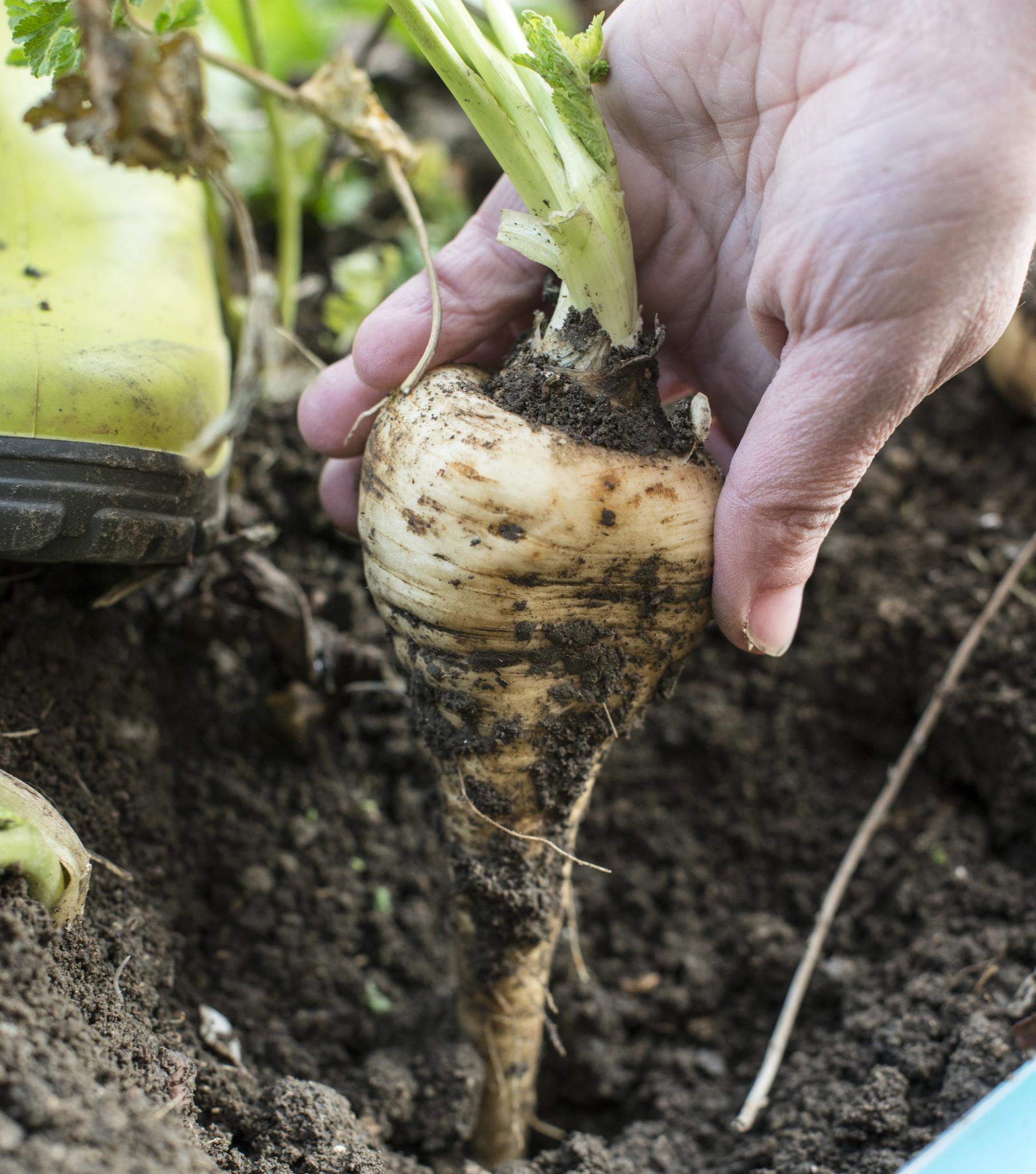
Parsnips mature in about 16 weeks after planting, depending on the variety. Harvest when roots are at least 1 inch in diameter.
When exposed to near-freezing temperatures for 2 to 4 weeks in the fall/early winter, the starch in the root changes into sugar, resulting in a strong, sweet, unique taste.
- Leave your parsnips in the ground for a few frosts, but harvest before the ground freezes.
- Or leave them in the ground for the entire winter, covered with a thick layer of mulch. Harvest immediately after the ground thaws in the spring, before top growth starts. If a flower stalk develops, roots may turn woody.
How to Store Parsnips
Before storing parsnips, trim foliage down to 2 to 3 inches. Store parsnips between 32 and 35°F (0 and 2°C), with a humidity of 90 to 95%. For longer-term storage (4 to 6 months), store roots in slightly damp sand, sawdust, or leaves.
Gardening Products
Cooking Notes
Parsnips and carrots are wonderful when roasted together with rosemary on a baking sheet. The cores of a parsnip can be a little tough. When roasting, we recommend cutting parsnips at an angle into disks.
One of our favorite ways to enjoy parsnips is by pureeing similar to mashed potatoes. They have a sweet and rich flavor and aren’t as high in starch as potatoes. Steam first and then add to your food processor.
More Like This


Comments

They may have been harvested too late. They become more fibrous and woody if they get too large. It's fine to eat them; as you have done, just cut out that tough center.
Next time, you might also try spacing them a little more closely, such as 2 to 4 inches apart, to keep them smaller. Make sure that they get plenty of water, and provide mulch to keep the soil moist--too little water encourages woodiness.
Parsnips harvested in early spring, before new growth starts, can taste sweet, as the starches change to sugar in preparation for growth. However, once the tops start to grow, the root can lose flavor and become fibrous. If you harvested them just when the leaves were barely emerging, it might be worth a taste. If there was a lot of growth, however, flavor might have suffered.
You are definitely correct to not eat any wild plant without a definite identification by an expert. Unfortunately, we wouldn't be able to do that here. We'd suggest that you take the plant sample to a knowledgeable horticulturist in your area, such as those at your county's Cooperative Extension.
http://www.almanac.com/content/cooperative-extension-services
The wild parsnip plant (Pastinaca sativa) has several lookalikes, including one of the deadliest plants in North America, water hemlock. Even wild parsnips, although the roots are edible, have a sap that can cause severe skin irritation, discoloration, rash, and blisters when the sap on the skin is exposed to light; all aboveground parts are poisonous. Only the root is edible. When harvesting wild parsnip (which is invasive in many areas), always use gloves, long sleeves, long pants, etc. to avoid getting the sap on your skin.
Water hemlock (Cicuta douglasii), poison hemlock (Conium maculatum), cowbane (Cicuta virosa), wild carrot, etc. all look similar. Below are a few sites that describe wild parsnip and the hemlock lookalikes:
http://ars.usda.gov/Services/docs.htm?docid=9996
http://fyi.uwex.edu/weedsci/2001/07/04/wild-parsnip-3/
http://www.ipm.iastate.edu/ipm/icm/2007/7-9/poison.html
http://blog.emergencyoutdoors.com/edible-wild-plants-wild-parsnip-pastinaca-sativa/
http://www.prairiehaven.com/?page_id=9686
http://wildwoodsurvival.com/survival/food/poisonousplants/waterhemlock/index.html
http://plants.ces.ncsu.edu/plants/all/cicuta-maculata/
If you overwinter your parsnips, just add a few inches of soil over the crowns after the first fall frosts.Harvest the roots in early spring. They should be even more tender and sweet!
- « Previous
- 1
- 2
- …
- 10
- Next »

Parsnips that have been planted too late in the season will be small. Could that be the trouble? For many areas of the country, the ideal time would be to sow seeds in early spring. Too much nitrogen, or too crowded, can also cause small roots.
If the parsnips overwinter, harvest them before the top growth starts, or the root quality may suffer, such as turning woody. The yellow seeds developing on top is natural--parsnips are biennial, so they will go to seed the second year.