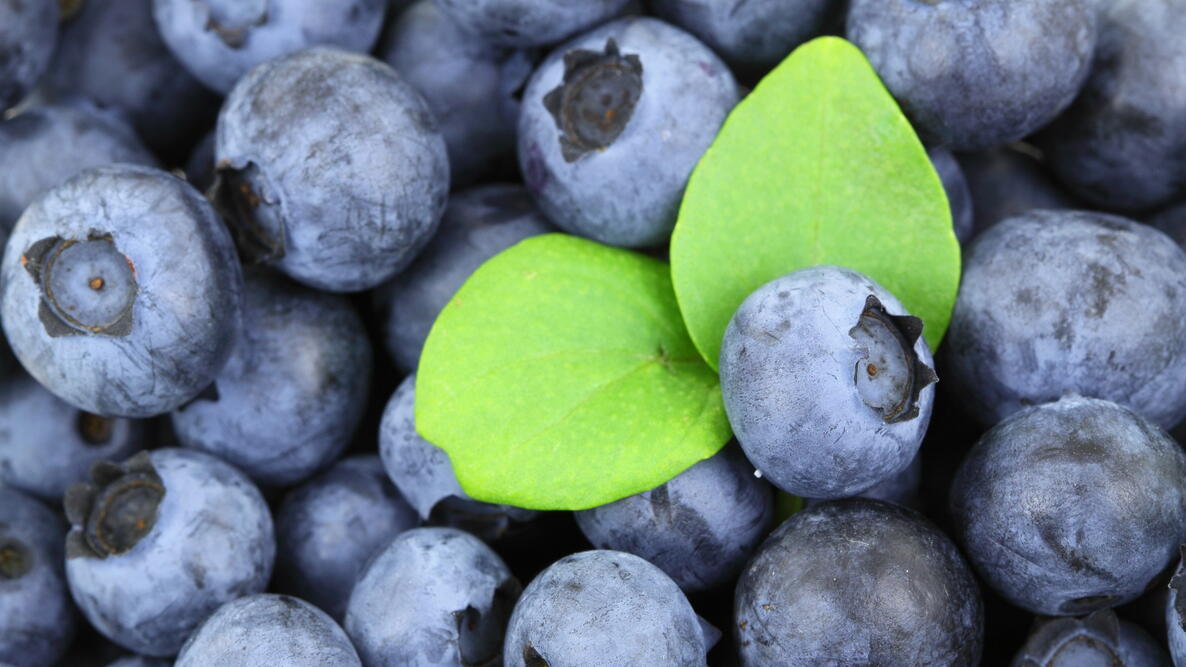
Caption
Blueberries are one of the easiest fruits to grow.
Everything You Need to Know to Grow Blueberries That Are Bursting with Flavor

Read Next
Planting
When to Plant Blueberry Bushes
- Blueberries can be planted in spring or also in late fall in all but the coldest regions. In Zones 5 and below, it’s best to wait until early to mid-spring to plant.
- If available, 1- to 3-year-old plants are a good choice. These can be bought in containers or bare-root. In either case, buy from a reputable nursery or website.
Choosing and Preparing a Planting Site
- Select a sunny, sheltered spot. While blueberries tolerate shade, better crops are obtained in the sun. At the same time, they should not be exposed to harsh, drying winds.
- Don’t plant blueberries too close to trees, as the trees will block out sunlight and suck up any moisture in the soil.
- If planting multiple bushes, it’s best to plant them in a group rather than scattered throughout your garden. This will bolster berry production and quality.
- Blueberries are a shallow-rooted plant. Therefore, they require soil that holds moisture but also drains well and doesn’t stay wet. Don’t plant blueberries in sites with heavy, clayey soils that stay wet.
- Blueberries thrive in soil that is acidic. The soil pH should ideally be between 4.0 and 5.0; soil that isn’t acidic enough will stunt growth. Soil can be acidified by mixing a small amount of granulated sulfur into the soil several months before planting. Peat moss and pine bark or needles are also good additions that will help acidify your soil.
- Mix organic matter into the soil before you set your blueberry bushes. (See more about preparing soil for planting.)

How to Plant Blueberry Bushes
- Tip: Be careful not to plant them too deeply. The rootball should be just below the surface (one-quarter to one-half inch).
- Dig holes about 20 inches deep and 18 inches wide (or about twice as wide and twice as deep as the plant’s roots).
- Space bushes 4–5 feet apart in a row, with at least 8 feet between rows. Prepare a planting mixture of two parts loam and one part oak leaf mold, peat moss, aged sawdust, or compost, and place a layer of this mixture in the bottom of the hole.
- Set the bush in the hole with the rootball just below the surface with its roots spread out. Pack the hole tightly with the soil.
- Apply fertilizer 1 month after planting, not at the time of planting. Apply ½ ounce of a 10-10-10 fertilizer in a band around the plant 6 to 12 inches from the crown.
Types
There are four types of blueberries: highbush, lowbush, hybrid half-high, and rabbiteye.
The most commonly planted blueberry is the highbush. Most blueberry breeding has focused on this species, so there are many varieties that range widely in cold hardiness and fruit season, size, and flavor.

Blueberries are partially self-fertile, so you will harvest more and larger berries by planting two or more varieties together. Planting more than one variety can also extend the harvest season.
Highbush (Vaccinium corymbosum): A six-foot shrub hardy from Zone 4 to Zone 7.
- For withstanding cold winters, choose ‘Bluecrop’, ‘Blueray’, ‘Herbert’, ‘Jersey’, or ‘Meader’.
- For big berries, choose ‘Berkeley’, ‘Bluecrop’, ‘Blueray’, ‘Coville’, ‘Darrow’, or ‘Herbert’.
- For flavor, usually, the main reason for growing your own fruit, choose ‘Blueray’, ‘Darrow’, ‘Herbert’, ‘Ivanhoe’, ‘Pioneer’, ‘Stanley’, or ‘Wareham’.
- For something different, try ‘Pink Lemonade’, which produces bright pink blueberries!
Lowbush (Vaccinium angustifolium): For the coldest climates, lowbush varieties are your best bet, hardy from Zone 3 to Zone 7.
- These are the blueberries you find in cans on supermarket shelves. When fresh, the fruits are sweet and covered with a waxy bloom so thick that the berries appear sky blue or gray.
- The creeping plants, a foot or so high, are spread by underground stems, or rhizomes. They blanket the rocky upland soils of the Northeast and adjacent portions of Canada. Lowbush blueberries make a nice ornamental fruiting ground cover.
- Plants sold by nurseries are usually seedlings or unnamed wild plants rather than named varieties.
Half-High: Breeders have combined qualities of highbush and lowbush blueberries into hybrids known as half-high blueberries.
- The University of Minnesota introductions include ‘Northcountry’, a variety that grows 18 to 24 inches high and has excellent, mild-flavored, slightly aromatic sky-blue fruits; and ‘Northblue’, which grows 20 to 30 inches high and produces an abundance of nickel-size, dark-blue, somewhat tart fruits—just right for pies.
- ‘Northland’ is a half-high that grows 3 to 4 feet tall. From Michigan, it has relatively bland, average-quality fruit.
Blueberries for Southern Gardens (Zones 7–9):
- Rabbiteye (Vaccinium virgatum): Grown in the southeastern United States, rabbiteye varieties are extremely adaptable, productive, and pest-tolerant. They do, however, have a high degree of self-incompatibility and require two or more varieties to be planted together to ensure pollination. Recommended varieties include ‘Powderblue’, ‘Woodard’, and ‘Brightwell’.
- Southern Highbush (hybrids of V. virgatum, V. corymbosum, or V. darrowii): Southern highbush varieties tend to be pickier and harder to grow than rabbiteyes, but there are a few high-quality varieties that do well. Among these are ‘Emerald’, ‘Windsor’, and ‘Springhigh’.
- Read more about blueberries for southern gardens from the University of Florida: Blueberry Gardener’s Guide.
Harvesting
How to Harvest Blueberries
- Blueberries are typically ready for picking between June and August.
- Don’t rush to pick the berries as soon as they turn blue. Wait a couple of days. When they are ready, they should fall off right into your hand.
- If you plant 2-year-old blueberry bushes, they should start to bear within a year or two. (Pick off any flowers that form the first year or two after planting to allow the bush to become established.) Be aware that full production is only reached after about 6 years (depending on variety).
How to Store Blueberries
- Blueberries are one of the easiest fruits to freeze. Learn how to freeze blueberries so you can have them all winter long.

Gardening Products
Potting and Repotting
Can You Grow Blueberries in a Container?
Yes! In fact, blueberries grown in containers are easier to protect from birds and other critters, more disease-resistant, easy to harvest, and easy to move if needed. Plus, if you live in an area without acidic soil, growing blueberries in containers allows you to tailor the soil pH specifically for them.
Here’s how to do it:
- Use a large container with drainage holes.
- Use a potting mix designed for acid-loving plants, such as azaleas or rhododendrons, or mix sandy soil with peat moss and compost.
- Plant the bush in the container and water the bush well.
- Add mulch on top of the soil to keep in moisture.
- Place the pot in a sunny spot.
- Keep soil moist.
- In northern regions, overwinter the blueberry container in a protected area, cover it with straw, or wrap it in burlap.
Blueberry Varieties for Containers
- ‘Top Hat’: Bred by the Michigan State University for small spaces and containers.
- ‘Pink Lemonade’: Pink blueberries contain genetics from rabbiteye blueberries (a standard in the hot South). These pink berries can be planted in nearly every climate.
- ‘Pink Champagne’: Another pink variety that is full of antioxidants and sweeter than other blueberries.

More Like This



Your Jersey should actually benefit from having another variety such as the Duke for pollination. You will get more and larger berries if you have a pollinator.They should be planted about 5 to 6 feet apart.
Blueberry leaves should not fall off in the spring. When you fertilize it is recommended that you sprinkle 1 1/2 tablespoons of fertilizer (per bush) about 18 inches from the base of the plant. Fertilizer should not touch the stems or the crown. Water your bushes and see if they will bounce back.
Some good rabbiteye varieties for your area are Garden Blue, Climax, Southland, Bluebelle and Brightblue. Blueberries need well-drained, acidic soil that is high in organic matter. We suggest that you test your soil before planting.
Hi Wilma,
Blueberries usually have buds before they leaf out. Don't pinch them off. You may get some nice berries this year.
- « Previous
- 1
- 2
- …
- 10
- Next »

Comments