
Why Do We Celebrate St. Patrick’s Day?

Everyone is Irish on St. Patrick’s Day! When is St. Patrick’s Day? Who was the real St. Patrick? Why are shamrocks a symbol of this day? Enjoy St. Patrick’s Day history, legends, and lore.
Celebrate St. Patrick’s Day 2026!
This year, St. Patrick’s Day will be observed on Tuesday, March 17.
Although the holiday originally started as a Christian feast day celebrating the life of St. Patrick and the spreading of Christianity to Ireland, today, it is a day of revelry and a celebration of all things Irish. Don’t forget to wear green!
When Is St. Patrick’s Day?
St. Patrick’s Day is officially observed on March 17 each year, though celebrations may not be limited to this date. The significance of March 17 is that it’s said to be the date of St. Patrick’s death in the late 5th century (circa A.D. 493).
| Year | St. Patrick’s Day |
|---|---|
| 2026 | Tuesday, March 17 |
| 2027 | Wednesday, March 17 |
| 2028 | Friday, March 17 |
| 2029 | Saturday, March 17 |
*In the years when St. Patrick’s Day falls on a Sunday or during Holy Week, the Almanac keeps it there and treats it as a secular holiday only. Churches may transfer this to another date, however, for the feast day. Or, cities may change their official celebration date.
Who Was St. Patrick? Was He a Real Person?
Saint Patrick is the patron saint and national apostle of Ireland. He is credited with successfully spreading Christianity throughout Ireland—hence the Christian celebration of his life and name.
Was There Really a St. Patrick?
Definitely. However, there are many legends about him that mix with the truth. Did he play a large role in spreading Christianity to Ireland? Yes, absolutely. Did he really drive all the snakes out of Ireland? Probably not, since snakes weren’t native to Ireland to begin with!
In any case, St. Patrick’s impact was significant enough to warrant our modern-day celebrations. Here’s a bit about St. Patrick himself.
A Young St. Patrick Finds God
The man who would eventually become St. Patrick was born in Britain (part of the Roman Empire at the time) as Maewyn Succat in the late 4th century. His family was Christian, but it’s said that Maewyn himself was an atheist throughout his childhood.
That would change at age 16 (around A.D. 400) when Maewyn was kidnapped from his home on the west coast of Britain by Irish pirates, who proceeded to carry him off to Ireland and force him to work as a shepherd herding sheep. After 6 years, he escaped his captors, walking nearly 200 miles through the Irish landscape and convincing a ship to carry him back to Britain. This harrowing experience certainly had an effect on Maewyn, who was convinced it was the Lord who protected him and delivered him safely home.
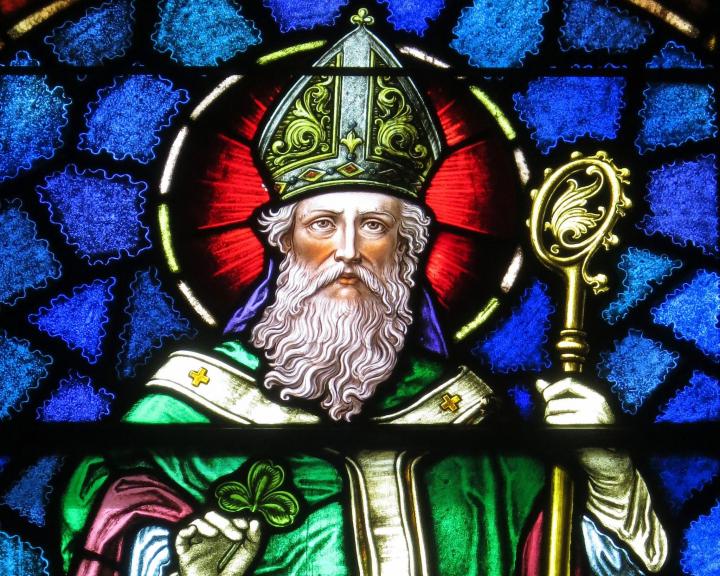
Photo by Nheyob/Wikimedia Commons.
St. Patrick Spreads the Gospel
Upon returning home, Maewyn received his call (in a dream) to preach the Gospel—in Ireland, of all places! He spent the next 15 or so years in a monastery in Britain, preparing for his missionary work. When he became a priest, his name was changed to Patricius, and he returned to the land of his captors to begin his teachings.
Although some Christians already lived in Ireland at the time, the country was largely pagan, so spreading a foreign religion was not an easy task. Patricius traveled from village to village to share the teachings of the Lord and was eventually successful enough to found many churches there.
Why Is the Shamrock Associated With St. Patrick’s Day?
We wear a shamrock on St. Patrick’s Day because, legend says, St. Patrick used its three leaves to explain the Holy Trinity in his teachings. (The Trinity is the Father, the Son, and the Spirit as three divine persons who are one divine being [God].) The truth of the St. Patrick legend, however, is in question, as there is no direct record that the saint actually used the shamrock as a teaching tool.
Note: The symbol of St. Patrick is a three-leaf shamrock, not a four-leaf clover. However, long before the shamrock became associated with St. Patrick’s Day, the four-leaf clover was regarded by ancient Celts as a charm against evil spirits. In the early 1900s, O. H. Benson, an Iowa school superintendent, came up with the idea of using a clover as the emblem for a newly founded agricultural club for children in his area. In 1911, the four-leaf clover was chosen as the emblem for the national club program, later named 4-H.
More St. Patrick’s Day Facts, Fun, and Folklore
- Blue was the color originally associated with St. Patrick, but green is now favored.
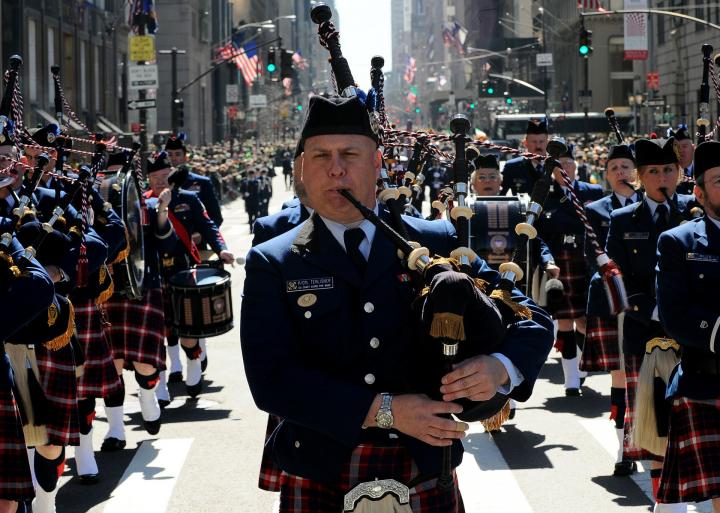
- The first St. Patrick’s Day parade in the American colonies was held in New York City on this day in 1762.
- St. Patrick’s Day is the traditional day for planting peas, even in the snow!
- Cabbage seeds are often planted today, too, and old-time farmers believed that to make them grow well, you needed to plant them while wearing your nightclothes! See our Cabbage Growing Guide. No PJs are required!
On St. Patrick’s Day, the warm side of a stone turns up,
and the broad-back goose begins to lay.

Photo: Sumners Graphics Inc./Getty Images.
St. Patrick’s Day Recipes
Would you like to cook something special for St. Patrick’s Day? You don’t need the luck of the Irish! Check out our list of St. Patrick’s Day recipes for corned beef and cabbage, Irish soda bread, and more ideas beyond green milk and beer!
Joke of the Month
Q: Why should you never iron a four-leaf clover?
A: You don’t want to press your luck!
How do you celebrate St. Patrick’s Day? Let us know in the comments!

More Like This



Thank you for your feedback! You are certainly correct, and we have revised the article accordingly.

Comments