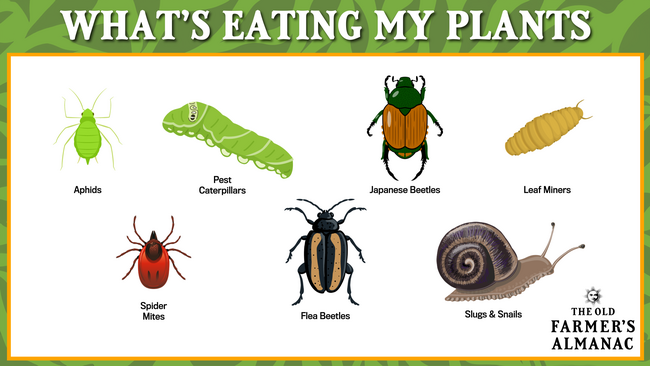
If slippery slugs and slimy snails are stealing your seedlings, it’s time to think like a slug and get one step ahead of the slime trail! Find out which control methods work to get rid of slugs and snails—and which don’t! Plus, see a helpful video.
We will help you bring your slug woes under control as naturally as possible. Spoiler alert: That means there’s no room for slug pellets!
What Are Slugs and Snails?
Did you know that the average garden contains upwards of 15,000 slugs?! No wonder our plants get nibbled or even destroyed.
Slugs and snails are not insects; they are soft-bodied mollusks. Unlike seagoing mollusks, these landlubbers are equipped with a single lung. The main difference between slugs and snails is that the latter have an distinct shell, primarily composed of calcium carbonate.
Slugs and snails are hermaphroditic, with each individual having both male and female reproductive organs. As you would expect, their love life is complex. The common gray garden slug dances an elaborate, hour-long nuptial waltz before mating, while other species perform acrobatic movements while hanging suspended from threads of slime.
While slugs do try the patience of us gardeners, they’re not all bad. For example, the slugs found in compost heaps help with decomposition, speeding the process along. There are also lots of slugs that have no interest in your vegetables and prefer to eat things like algae instead. And then there’s their value as a food source for all manner of wildlife, from beetles to birds to frogs and toads. Like weeds, it’s not that slugs are intrinsically “bad”—we just don’t want them in certain places, such as around susceptible plants.
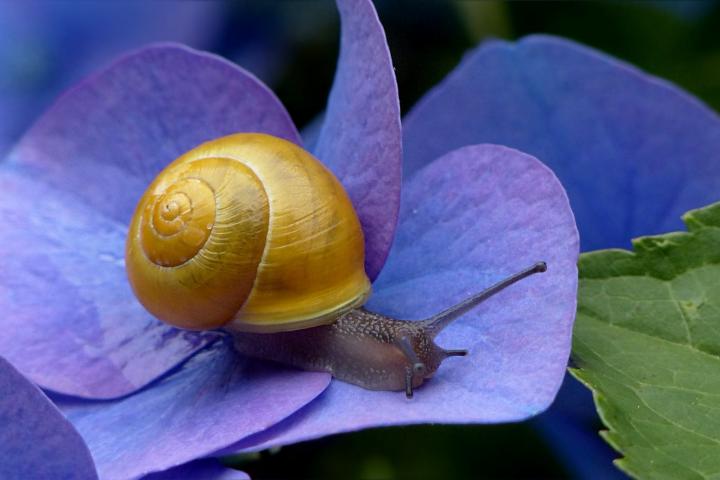
Most garden slugs and snails are gray, dull orange, or dark brown and 1 to 3 inches long. They will hide in dark, damp places during the day.
Many people are prompted to ask, “Where do slugs come from?” They seem to materialize out of nowhere! They are hard to spot in the soil due to their dark color, but also because they only feed at night and hide throughout the day. If you realize you have slug and snail damage but can’t find the culprits, you’re not alone.
Slugs and snails will leave a slimy secretion where they have been, so even if you can’t spot them, you’ll know they are there. Look for slime both on plants and in the surrounding soil. It is easiest to see the trails of slime first thing in the morning.
You can monitor slug and snail activity in your garden by digging holes that are 4 inches wide and 6 inches deep. Cover these holes with a flat board, and then check for slugs after 3 days. If you see many of them, these might be the sneaky pests that are eating your plants!
Slugs and snails lay their eggs in moist soil or compost. Their populations can grow rapidly in cool and moist conditions.
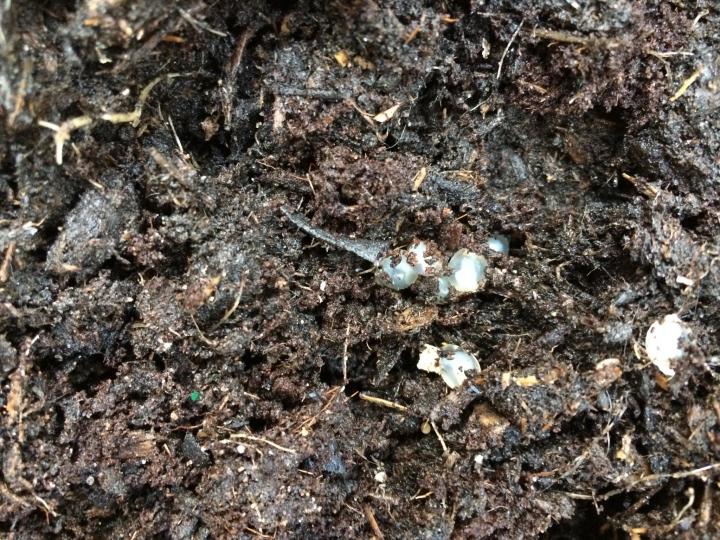
Slugs lay their small white eggs in damp soil. Photo Credit: GrowVeg.com.
What Do Slugs Eat?
Slugs will feed on almost anything in the garden—look for holes and ragged edges on leaves and stems. The holes should have irregular shapes due to the slugs’ file-like mouthparts. Small seedlings can be consumed entirely. Slugs can digest tissues from most plants, but you might find them especially liking plants with broad, delicate leaves, like beans, lettuce, cabbage, bok choy, and tomatoes.
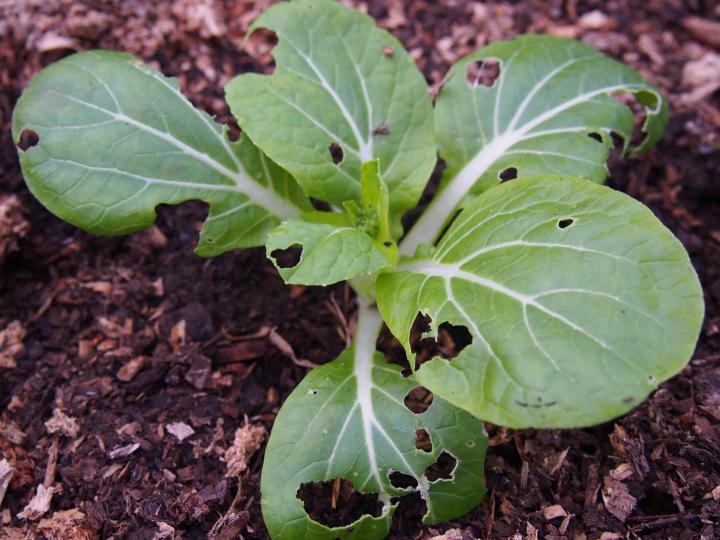
The slug damage on this bok choy plant is evidenced by its holes and ragged edges. Photo Credit: GrowVeg.com.
Gardening Products
Control and Prevention
Remove Hiding Places for Slugs and Snails
The first step towards a more manageable slug population is to remove hiding places from within and around your main growing areas.
Cut down long grass right around vegetable gardens. Through regular mowing, you’re removing these opportunities for slugs to lay low.
Remove debris lying about. Upturned pots, bits of wood, old sacks – they are all potential hiding places for our slippery slimesters.
Work within beds to remove any dead or dying leaves as well as, of course, any weeds. Removing all this excess vegetation to the compost heap keeps things more open in our growing areas, improving airflow and discouraging the damp, shaded conditions slugs love.
Trap and Remove Slugs and Snails
Create the perfect slug and snail trap by laying boards, cabbage leaves, or pieces of cardboard on the bare soil around your plantings. Start by watering the ground if it’s dry, then place a plank of wood or similar over the surface. Check back the next morning, and you’re very likely to find slugs lurking beneath. Pick them off and return the plank to collect the next batch.
Citrus halves, like grapefruit skins, are highly effective slug collectors because they create a cool, shady recess for our slugs to hang out in. Again, lay down shells at strategic locations—close to susceptible crops like salad greens or tender seedlings. For something longer-lasting, you can use half a coconut shell at each corner of your raised bed (after you’ve enjoyed the coconut flesh, of course), which they like to crawl into.
Then, there are beer traps. Everyone knows about luring slugs to a drunken death by placing shallow dishes of beer around the garden. They can’t resist the stuff! Note that any yeasty, sweet liquid will attract them, so keep the beer for yourself and make a gooey brew that the slugs will find delicious by mixing equal parts flour and water with a heaping spoonful of molasses, a sprinkling of cornmeal, and a teaspoon of yeast. Put this goop in shallow containers around the yard, and it will have much the same effect as beer without having to ask for ID.
Go On a Slug Hunt!
If you really want to make an impact, go out on the hunt for slugs when they’re most likely to be out and gorging on your plants: at night, particularly in warm, damp weather. You’ll need a bucket and a flashlight for this. Head out soon after dusk to begin your hunt. Relocate slugs to a less susceptible area, add them to your compost heap, or, to be sure, take them out to a nearby wooded area or something similar. Go on further slug hunts over the coming nights, and you’ll pick up the stragglers and should make an appreciable dent in the slug population.
If you want to dispatch of your slugs, you have numerous gruesome ways to do this—from drowning them in a bucket of water to squashing them. It depends on how squeamish you are! A more humane approach would be to drop the slugs into a container, cover and place in freezer for three hours; when frozen stiff, dump them on your compost pile. Or, simply relocate them!
Ready to think like a slug? Ben shows us how to make many of the control methods!
Slug Pellet Alternatives
We’ve moved on from using commercial slug pellets due to their impact on other animals and the environment; many are laden with chemicals that do a good job of killing slugs but may also harm animals higher up the food chain. In our enlightened times, we should look at alternatives.
One option is to apply microscopic nematodes onto slug-affected ground. The nematodes are first suspended in water and then watered over soil that has warmed up enough following the winter months. The nematodes find their way into the slugs, where they infect them with a deadly bacteria. It sounds grim, but these nematodes come with zero collateral damage, making them a very safe form of slug control.
Physical Barriers
Several studies have shown that a barrier of diatomaceous earth (DE) can help. This is a naturally occurring, silica-based substance that can be crumbled into a fine powder. Slugs really don’t like crossing the moisture-sapping powder. Create a thick barrier of DE that’s at least 3 inches in width. Just make sure you buy “food grade” DE. This works best in dry weather; it will need to be replaced when it gets wet.
Studies have also shown that barriers made of copper, like copper tape, bands, screening, or foil, can repel slugs. When slugs or snails interact with copper, it gives them a sensation akin to an electric shock, causing them to avoid the material. This works best on a small scale, as surrounding an entire patch with enough copper material can quickly get unwieldy. Wrapping pots or planters in a band of copper that’s at least 1 inch wide is the most efficient way.
What Does NOT Work
Many solutions that have been tested are not very effective, including bark mulch, wood ash, coffee grounds, coarse sand, pine needles, eggshells (yes, eggshells!), sharp grit, and wool pellets. Every study has found these to be useless.
More Slug Control Tips
Some plants have been shown to thrive despite being around slugs and snails. If you tend to see these pests and are having trouble getting rid of them, try planting astilbe, phlox, or mint to reduce damage.
Water plants in the morning if possible—this will give the soil surface time to dry out a bit before nightfall when the slugs come out.
Vulnerable crops, such as leafy greens and salads, can be started off in pots or plug trays away from the growing areas. By the time they are planted, the plants will be that much bigger, more robust, and better positioned to withstand attacks.
You can protect recent transplants with cloches or any barrier that physically keeps slugs out, such as bottomless plastic bottles popped over individual plants.
If you grow potatoes, dig them up as soon as they are ready because slugs love these tubers. Some varieties are also more tolerant of slugs than others.
Slugs and snails have many natural predators. If you have chickens or ducks, they will help by eating these pests and their eggs. Amphibians, such as frogs and toads, love to feast on slugs.
Garter snakes, turtles, and salamanders consider slugs delectable, so don’t freak out and run for the hoe next time you see a snake in your garden. Remember, the enemy of your enemy is your friend.
Companion planting is an effective way to deter pests. In order to keep slugs and snails away from more valuable plants, place plants that they love near your more valuable plants as a trap, and then destroy the infested plants. Good traps for slugs include chervil, marigold, and thyme.
Catherine Boeckmann is the Executive Digital Editor of Almanac.com, the website companion of The Old Farmer's Almanac. She covers gardening, plants, pest control, soil composition, seasonal and moon c...
Be careful with the copper sheeting around your plants. Copper will kill plants too.
Reply to comment
<span>Debbie</span>Sun, 04/21/2019 - 22:46
I have slugs in my house. How are they getting in? and besides scooping them up and throwing them outside how do I keep them out. I notice them more after it rains a lot.
Reply to comment
<span>Ray Vallely</span>Thu, 04/18/2019 - 07:08
I have a major problem with slugs living in my lawn. I have a small, long-haired dog, which comes back inside at night after being outside to do his 'business' and his underbelly and legs are covered in slugs. Removing the slugs and their slime from his coat is a nightmare. Being in the lawn makes it impossible to spread any sort of deterrent such as salt, phenol, etc, and placing cardboard or timber slats simply hasn't worked. Any suggestions?
Reply to comment
<span>Naik</span>Tue, 09/11/2018 - 13:32
Sprinkle floor cleaning phenyl, slugs will curl up and die...
Reply to comment
<span>Walter Grant</span>Wed, 08/08/2018 - 06:03
Just sprinkle salt on your slugs and snails and they will curl up and die!
Yes beer works to get rid of them but beware if raccoons are in the area they will drink the beer and eat the slugs that drowned in it -experience
Reply to comment
<span>Rmdudoit</span>Sun, 08/12/2018 - 03:42
I used to use salt but it took the slugs a long time to die. Found a faster method was white vinegar sprayed or poured on slug. Also keep several wide mouthed jars with lids and one inch of white vinegar (plus a stick beside each jar) around the yard. Great for when you overturn a rock or pail, or old wood, etc and find anything from a fat 2 inch slug to a tiny baby slug snoozing. Whatever the size they stopped moving immediately upon hitting the vinegar. The vinegar even flushes out centipedes if poured on damp rocky areas. Downside to pouring on ground is it also kills worms which I need for my chickens. Whether hunting at dawn and dusk or coming upon them accidentally during daytime, at least I do not worry about the bees or praying mantis that also populate the garden. Happy slug hunting folks! P.S vinegar is great used directly on centipede or mosquito bites.
Reply to comment
<span>Don</span>Sat, 04/13/2019 - 12:38
Affirming white vinegar as slug killer.
Reply to comment
<span>Anthony</span>Tue, 08/07/2018 - 15:41
How effective can birds be at controlling slugs when the slugs are nocturnal and most birds are not?
Reply to comment
<span>Anne Rockwell</span>Tue, 08/07/2018 - 16:23
The crows actually "find and dig the slugs from the ground like a Robin hunts for worms; Crows are the bet slug eater says Ralph Snodsmith;
Comments