
Caption
The position you sleep in can affect your health, so try not to sleep on your stomach!

Be it for a catnap or a full night’s sleep, find out which sleeping position is best and how your favorite sleeping position affects your health. We’ll also show you how providing pillows to support your sleeping position can help reduce stress on your body and get you sleeping better.
Best Sleeping Positions for Health and Comfort
Front, back, right side, left side? Curled up, straight as a log, one leg over the other, splayed out across the entire bed? One pillow? Two, three, none? Pillow between legs, under knees, under feet, under stomach? Head and chest elevated, or legs above head?
Is There a Best Sleeping Position?
It’s not a simple answer in that you could tell someone to “only sleep facing left or right.”
The real answer is: The best position is one in which you keep your spine in a neutral position. A neutral spine will ensure that your neck, upper back, and lower back are not put under stress and that your posture isn’t negatively affected.
Thus, almost always, the back and side sleeping positions are considered the best for your body. For snorers, side sleeping is usually the best sleep position. This is because side sleeping reduces the compression of your airways. The worst sleep position is on your stomach.
Tips for Back Sleepers
If sleeping on your back:
- Place a pillow under your knees to slightly raise them; this will be more comfortable, keep the natural curve of your spine intact, and reduce stress on your lower back.
- To support your head and neck, use a pillow that won’t push your head forward too much nor let it loll backward uncomfortably. Ideally, your ears should be aligned with your shoulders and hips.
Tips for Side Sleepers
If sleeping on your side:
- Your head and neck should be aligned with the rest of your spine, parallel to the mattress, so use a pillow (or two) to make sure that your head is properly supported.
- Place a pillow between your knees to keep them together. This prevents the pelvis from tilting in any one direction.
- Depending on your mattress, you may need to support your waist, too; a rolled towel or small throw pillow can be used effectively—just make sure that it isn’t firm enough to push your spine out of alignment with your neck and lower back.
Tips for Stomach Sleepers
As a general rule, avoid sleeping on your stomach—it disturbs the normal alignment of your spine. Sleeping on the stomach strains the neck and spine, which in turn may lead to joint and muscle pain or numbness and tingling. Stomach sleepers are at risk for snoring as well as the airways becoming compressed.
If you must sleep on your stomach:
- Place a flat pillow under your lower stomach and pelvis to support the natural curve of your spine.
It’s important to get a good night’s sleep, so in the end, keep the above advice in mind and sleep in whichever position you feel most comfortable.
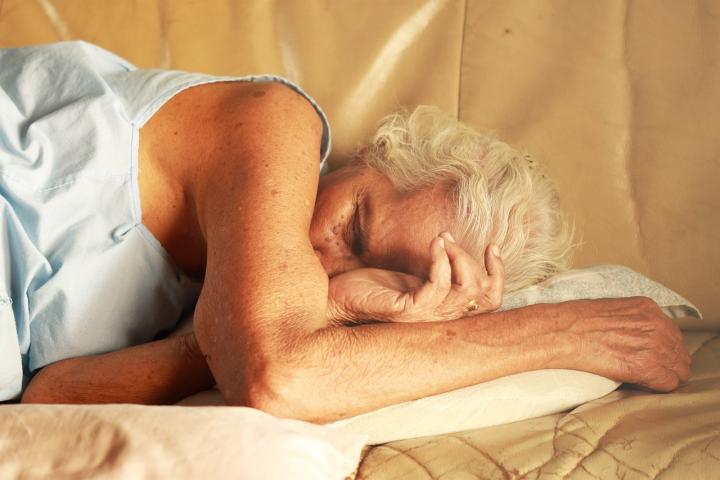
How Sleeping Position Affects Health
Turns out, there’s a robust body of clinical research (and professional advice) on the topic of sleeping position. How you arrange yourself during sleep may increase or reduce your risks of these conditions (click the links to learn about the relation between sleeping position and each condition):
- Parkinson’s and Alzheimer’s diseases
- Sleep apnea
- Death from epilepsy
- Acid reflux
- Vertigo
- Glaucoma
- Snoring
- Debilitating back or neck pain
- Sudden death for infants (Note: While pediatricians recommend always putting your baby to sleep on her back, they also stress the importance of adequate “tummy time” while she’s awake and active.)
If you’re at risk for (or already have) one of the conditions listed above, do a little of your own research and ask your doctor for more information on the possible effects of sleeping position. If you suffer from more than one condition correlated with sleep position, be forewarned: a better position for one of them may prove to be worse for the other.

How to Change Your Sleeping Position
If you find that you’re stuck sleeping in a way that exacerbates one of the conditions listed above, you might try changing your sleeping position. Experts have a few things to say about doing so:
- It’s difficult to change the way you sleep. One recommendation for avoiding either the prone or supine sleep position involves strapping or taping an object to your back (e.g., a tennis ball) or front (a dried pea) to provide just enough of an irritant to prevent yourself from sleeping that way. There are also various devices on the market and bed/mattress manipulations intended to “train” sleeping posture.
- Similarly, if you’re trying to avoid sleeping on a particular side, stack a few extra pillows behind your back to prevent yourself from easily rolling over in the night.
- Most of us don’t stay put while we sleep anyway, changing position on average about a dozen times each night.
Frequently Asked Questions
What is the best sleeping position for back pain?
The best position for back pain is usually sleeping on your back with a pillow under your knees to support the natural curve of your spine. Side sleeping with a pillow between your knees can also reduce strain on your lower back.
Which sleeping position is healthiest overall?
Sleeping on your side or back is generally considered healthiest. These positions keep your spine in a neutral alignment, reduce stress on joints, and help with breathing and circulation.
Is sleeping on your stomach bad for you?
Yes, sleeping on your stomach can strain your neck and spine, potentially causing pain or numbness. If you must sleep this way, placing a flat pillow under your pelvis can help reduce strain.
Can changing your sleeping position improve your health?
Yes. Adjusting your sleeping position can reduce back and neck pain, improve breathing, and potentially reduce risks associated with sleep apnea, acid reflux, or snoring.
How can I train myself to sleep in a new position?
Experts suggest using pillows to prevent rolling into an undesired position or placing small objects like a tennis ball on your back as a gentle reminder. It may take several weeks to adjust.
What pillow arrangements are best for different sleeping positions?
- Back sleepers: Pillow under knees and a supportive pillow for head and neck.
- Side sleepers: Pillow between knees, plus one under the head to keep neck aligned.
- Stomach sleepers: Thin pillow or none under head, flat pillow under pelvis.
If you’re having trouble sleeping, consult your healthcare professionals to learn more about ways you can help yourself get more sleep. You may find some help from natural sleep remedies. And find out how to prevent nighttime leg cramps.
What have you learned about your sleep position? Please do share below. We’re always learning.



- « Previous
- 1
- 2
- …
- 10
- Next »

Comments