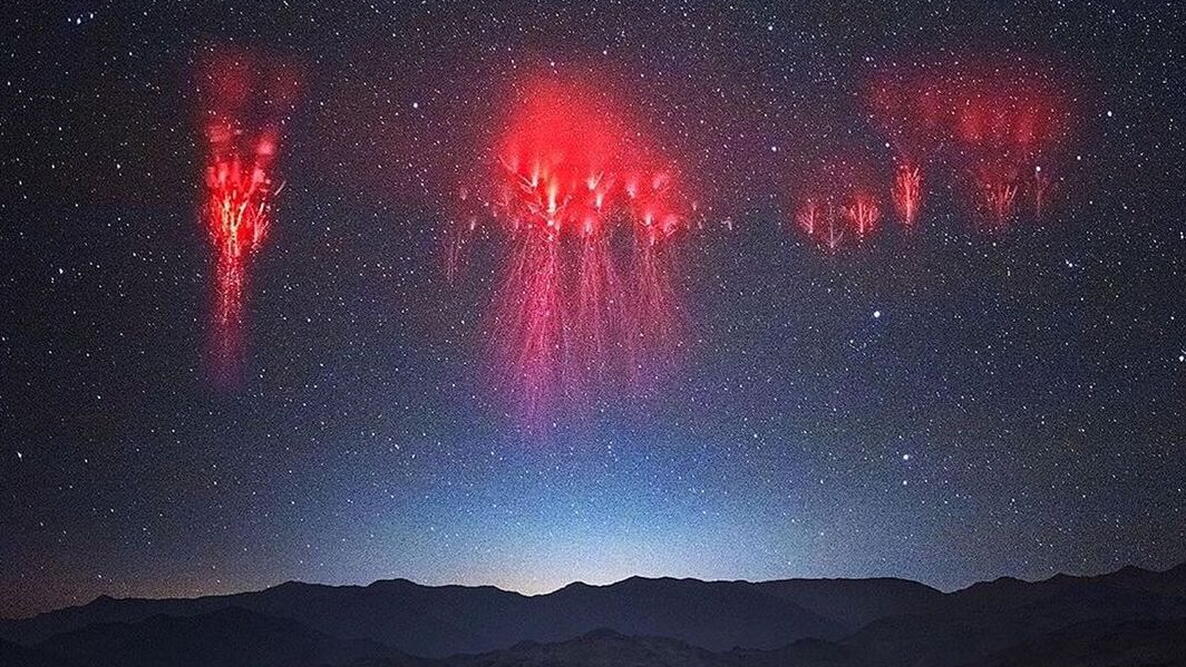

Ever heard of lightning’s strange cousins—red sprites, blue jets, elves, trolls, and gnomes? These brilliant atmospheric lights are not fairy tales. They’re part of a colorful community of high-altitude lightning phenomena that burst into life above thunderstorm clouds. Learn what causes these mysterious flashes—and how to see a lightning sprite for yourself.
For over a century, reports of lightning shooting upward from storms were dismissed as fiction, much like the old legends of raining frogs. Visual reports date back to at least 1886, but even when respected pilots and scientists—including Nobel Prize–winning physicist C. T. R. Wilson—described them, the scientific community largely ignored the sightings.
That changed in 1989, when scientists at the University of Minnesota captured sprites on film for the first time. Since then, they have been photographed and recorded thousands of times, confirming that these strange lights are very real.
What Are Sprites and TLEs?
Scientists now study not only the lightning that crashes downward to Earth, but also the colorful discharges that shoot upward toward space. These upper-atmosphere flashes occur between thunderstorms and the ionosphere.
Together, these phenomena are called Transient Luminous Events (TLEs). While the scientific term sounds serious, individual TLEs have playful, fairy-inspired names—because scientists do, occasionally, have a sense of humor.
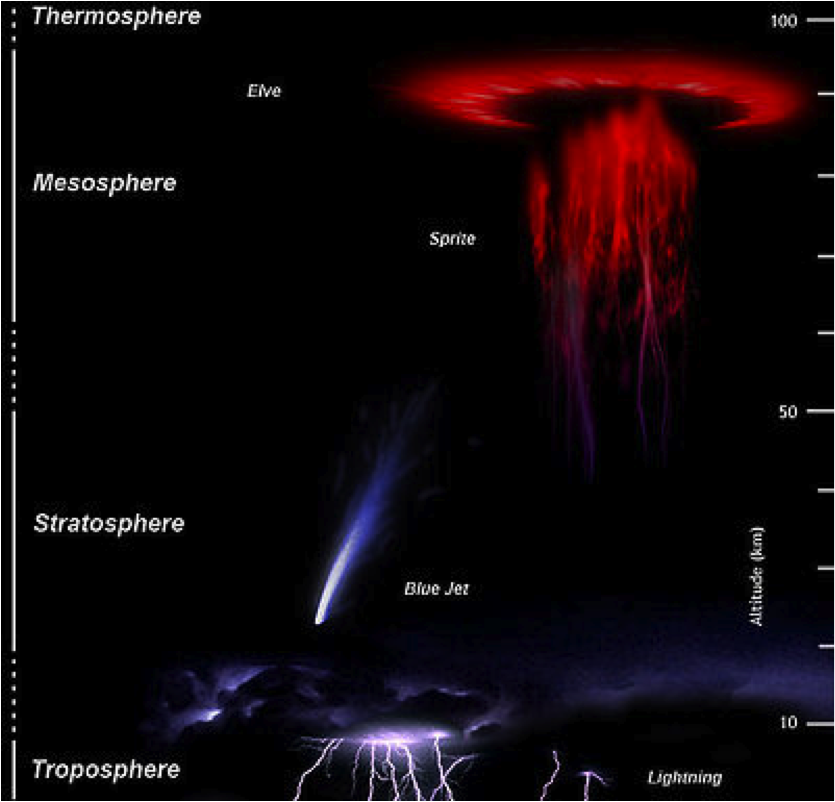
Photo: Wikipedia
So, if you look high in the sky, well above the thunderstorms, what can you see?
Sprites (Red Sprites)
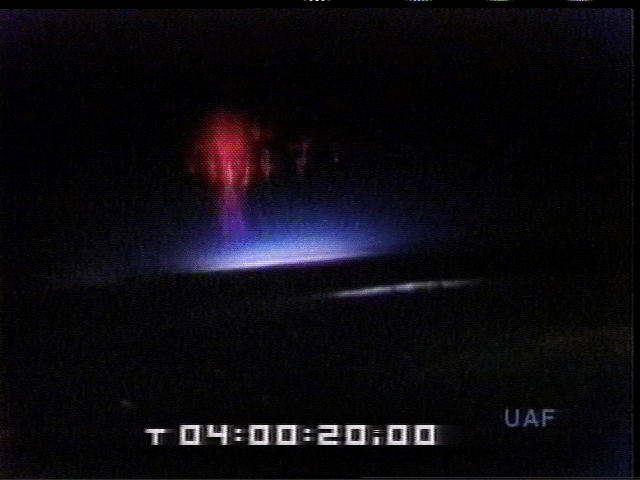
Sprites are the most common TLE. They appear as luminous reddish-orange flashes above large thunderstorms, typically forming at an altitude of 30–60 miles. Sprites often occur in clusters and flicker for only a fraction of a second. They are triggered by strong positive lightning strokes from thundercloud to ground and are most often observed in the Midwest.
Blue Jets
Blue jets are dim blue bursts that shoot upward from the tops of storms—especially those with heavy hail. They are rare and usually visible only from aircraft.
Elves
Elves form a brief, expanding disk of light about 60 miles above Earth. Their name is an acronym: Emissions of Light and Very Low Frequency from EMP Sources.
Trolls
Trolls appear as red spots near cloud tops after an exceptionally strong red sprite. Their name stands for Transient Red Optical Luminous Lineament.
Gnomes
The tiniest and fastest TLEs, gnomes are microsecond-long white spikes of light flashing from the top of a storm’s anvil.
Where Do Sprites and TLEs Occur?
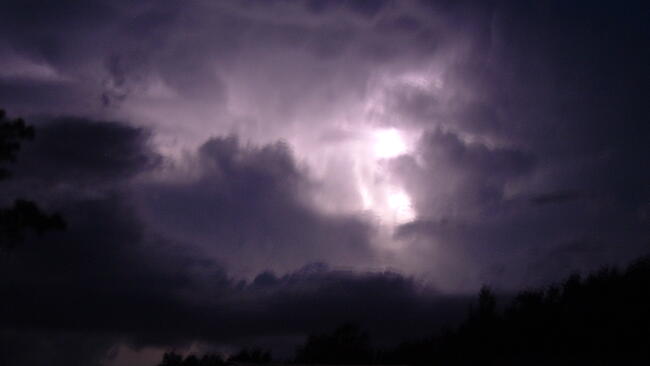
All typical weather—rain, lightning, clouds—happens in the troposphere, roughly 4 to 12 miles above Earth. But sprites and other TLEs occur far above that, in the mesosphere, up to 50 miles high. That’s why most people never see them—they’re simply not looking high enough above the storm.
How to See a Red Sprite
Red sprites aren’t actually rare. They’re just easily missed because of their height, speed, and faintness. Here’s how to improve your chances of seeing one:
1. Look during strong nighttime thunderstorms.
The most intense storms—common in spring and summer, especially in June—produce the best conditions for sprites.
2. Watch from a distance.
You’ll need the storm to be 100–200 miles away so you have a clear view above the cloud tops. Use weather radar to track a storm moving out of your area.
3. Choose a dark sky.
Avoid light pollution and bright moonlight. Clear, dark skies make sprites easier to spot.
4. Let your eyes adjust.
Give yourself 20 minutes to adapt to the dark. Look above the storm clouds, not at the lightning itself. Note: Sprites typically appear once for every 200 lightning strokes, so patience is key.
5. Cameras may struggle.
Sprites are fleeting—capturing one on camera can be difficult without specialized equipment.
For inspiration, watch Paul M. Smith’s stunning video of Red Sprite lightning from the 2019 Oklahoma storm season:
The next time you see a thunderstorm, take a moment to look beyond the clouds. High above the lightning flashes you know so well, you just might glimpse a glowing, otherworldly show—a true atmospheric fairyland lighting up the night sky.

Oh, how cool to be high enough to see these high-altitude sprites! Thanks for sharing this amazing experience, Sally!
- « Previous
- 1
- 2
- …
- 10
- Next »

Comments