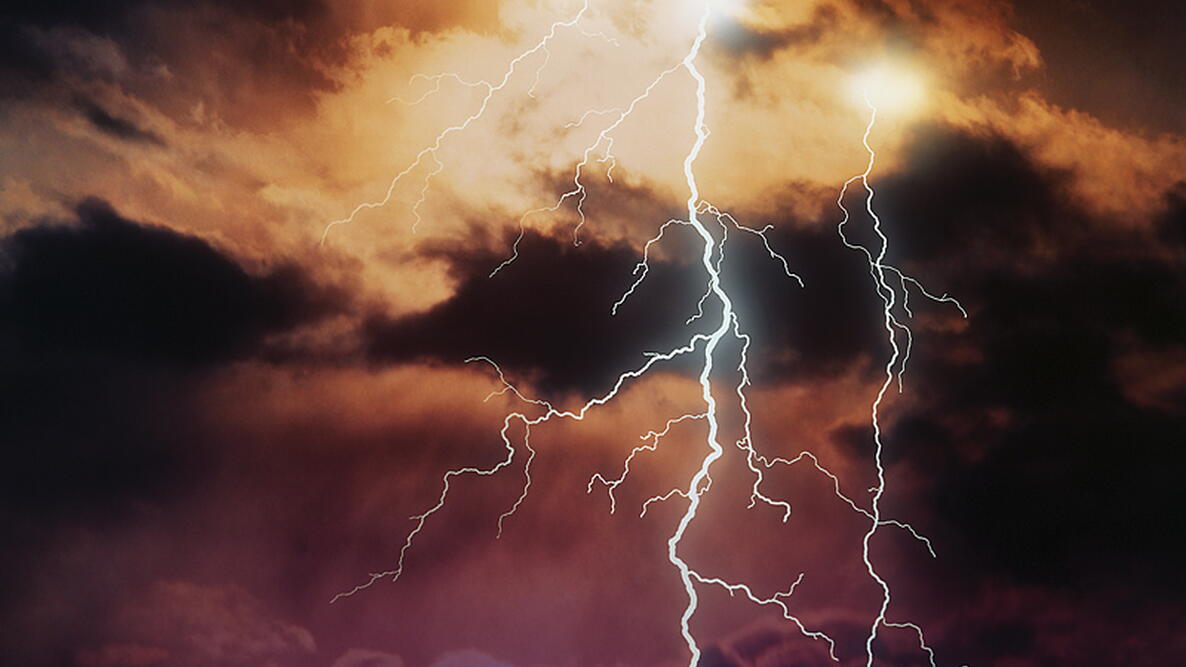

Lightning never strikes the same place twice … right? Not exactly. Whether you’re storm-watching from the porch or racing for cover, these electric facts and safety tips might just save your hide (and your hair). Let’s separate the flash facts from the flash fiction.
What Is Lightning?
What you are watching are spectacular electric sparks! Just as you build up static charges when you shuffle your feet along a carpet, the collisions of ice and slush churning in a thundercloud build up electrical charges too.
The slush near the bottom of a cloud often builds up a negative charge while the tiny ice crystals carried to the top build a positive charge. Eventually, the buildup causes enough imbalance that electricity is released to reduce it—like that spark that stings you when you touch something after building up static. The giant discharge flows somewhere, and about 25 percent of the time—bang!—it reaches the ground.
How Far Away Is Lightning?
When you see a flash of lightning, start counting the seconds until you hear the following thunder. Then divide that number by five. The resulting number will tell you roughly how many miles away you are from where lightning just struck.
For example, if that resulting number was 5 seconds, then the lightning struck 1 mile away. If the resulting number was 10 seconds, the lightning was 2 miles away.
How Do You Calculate the Distance of a Thunderstorm?
Don’t be fooled by blue skies. Lightning often strikes from 3 to 6 miles away, though it can be as far away as 10 miles or even farther. According to safety experts, if the storm is within about 6 to 10 miles, or you can see lightning or hear thunder, it is time to take cover.
Follow the 30-30 rule:
If the time between the lightning flash and the crack of thunder is 30 seconds or less, the lightning is about 6 miles away or closer.
- After you see lightning, start counting to 30. (Use a stopwatch or count “One-Mississippi, Two-Mississippi, Three-Mississippi,” etc.)
- If you hear thunder before you reach 30, seek shelter indoors immediately.
- Stay inside for at least 30 minutes after hearing the last clap of thunder.
When the storm passes and the skies turn blue again, stay cautious. Lightning threats continue for much longer periods than most people realize. This is why we have the 30-minute safety rule.
Predicting Lightning
First, know that every thunderstorm produces lightning.
Warm, humid summer days are the times when thunderstorms are most likely to develop, especially in the afternoons, as the sun heats the air and heat rises into the atmosphere. Watch as those puffing cumulus clouds start to form. As they build, they’ll start to “tower” vertically upward and are likely to develop into a thunderstorm.
Flash Fact: If your hair stands up in a storm, it could be a bad sign that positive charges are rising through you. Get yourself indoors immediately.

Can Lightning Kill You?
Lightning is one of the leading weather-related causes of death and injury in the United States. There were 3,696 deaths recorded in the U.S. between 1959 and 2003. From 2006 through 2025, the U.S. recorded 517 lightning-related deaths.
What Are the Odds of Being Struck by Lightning?
The odds of being struck by lightning in a given year are less than one in one million. But the odds of being struck in your lifetime are about 1 in 19,000.
About 70 percent of those struck by lightning suffer serious long-term effects such as severe burns, permanent brain damage, memory loss, and personality change.
Some places are more dangerous than others.
- Kifuka in the Democratic Republic of the Congo averages 410 lightning strikes per square mile every year.
- In North America, the champion may be the Tampa-Orlando area, with around 90 flashes per square mile per year.
Even then, statistics show that not all people face the same risks. Older women are relatively safe (at least based on lightning fatality rates), but guys between the ages of 20 and 30 seem to be relative lightning rods.
10 Lightning Facts and Fiction
The rules for safety in lightning storms are mostly common sense, but you may find a few surprises here. Separate the facts from the fiction.
- Do not hide under a tall tree. Relying on a tree—especially a solitary one—for protection is one of the worst things you can do, after staying out in the open. If lightning does hit the tree, there’s the chance that a “ground charge” will spread out from the tree in all directions. Also, don’t touch anything metal outside—such as a fence or bike—as metal can conduct electricity.
- If no shelter is available, crouch low, with as little of your body touching the ground as possible. Lightning causes electric currents along the top of the ground that can be deadly over 100 feet away. Do not lie flat on the ground. While lightning hits the ground, it sends deadly electrical currents in all directions. By lying down, you may even be more likely to be electrocuted because you’re providing more surface area.
- Cars are relatively safe shelters and will likely protect you. Make sure the windows are shut. The car isn’t safe because of rubber tires, but because the metal roof and sides divert lightning around you. Convertibles and motorcycles offer no lightning protection.
- Stay out of water! Swimming is very dangerous. Wet bodies are a channel for electrical discharge, and water is also a good conductor of electricity.
- Find shelter quickly. “When the thunder roars, go indoors” is a common warning. A house or large structure is the safest place you can be during a storm. Note that small structures (such as athletic huts or metal sheds) are only meant to protect from rain and sun and not designed to be lightning-safe with mechanisms for grounding from the roof to ground.
While being in your home or a large shelter is safest, you may be surprised to discover that one-third of lightning strike injuries still happen indoors! There are a few tips to remember when you are waiting out a storm inside … - Stay away from windows and doors in your home, especially metal doors and frames. As tempting as it is, you may not want to stand next to a big window watching a huge lightning storm.
- Avoid concrete walls or flooring, which often have metal rods or framing for support. Lightning can travel through any metal wires or bars in concrete walls or flooring.
- Stay away from plumbing and water indoors during a storm. Metal piping conducts electricity. Never take a bath or shower during a thunderstorm.
- Don’t get near electrical equipment like televisions, stereos, wires, TV cables, and “smart” electronics during a big storm. Don’t use a corded phone (cellular or cordless phones are fine). Talking on the telephone has historically been a leading activity associated with lightning injuries inside the home!
- Surge protectors do not protect against direct lightning strikes. Unplug equipment such as computers and televisions or anything connected to an electrical outlet. Lightning can travel through electrical systems, radio and television reception systems, and any metal wires or bars. (These items must be installed in conjunction with a lightning protection system to provide whole-house protection.)
Flash Fact: Did you know that rubber shoes do nothing to protect you from lightning?
.jpg)
FAQs
Can lightning strike the same place twice?
Yes. Lightning frequently strikes tall buildings, towers, and trees multiple times.
How far away can lightning strike?
Lightning can strike 10 miles or more from the center of a thunderstorm.
Is it safe to use a cell phone during a thunderstorm?
Yes. Cell phones and cordless phones are safe. Corded phones should be avoided.
Are cars safe during lightning storms?
Yes. The metal frame of a car helps channel electricity around passengers.
Does lightning always come with rain?
No. Lightning can strike well away from the rain core of a storm.
What should I do if my hair stands up during a storm?
Seek shelter immediately. Hair standing up may indicate an imminent lightning strike.
Can lightning travel through plumbing?
Yes. Metal pipes conduct electricity, which is why showers and baths should be avoided during storms.
Enjoy the light shows, but stay safe!

More Like This

Comments