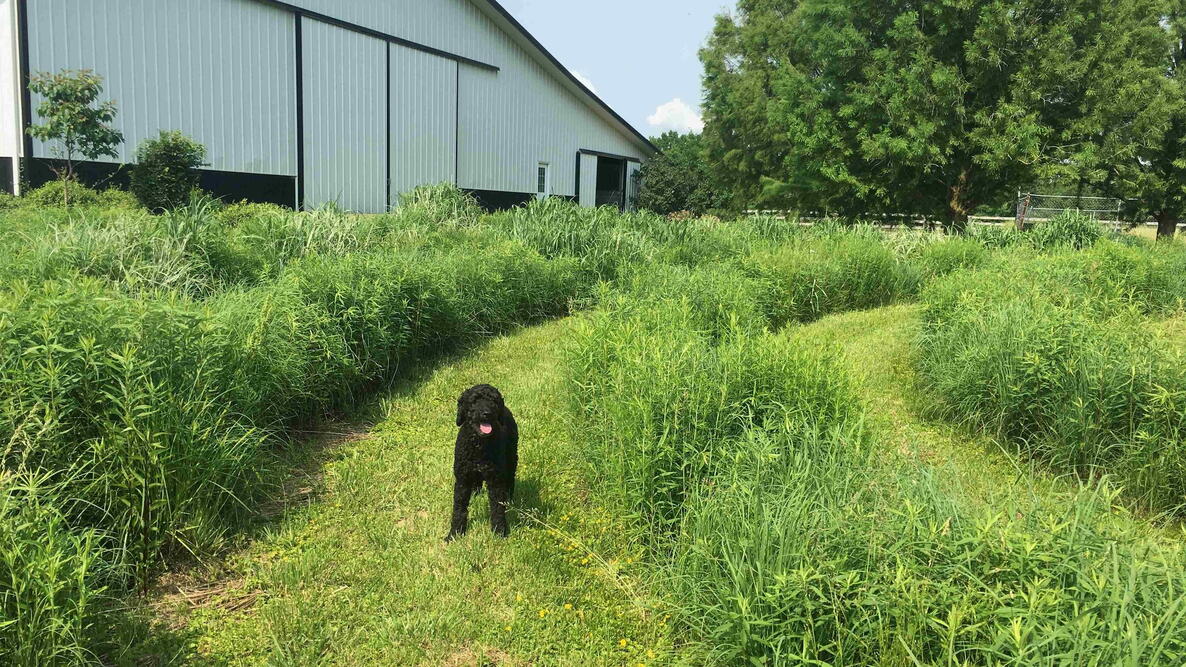

The first time I walked our labyrinth, I wasn’t thinking about ancient traditions or meditation. I was just following my son down a narrow path, our dog weaving ahead of us and disappearing into grasses taller than both of us.
From the outside, it looks like a field.
From the inside, it feels like something else.
The labyrinth sits on our family’s land in rural Ohio, just beyond the barn, where the yard gives way to open sky. From above, you can see its looping pattern etched into the grass beside the pond, but once you’re on the ground, that larger shape disappears. You just follow what’s in front of you.

My mother created the labyrinth—though “created” makes it sound more straightforward than it was.
Like most good gardens, it took time, failure, and a willingness to try again.
Where It Began
The idea started with a trip. My mom and her sister visited a prairie labyrinth in Missouri and came home determined to make one of their own.
Many people first encounter labyrinths in Greek mythology, in the story of the Minotaur. In the Middle Ages, labyrinths were set into the floors of cathedrals, carved out of stone.
Ours, though, would be made of native plants.
Back home, she mowed part of the yard, then mapped out the design with rope, carefully tracing each curve across the field.
At one point, the labyrinth existed only as rows of nursery pots set about 8 feet apart—an outline of something that didn’t yet exist, but might.
Planting the Labyrinth (and What Didn’t Work)
The first planting failed. A wet spring kept the grasses from taking hold.
So she tried again.
That fall, she planted hundreds of individual grasses along the pattern, spacing each one carefully and imagining how it would grow into the curves of the labyrinth.

And every single plant died.
You think you’ve figured it out, and then the weather—or the soil—has other plans.
What Finally Took Hold
The third attempt was simpler.
The following spring, she prepared the soil so it wasn’t too compact. Then she simply spread seed—all grasses native to the Midwest. She also mixed in different wildflowers.
They took.
By early summer, the labyrinth began to take shape.

By midsummer, it was fully there: winding paths edged with grasses that swayed and thickened as the weeks passed.

Milkweed sprang up along the edges, drawing butterflies.

Wildflowers, like black-eyed Susans and blue-eyed grass, added color and softened the borders.

Walking the Labyrinth
People often think a labyrinth is a maze. It isn’t.
A maze is meant to confuse you. A labyrinth is the opposite. Every turn leads you forward, all the way to the center.
The path loops and curves—sometimes bringing you close to where you started, sometimes farther away—but it’s always one continuous line.
In that way, it feels a little like a pilgrimage—not in any formal sense, just in the act of walking and paying attention.
At first, when the grasses are still low, you can see across the curves and understand the design. But as the season progresses, the experience changes.

The grasses grow taller, closing in around you until you can’t see beyond the next bend. There’s a kind of quiet—not silence exactly, but a layering of sound. Wind through the grass. Insects. A dog moving somewhere ahead of you, then suddenly beside you again.
By late summer, they grow so tall you can barely see over them. Walking through it feels less like crossing a field and more like moving through a corridor.
You stop thinking about the pattern.
You just walk.
At the Center
At the center of the labyrinth is a small clearing—simple, but satisfying to reach.
There’s no grand feature. Every turn has led you here.

In many labyrinths, the center is a place to slow down and stay awhile before turning back out again.

Over time, it became something more personal.

A whimsical fairy garden took shape over time—tiny houses, stones, and crystals tucked into the space.

A Garden That Changes With the Seasons
Unlike a stone labyrinth, this one never stays the same.
The paths are now defined by mowing—set to the width of the mower—and the grasses gradually take over, sometimes crowding out the flowers that first bloomed there.
By late summer, they grow so tall you can barely see over them. Walking through it feels less like crossing a field and more like moving through a corridor of green.

In the fall, the grasses brown and die back.
They’re burned to the ground on a wet winter day—a controlled burn that clears out the old growth and returns nutrients to the soil—and the field rests until spring.
Then it begins again.

Why We Walk It
I didn’t expect a labyrinth to matter as much as it does.
But walking it—alone or with a dog weaving ahead—creates a kind of quiet joy that’s hard to find elsewhere. There’s no decision-making, no wrong turns, and no need to figure anything out. Just a single path, laid out in front of you.








Thank you, Janice! Great question. As well as mowing the paths and doing some pruning, it's important to clear out the old dead grasses and weed growth every 2 to 3 years. You conduct a controlled burn on a day that is NOT windy. If this done in the wet spring, the heat can help germinate new growth, too.
- « Previous
- 1
- 2
- …
- 10
- Next »

Comments