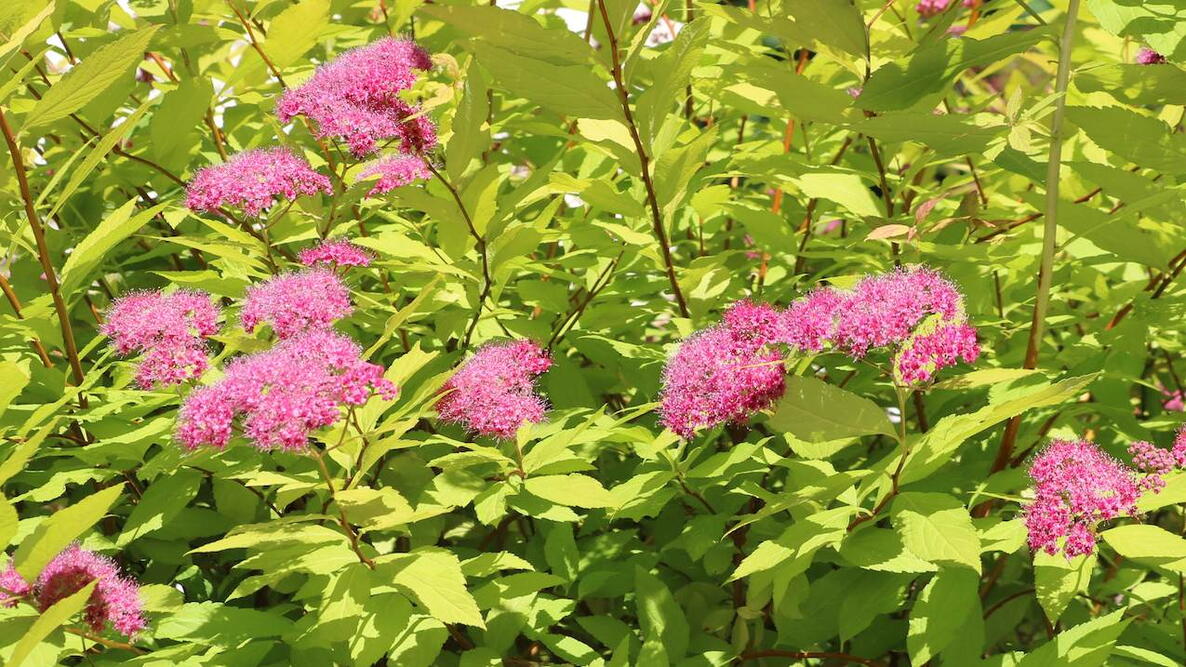

Spirea shrubs are easy-to-grow flowering plants known for their abundant blooms, colorful foliage, and reliable performance in home landscapes. Gardeners plant spirea for long-lasting summer color, pollinator activity, and low-maintenance beauty in borders, hedges, and foundation plantings. This growing guide explains how spirea behaves in the garden and how to choose the right variety for your space.

Spirea shrubs grow in compact to medium-sized mounds, typically reaching 2 to 8 feet tall, depending on the variety. They bloom from late spring through summer with clusters of white, pink, or red flowers and often provide attractive foliage in spring, summer, and fall. Shorter varieties work well along walkways, rock gardens, and foundations, while taller types create colorful privacy hedges or natural borders in larger landscapes.
These shrubs attract bees, butterflies, and hummingbirds throughout the blooming season and are generally deer-resistant. Once established, spirea tolerates dry conditions and thrives in a wide range of garden settings, making it a dependable choice for slopes, borders, and pollinator-friendly plantings.
Spirea shrubs are cold-hardy in USDA Zones 4 to 8, and some varieties are suitable down to Zone 3.
Planting
Where to Plant Spirea
Spireas like full sun but will do fine in partial shade; although they may bloom a bit less, they’ll still flower. They aren’t picky about soil type or pH as long as the site has well-draining soil.
When to Plant Spirea

Gardeners usually purchase spirea bushes from the garden center as small or medium-sized potted shrubs. They can also be found online. Plant as soon as possible in spring while the shrub is still dormant. Or, in warmer climates, they also do well when planted in mid-autumn. Water them weekly (if it doesn’t rain at least an inch), and they’ll be well-established after the first season.
How to Plant Spirea
For containerized spirea:
- Loosen the soil and prepare the site, removing stones, roots, turf, and weeds.
- If the plant is in a container, remove it by squeezing the edges of the plastic nursery pot. If the plant doesn’t work free, try watering it thoroughly and waiting for 20 to 30 minutes.
- Trim any circling roots, loosen the edges of the root ball, and prepare a hole twice the size of the original pot. The hole should have sloping sides like a bowl.
- Set the plant in the hole so the soil level of the plant’s root ball matches or is slightly higher than that of the surrounding ground. Dig a bit deeper or fill in as necessary. Don’t leave a hard layer at the bottom of the hole—loosen it up with your trowel.
- Replace the soil you removed, applying light but firm pressure as you go to eliminate air pockets around the roots.
- Water deeply immediately after planting.
- Add a layer of mulch to keep the weeds down and the soil moisture even. Avoid piling it up around the stem.
For bare-root spireas:
- Remove the shrub from its packaging and soak the roots in a bucket of water for 1 to 2 hours.
- While the plant is soaking, prepare the planting site. Dig a hole slightly deeper than the roots and at least 6 inches wider on all sides. You want room to spread the roots rather than leaving them in a tube shape.
- Test-fit the shrub in the hole and adjust as necessary by adding or removing soil. The spirea should be planted with the crown just at or slightly higher than the surrounding ground level. Look for the stain on the stem to indicate how deep it was grown at the nursery.
- Spread the roots, trim off any broken pieces, and fill in the soil, taking care to keep the shrub upright. It’s easy to plant bare-root shrubs and trees crooked!
- When the hole is halfway filled, water the shrub, then continue filling the hole, removing air pockets as you go.
- When finished, water again.
- Apply a layer of mulch. Taller bare-root shrubs may need staking for the first month to keep them upright.
Types
When choosing a spirea, look at its cold hardiness, but also check out the foliage, flower color, and timing. Some varieties begin blooming in spring, and others do not until summer, but all are long bloomers, continuing to put up new flowers for weeks, if not months. Flowers bloom in pink, white, lavender, and red. Once they finish flowering, they have small, colorful leaves that turn gold, orange, or burgundy in the autumn.
- ‘Double Play Doozie’ spirea (Spiraea x ‘NCSX2’) is a hybrid, seedless cultivar (no deadheading needed) with deep red spring foliage that changes to a verdant green in summer. Purple flowers continue all season. It is hardy in USDA Zones 3 to 9 and reaches 2 to 3 feet tall and wide.
- ‘Pink Sparkler’ spirea (S. betulifolia ‘COURISPI01’) is a birchleaf spirea modestly sized at 3 to 4 feet high. It grows in a mounded shape, with large pink blooms and burgundy wine–red autumn color. It’s hardy in USDA Zones 3 to 8.
- ‘Renaissance’ spirea (S. x vanhouttei) displays blue-green foliage with white blooms in summer. The autumn color is a brilliant reddish orange. It’s hardy in USDA Zones 3 to 8 and reaches 5 to 7 feet tall and wide.
- ‘Snowmound’ spirea (S. nipponica) is a rapidly growing spirea with a graceful arching shape. Branches arc outward from the center, forming a fountain covered in white blooms. Usually 3 to 5 feet in height, it can grow larger on good sites. It’s hardy in USDA Zones 3 to 8.
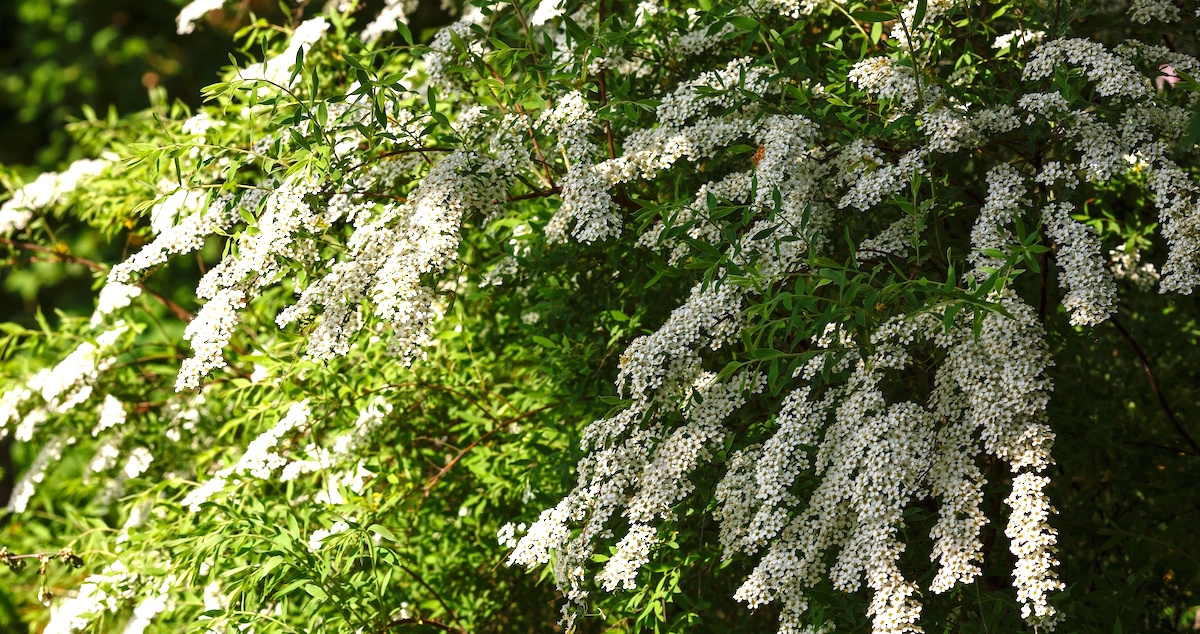
Note: Spiraea japonica is an aggressive spreader and is listed as an invasive species in several eastern states, including Georgia, Kentucky, North and South Carolina, Tennessee, and Virginia. If you live in those areas, consider an alternative type.

More Like This

Comments