

If you spend hours sitting—whether at a desk, crafting table, or couch—you’re not alone. But too much sitting comes with serious health risks, from heart disease to higher stress. The good news? You don’t need to overhaul your life to see benefits. Small “microbreaks” and a few minutes outdoors can boost your energy, sharpen focus, and even improve long-term well-being. Here’s how simple movement and nature can make a big difference.
Why Sitting Too Much Is Harmful
Sitting too much? As someone who has “sat for a living” for decades as a writer-editor, I can relate to sitting for long periods of time. Recent studies have associated long periods of sitting with more cardiovascular disease, larger waists, more cancer, and other health risks.
What Are Microbreaks?
Experts recommend taking short breaks every 20 to 30 minutes that get you up and moving around. Canadian blogger Paul Ingraham calls it “microbreaking.”
Easy Microbreak Ideas at Home and Work
You don’t need to do vigorous exercise during these brief breaks from sitting. Just get up and move around for a couple of minutes.
- At home, you could put a load of laundry in the washer, get a glass of water, take a couple of trips up and down the stairs, walk around the driveway, or pace while you talk on a cell phone.
- People at work could walk to the printer, copier, or restroom; walk in place; or stroll to a colleague’s desk with a question.
Don’t forget, though, that these mini-movement breaks don’t substitute for longer bouts of aerobic and strengthening exercise that build and maintain your fitness base.
The Healing Power of Nature
Now, it’s time to think about getting outside.
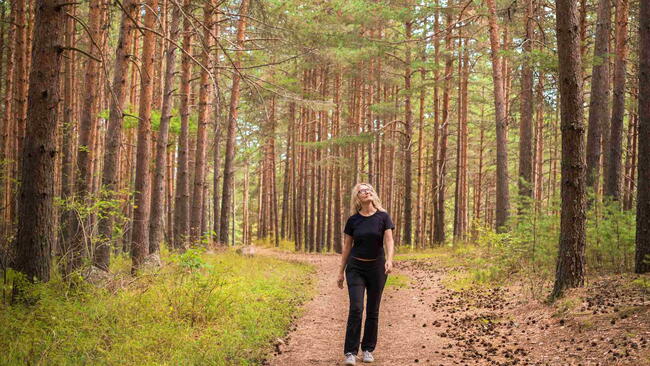
A substantial body of research affirms the numerous health benefits of spending time in natural settings, such as walking in woods or urban parks, canoeing down a river, tending a vegetable garden, or meandering along a coastline or lakeshore.
Researchers have found that spending time in nature strengthens a person’s immune system, reduces stress hormones, lowers blood pressure, and improves social interactions. Furthermore, it may enhance learning and increase empathy.
Even a brief 5-minute dose of outdoor time increases our sense of well-being. Try a short stroll, or what I call slow walking.
Interestingly, green spaces such as parks and community gardens in urban residential environments seem to reduce crime (especially gun violence), decrease domestic violence, stimulate positive social interactions, and strengthen family connections.
What’s more, hospital patients exposed to green spaces through their windows (rather than parking lots) have better clinical outcomes. They experience less fear, anxiety, and anger; have lower blood pressure; and need fewer medications.
So there’s much to be said for even just the notion of the outdoors.

Biophilia: Why We’re Wired for the Outdoors
Human health may depend on connecting with nature.
The term “biophilia” refers to the hypothesis that human health may depend on a connection with nature.
Biologist Edward O. Wilson and others have hypothesized that a deep affinity, which they call “biophilia,” exists between humans and other living systems. Proponents of the hypothesis suggest that a connection with the plants and animals around us, including those species too small to see, is essential to our physical and mental health and productivity.
Consequently, public health advocates around the world have begun advocating immersion in nature for health.
Ready for some more ideas? Here are some 10-minute workouts, from jumping with a rope to the parking lot trot.
Try a 2-minute microbreak right now—stretch, step outside, and reset your body and mind!







Thanks for posting that sharp reminder, Pat. Many Americans work in jobs that don't allow freedoms such as the ability to get up and move from time to time to shake off some of the negative health affects of long sitting.
Of course I was aiming at the many who don't have such severe workplace restrictions, and who sit most of the day (and often well into the night) on the job, commuting, and later, on the couch.
Writing always involves making choices about which group or groups of readers to address. What speaks to one group can feel exclusive and ignorant to others. Both in tone and content, my post excluded the folks you want us all to remember.

Comments