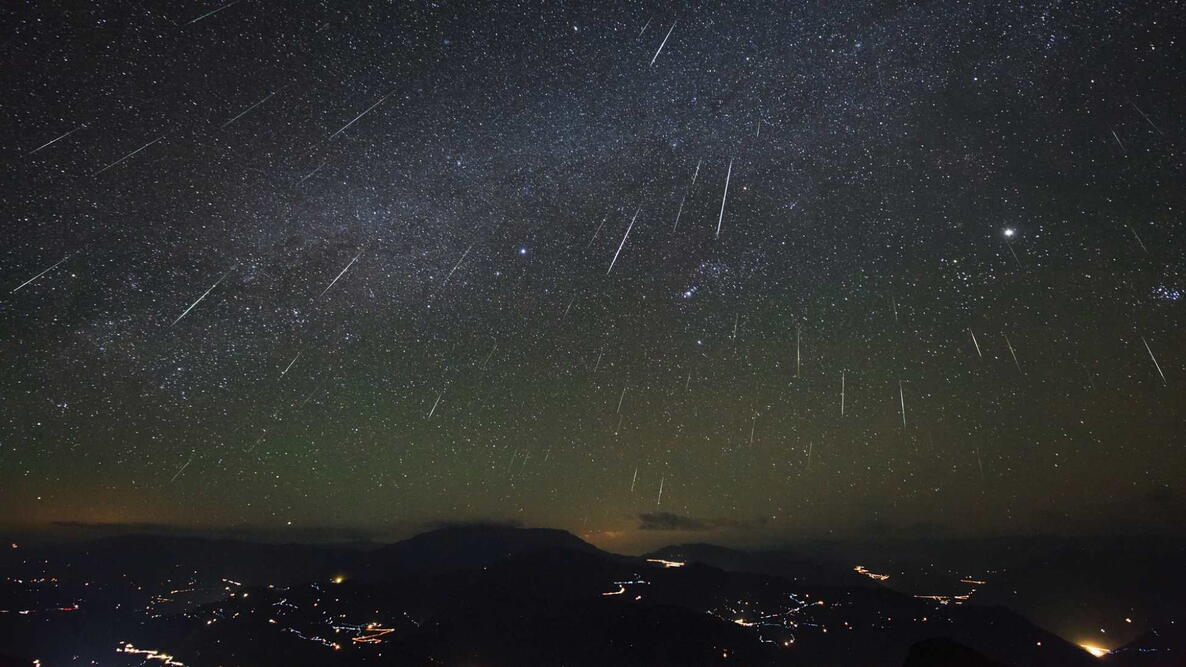
Caption
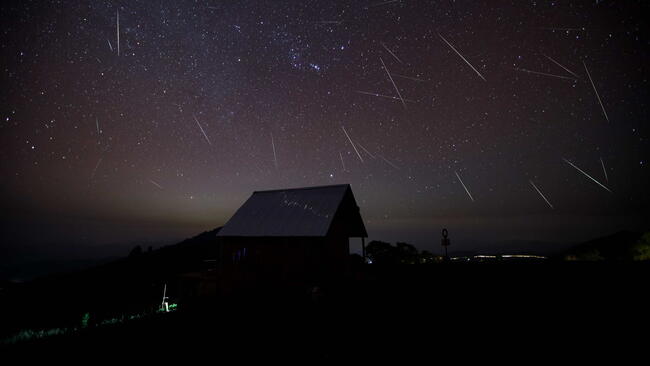
The Geminid meteor shower lights up the winter sky, so bundle up and get outside to see it!

December’s premiere sky show is the Geminid meteor shower can produce up to 75 meteors per hour. The annual celestial event is a stargazer’s dream—so get ready for the grand finale of the night sky calendar.
When Is the Geminid Meteor Shower?
The Geminids occur every year from about November 19 to December 16, peaking the night of December 13 into the morning of December 14.
And unlike summer’s more famous Perseid meteors, which don’t get exciting until after midnight, you can observe the Geminids any part of the sky from 9 P.M. through dawn the next day.
This is the shower’s maximum—when the most meteors fall per hour. Given that the Geminid meteor shower is the most active shower of the year, expect to see an average of 75 meteors per hour during its peak! The show typically peaks around 2 A.M., and lasts into the morning hours.
What Is the Geminid Meteor Shower?
The Geminid meteor shower is one of the year’s most active and reliable meteor showers! They streak through the sky every minute or two.
This shower is unique because the constellation Gemini arises just an hour or two after nightfall, making the meteors visible all night. Most meteor showers require waiting until midnight or predawn for the best viewing.
The constellation Gemini is the point of origin and the meteors will appear to fall away from the constellation.
Because the sun sets so early in December, the meteor shower is usually in full swing by 9 P.M. Although optimal viewing occurs when Gemini is at its highest point (around 2 A.M.), meteors can be seen all night long.
What Is a Meteor?
Meteors occur when the Earth rushes through a stream of dust and debris left behind by a passing comet. When the bits strike the Earth’s upper atmosphere, friction with the air causes each particle to heat and burn up. The result is a meteor. Learn more about meteor showers.
Interestingly, Geminid meteors didn’t seem to be associated with a comet until recently. The Geminid meteor shower was thought to be caused by asteroid 3200 Phaethon, first detected by NASA in 1983. The odd part of this is that asteroids don’t disintegrate like comets do to produce meteor showers. Phaethon has since been reclassified as an extinct comet that has lost its outer covering. This helps explain why the Geminids are so bright. They’re little pieces of mostly rocky material that take longer to burn up as they fall into the atmosphere, whereas the softer, icier debris from comets causes most meteor showers.
The Geminid meteors also move more slowly than others, such as the Perseids. The decrease in speed makes viewing much easier. The Geminid meteor shower is also relatively new. All other major meteor showers have been observed for centuries, but the Geminids were first observed in 1862 in Manchester, England. The Geminid meteor shower was initially very modest, with only 10 to 20 meteors per hour.
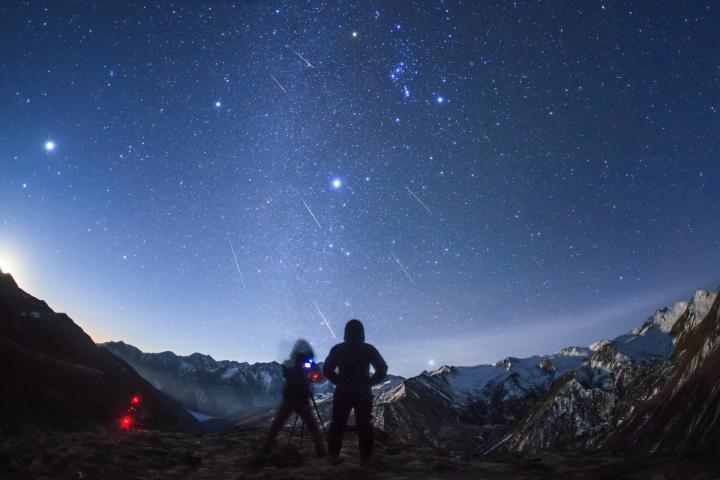
Photo Credit: Jeff Dai/Universities Space Research Association.
Viewing Tips for the Geminid Meteor Shower
Geminids offer one of the best meteor showers of the year, making them perfect for kids who can’t stay up until midnight when other meteor showers typically become visible.
Unfortunately, due to the December timing, the Geminids are sometimes clouded out by a snowstorm or overcast skies. Keep your fingers crossed that the skies stay clear, and check our 5-day weather forecast to plan ahead.
As with any meteor shower, it is best to find a place far away from artificial lights. This can be tough in December when you want to stay close to a warm shelter, so watch with a friend who lives in the country. You’ll need to bundle up for the chilly weather, and we recommend making yourself some hot chocolate and cuddling up for a cheap but spectacular date. Try getting into sleeping bags on a reclining chair.
The meteors can appear anywhere in the sky, but you’ll have the best luck by gazing at whatever part of the sky is darkest at your location. Though it might be tempting, avoid using binoculars or a telescope. It is better to look at the whole sky than a tiny part, and your eyes will automatically move toward any motion above. Avoid looking at your cell phone or other lights during the meteor shower, as this will affect your night vision.
The shower is best when the Moon is absent. In years when there’s “moonshine”, try to look towards the part of the sky furthest from the Moon.
Fingers crossed that the Geminid meteor shower isn’t a snow day this year! Be sure to tell us about your meteor shower experience below.
Learn More
- See the Meteor Shower Calendar for all the meteor showers of the year.
- Read about the other “big” meteor shower: The Perseids!
- For more information about meteors and meteorites, check out When a Meteor is not a Meteor.

More Like This
- « Previous
- 1
- 2
- …
- 10
- Next »

Comments