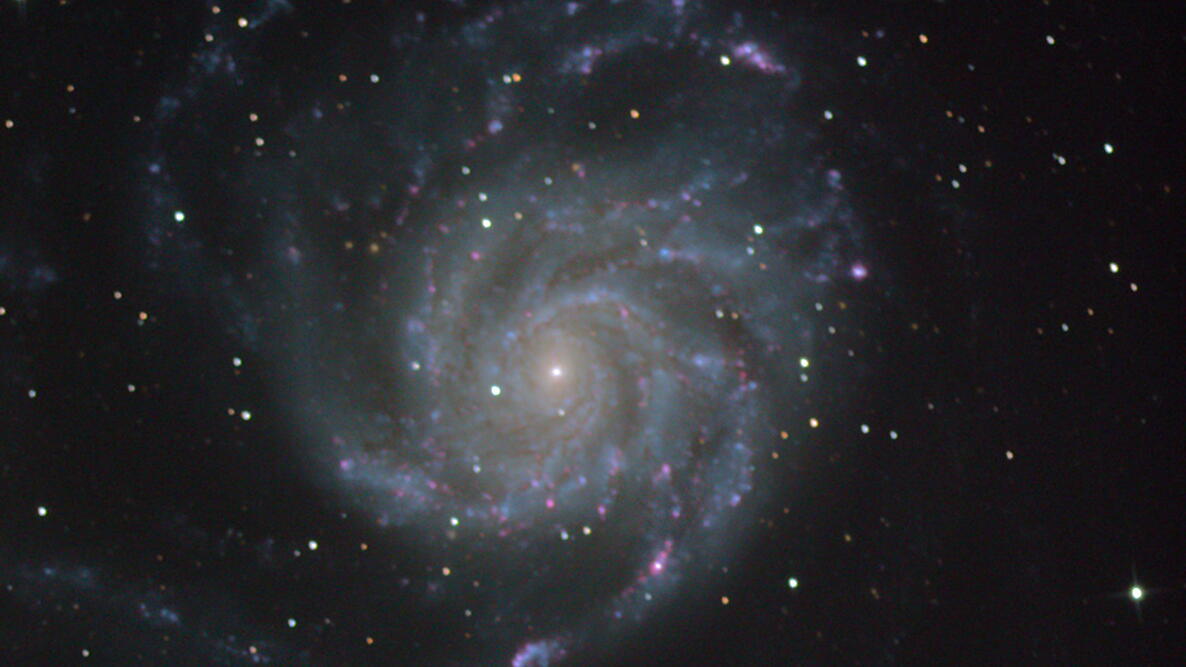
Caption

Spring is one of the best times of year for stargazing because our view of the universe opens beyond the Milky Way. From March through mid-May, astronomers can spot dozens of distant galaxies—including the famous Whirlpool and Pinwheel galaxies. Here’s how to find them and what you need to start galaxy hunting.
What Is a Galaxy?
It may help the novice sky watcher to understand the definition of a galaxy: A galaxy is a huge collection of gas, dust, and billions of stars and their solar systems, all held together by gravity. Our planet, Earth, is part of a solar system; that solar system lives within the Milky Way galaxy.
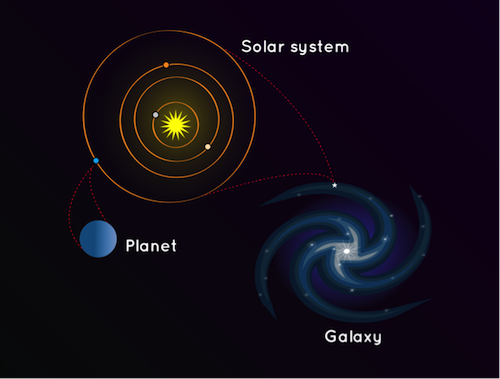
Of course, there are billions of other galaxies beyond our own. Each galaxy can be over 100,000 light-years across and contain over 200,000,000,000 individual stars. There are more stars in all of the galaxies of the visible universe than grains of sand on all of the ocean’s beaches combined.
3 Main Types of Galaxies
In space, galaxies can be oriented any which way. There is no up or down in space. There is no right, left, forward, or backward. We experience all of these things relative to our own earth and solar system.
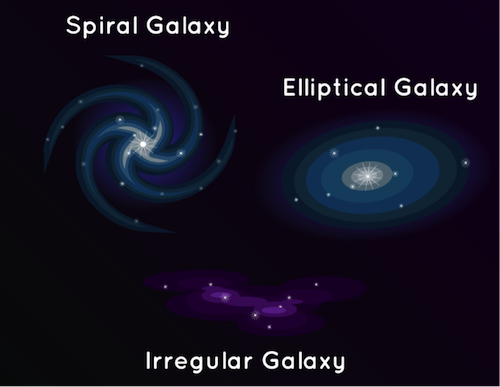
- Some galaxies, called spiral galaxies, are pinwheel-shaped, like ours. They have curved arms that make the galaxy look like a big spiral. Sometimes, the spirals are presented full-on to us, some are edge-on, and some are in between.
- Other galaxies are smooth and oval-shaped. They’re called elliptical galaxies.
- And there are also galaxies that aren’t spirals or ovals. These irregular galaxies have inconsistent shapes and often look like blobs.
The light that we see from each of these galaxies comes from the stars inside it.
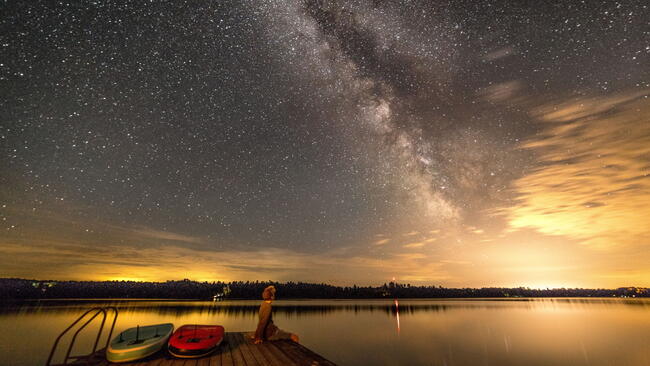
We usually see our own Milky Way spiral galaxy as a dinner plate and Earth as a single atom within that plate. What perspective do you have of the plate from that point of view? You have an edge-on view of the plate circling around you. This is why when you find a very dark location in summer or winter, the Milky Way appears as a “stripe” across the sky. That stripe is our home dinner plate, and we are the atom within it.
Why Spring Is the Best Season for Viewing Galaxies
Galaxies can be seen at any time of year, but the direction in which we are looking out into space changes with the seasons.
- In the summer months (June, July, August), the evening sky seen from the entire Earth is facing toward the center of the Milky Way galaxy. It spans the night sky from south to north. When you look up at stars in the night sky, you’re seeing other stars in the Milky Way. If it’s really dark, you can even see the dusty bands of the Milky Way stretch across the sky.
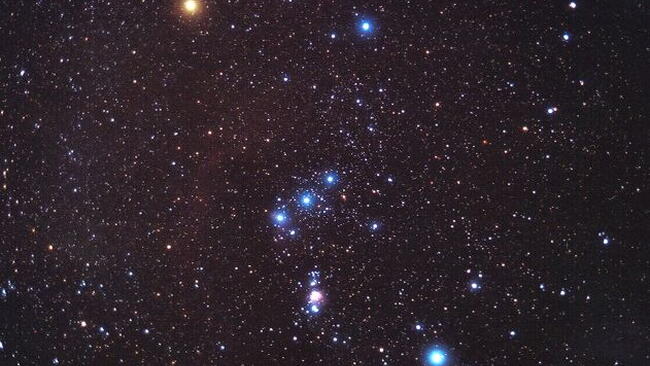
- In the winter (December, January, and February), we’re looking the opposite way, away from the galaxy’s center and into the spiral arm of the Milky Way. There are some gigantic stars located in this direction. They’re relatively close to us—within our local spiral arm—so they look bright!
- In the spring and fall, our solar system is tilted so that we look outward into deep space. It appears as if the Milky Way has vacated the night sky. This brings an opportunity to go beyond our home galaxy to see other distant galaxies.
How to See Galaxies in the Spring Sky
To spot a galaxy, you’ll need:
- a very dark night sky, away from the city lights. Look for nights near the New Moon. See our Moon phase calendar.
- a telescope that’s 6 inches or greater
- an astronomer app is always helpful to locate constellations more easily.
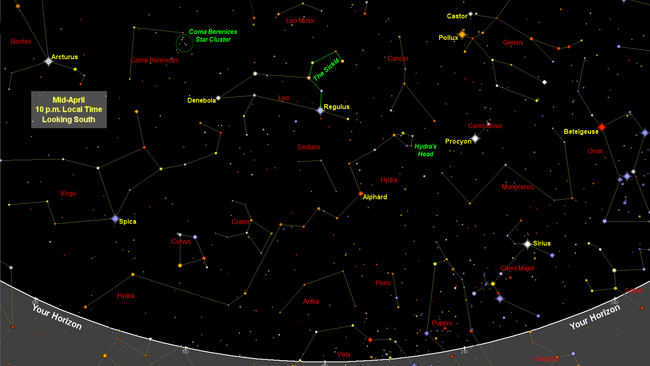
Look south and then high in the sky. (In April or May, you’ll be looking more or less overhead.) A patch of dark sky contains many of the spring galaxies.
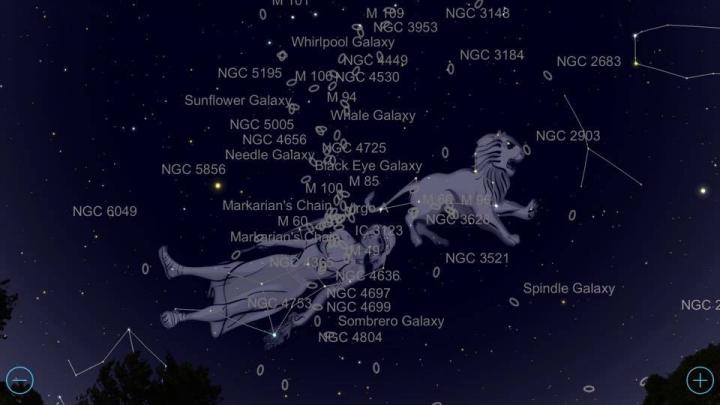
Most of these galaxies are located between Leo and Virgo, which are currently rising in the evening.
Famous Galaxies to Look For
See Leo below? The lion faces west, and his head and chest are defined by six stars forming a backward question mark. The bottommost star is the bright-white star Regulus.
Famous galaxies noted below include:
- M104, the Sombrero Galaxy in Virgo (magnitude 8.2)
- M51, the Whirlpool Galaxy in Canes Venatici (magnitude 8)
- C32, the Whale Galaxy in Canes Venatici (magnitude 9)
- C38, the Needle Galaxy in Coma Berenices (magnitude 9.2)
Enjoy photos of some of these galaxies below.
The Pinwheel Galaxy (M101)
A few galaxies are near enough to appear very large in the sky. The Pinwheel Galaxy, or M101 as it is classified, is a face-on spiral galaxy.
It’s huge—appearing to our eyes nearly as wide as the Full Moon—and shines at a relatively bright magnitude of 7.9.
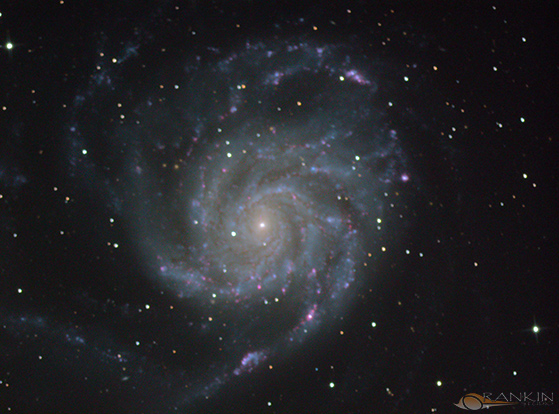
Credit: David Rankin
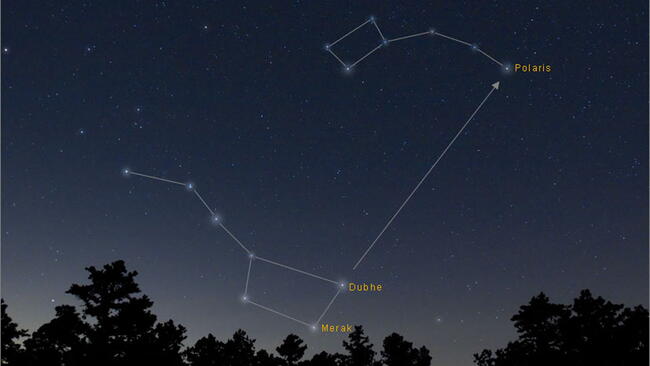
The Pinwheel Galaxy is located in the constellation Ursa Major (The Big Dipper), about 21 million light-years from Earth.
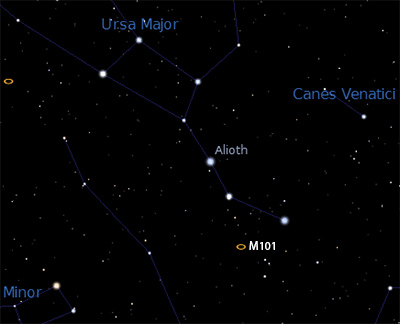
Our Milky Way looks very similar to the Pinwheel Galaxy, though we will probably never be able to see it from that point of view.
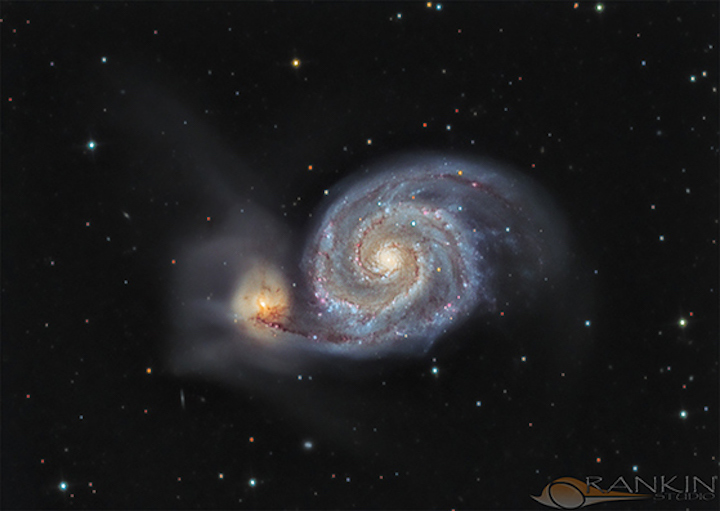
The Whirlpool Galaxy (M51)
Below is a photo of the Whirlpool Galaxy (M51). This is a massive spiral-type galaxy that is positioned beautifully face-on near The Big Dipper in the constellation Canes Venatici.
It is about 24 million light-years away and part of a cluster of gravitationally bound galaxies called … wait for it … the M51 group. Messier 51 was discovered on October 13, 1773, by Charles Messier.
Charles was a famous comet hunter, and on his quest to find the icy space balls, he put together a very nice catalog of objects he came across that were not comets. This one made it into his catalog as Messier 51, later to be dubbed “The Whirlpool Galaxy” for obvious reasons. The catalog Charles put together is still widely used today.
Frequently Asked Questions
Can you see galaxies without a telescope?
A few galaxies, such as the Andromeda Galaxy, can be seen with the naked eye under very dark skies. However, most galaxies are faint and require binoculars or a telescope to observe clearly.
Why is spring the best time to see galaxies?
During spring evenings, Earth faces away from the dense center of the Milky Way. This allows astronomers to look deeper into space and observe distant galaxies that are normally hidden.
What is the closest galaxy to Earth?
The closest large galaxy is the Andromeda Galaxy, about 2.5 million light-years away. Smaller dwarf galaxies are closer but harder to see.
How big is a typical galaxy?
Most galaxies are between 30,000 and 200,000 light-years across and contain billions or even trillions of stars.
What equipment do beginners need to see galaxies?
A dark sky location is the most important factor. A telescope with at least a 6-inch aperture will help reveal many faint galaxies.
What constellations contain the most spring galaxies?
Many famous spring galaxies lie between the constellations Leo, Virgo, Coma Berenices, and Canes Venatici.
Fun Fact: Did you know that our Milky Way galaxy is moving towards Andromeda, our closest galactic neighbor? Some day, they will run into each other, but it will probably take about five billion years. But even if it happened tomorrow, you might not notice. Galaxies are so big and spread out at the ends that even though galaxies bump into each other, the planets and solar systems often don’t get close to colliding.



Comments