

Volcanoes such as Grímsvötn are nature’s wildcard. First there is the fiery eruption , followed by the ash cloud that endangers air travel. Then the unreported final act arrives – the cold stormy winters of volcano weather.
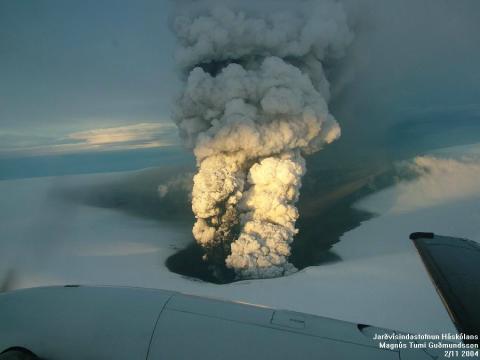
Grímsvötn erupts—blasting through the glacier.
Credit: freeonlinepicture.org
On May 21, the glaciers of Iceland ripped apart to reveal the angry crater of Mt. Grímsvötn. Molten lava and ice mingled in a mighty explosion. Plumes of ash and sulfur soared over 12 miles (20 km.) high in the air.
Europe winced. Volcanic ash is not soft little flakes of carbon – it is microscopic flakes of jagged glass surrounded by clouds of acid gasses. Planes that have entered these clouds have fallen like rocks. Last year’s eruption of the much smaller Eyjafjallajokull volcano stopped air traffic in Europe for 5 days.
Fortunately, Europe has updated it flight rules, so only a relatively few days of flight were lost in Iceland, Great Britain and Germany. The volcano continued to explode for five days and has finally settled back to grumpily rumbling in the glacier. As far as the news is concerned, the story is over and it is time to find something more exciting.
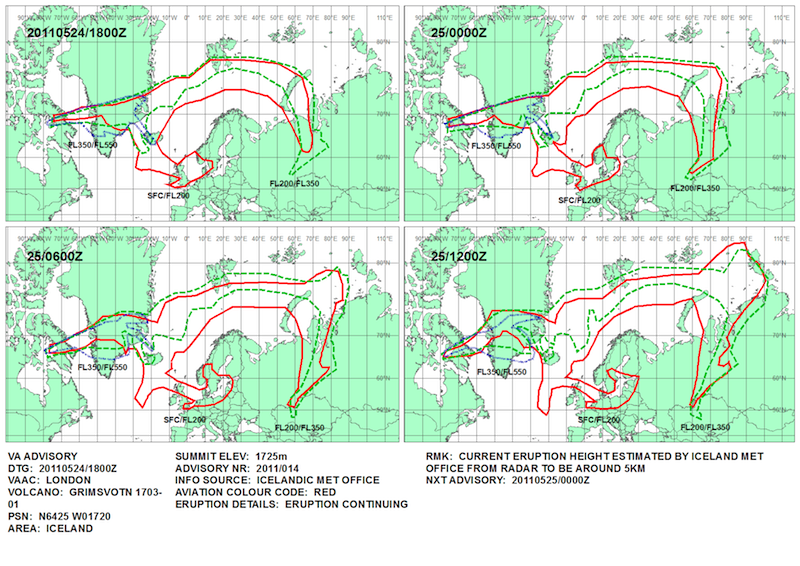
Grímsvötn ash cloud. Click to expand.
Source: Volcano Ash Advisory Centre—London
Here’s the unreported story. Grímsvötn was shooting out 2000 tons of ash, chemicals and steam every second! That’s a lot of pollution! Some of the material, especially the larger chunks of ash, fell back to the ground. But a lot of that stuff is still in the air. At 12 miles high, a lot of material entered the stratosphere, a quiet region of air where it will linger for over a year.
Sulfur and microscopic ash collect water and form clouds. For the next few months, the volcanic debris from Grímsvötn will be floating in the Arctic air mass. It will reflect back incoming sunlight and the polar air will grow colder.
For now we can ignore it. It’s almost summer and the polar air is far in the north. We will bar-b-que and swim and enjoy the golden warmth of the season.
Next fall, however, when the cold air begins to return, however, we will feel the extra nip in the air. The winter will be cold again and we will comment on how surprisingly stormy the weather is. We will feel that extra cold and some of us will recognize it for what it is – the last gift of a volcano in Iceland.




The amount of debris is just too massive. According to Dr. Ian Plimer, a noted scientist and climatologist in Australia, this eruption put up more CO2 than mankind has in the last 5 years combined. It's really huge.
There is a story that years ago the EPA complained to the government of Hawaii about the gas pollution from one of their volcanoes. On the last day of their session, the rather punch-drunk legislature passed an informal resolution -- if the EPA didn't like the volcano, they should go up the slope and put a cork in it.
Your nuclear winter comparison is excellent. That is how exactly how volcano weather works.
Last winter AND the winter before were volcano weather winters. In 2009 we had two large eruptions in the North Pacific - Mt. Redoubt in Alaska and Sarachev Peak in Russia. That is why the summer of 2009 was so wet and cool and the last two winters have been extreme. Last year's Iceland volcano, Eyjafjallajökull, was a problem for airplanes, but too small to enter the stratosphere. It crossed Europe and rained out in Russia and East Europe.
Unfortunately, this year's Grímsvötn was big, so it will create some problems, just as the impact of the 2009 volcanoes is beginning to fade.
- « Previous
- 1
- 2
- …
- 10
- Next »

Comments