Caption
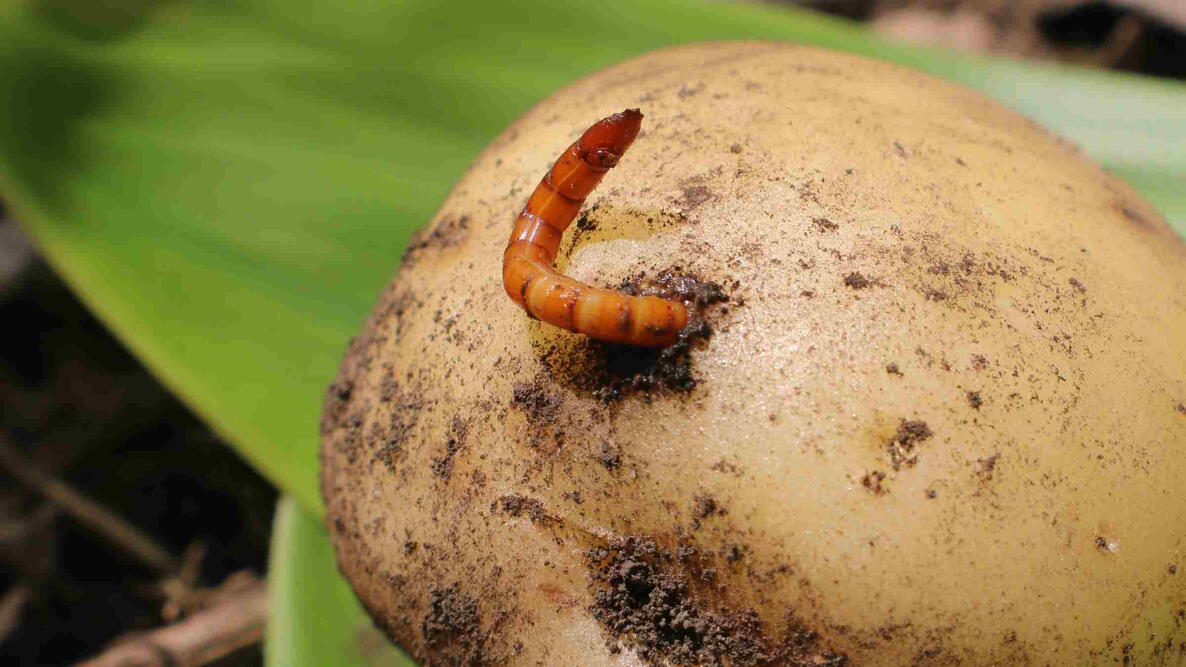
A wireworm emerges from a freshly dug potato, a hidden pest that can damage roots and tubers.

Why is there a neat hole in my potato? Who has been munching on my undug carrots? You may have seen wireworms before and dismissed them as just another creepy-crawly thing that lives in the ground. But wireworms are just waiting to derail your garden plans. Learn how to identify wireworms and what to do about them.
What are Wireworms?
Wireworms are the larval stage of click beetles. These beetles will flip into the air with an audible click when turned onto their backs, hence the name. The adult beetles don’t damage plants, so it’s only the larvae we get mad at. Of course, an adult laid that egg!
Several species of wireworms (click beetles) are present throughout the US and are more commonly found in areas that used to be grassy, like your newly created veggie patch in the backyard. They are most abundant in poorly drained areas, in old fields (or ground that used to be an old field, like a suburban lawn), and under sod.

Wireworms have a broad range of plants they’ll attack, including any underground portion of cabbage, beets, carrots, potatoes, radishes, and beans. Cool, wet spring weather often brings on more wireworm damage.
Wireworm Lifecycle
Wireworms take their time. Depending on the species, they may take 2 to 6 or more years to mature and pupate. The larvae live in the soil and move shallower or deeper depending mainly on temperature. Adult beetles emerge from the soil in spring to late summer, mate, and lay eggs in the soil. Since it takes several years for a larva to mature, several generations can occur at once in the soil.
Adult female beetles spend most of their time in the soil laying eggs, and each can deposit up to 100. Typically, wireworms are found in the top six inches of soil, but dry conditions can cause them to burrow deeper into the soil profile.
Identification
How to Identify Wireworms
I think wireworms look like millipedes, only without as many legs. They have the same reddish-brown, segmented look. Wireworms have 3 pairs of legs up near the head, not a thousand, and are often kind of shiny. They are hard-shelled and smooth, unlike a regular soft worm or grub. Their slender and hard appearance is why they’re called wireworms.

You have likely seen a wireworm when digging a hole to plant a new tree or when turning over a garden bed in spring. They are about as wide as a cocktail straw and from ¼ to 1.5 inches long. They don’t look as sinister as a fat, white grub, so you might have ignored them, although the birds will make a snack of any they find.
The adult beetles are hard-shelled, black, and otherwise nondescript. They just look like a plain old beetle. Try flipping them upside down, and if they jump upright with a clicking sound, you’ve got the right one. Then, feed them to your chickens if you have them!
Identifying Wireworm Damage
Wireworms feed on the belowground portion of plants. In spring, they’ll attack seeds, roots, crowns, and the stems of young plants. As the growing season progresses and tubers form, they’ll dine on those as well.
Wireworms feeding on seeds and seedlings can look like poor germination rates (they ate the seeds) or seedlings that seem to wilt and die for no other reason. Of course, we’re talking about out in the garden. If your seedlings in the house are wilting and flopping over, it could be damping off. When the roots are damaged, the plants wilt or become stunted.
There are so many causes of a wilted or stunted plant that you may not really notice until harvest time. Upon digging up root crops, wireworm damage looks like small tunnels or boreholes in potatoes, carrots, and other tubers. The damage is different from that caused by slugs. When a slug feeds on your carrot or potato, it leaves a broader, shallower pit and maybe some slime. Wireworm holes more closely resemble holes drilled with a drill bit.


More Like This

Comments