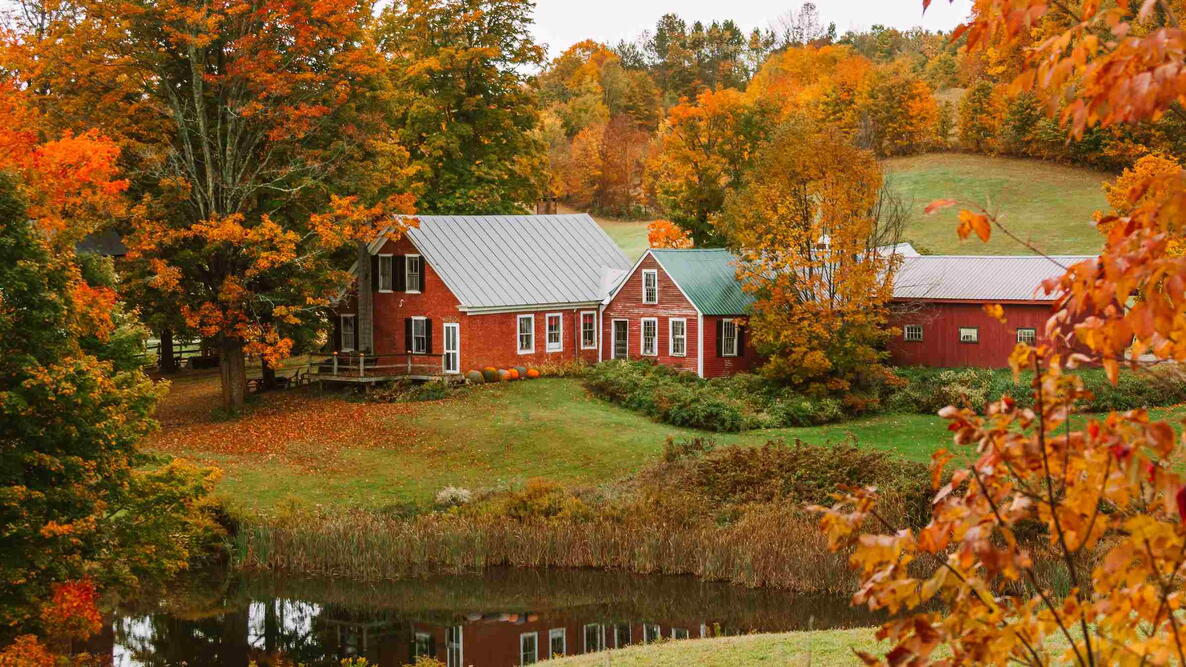

Step into the fields and barns of John Pierce, former group publisher of The Old Farmer’s Almanac, as he recalls the farm of his youth. In this quiet, evocative essay, Pierce traces the rhythms of soil, seasons, and family life—revealing a lasting bond between land and dreams.

It is the Soil
Growing up a child of the land, it is the soil itself I miss most. Soft, sandy loam that on hot summer days would puff between your toes like silk. It was, and remains, dirt in which you can get things to grow with only a minimum effort. Then it grew forage crops for small dairy farms as well as the requisite family garden; today it grows tract houses. They sprout quickly in season and show no signs that they will be tilled under come winter.
The Farm and the House
It was a small farm on a soft rise along the bank of a gentle river in southern New Hampshire. It always looked like the kind of place that a family could call home. The house was tall and square, and there were dates carved into the plaster in the formal front rooms—the earliest one read 1805.
Traces of the Past
These signs of former habitants were all around us. Two giant sugar maples and an equally large red pine framed the front of the house, obviously set in place by one of the farm’s original residents. The sets of initials etched into the barn’s hewn timbers bespoke generations of adolescent romances. Even the fields themselves would occasionally offer up reminders of past owners: an old farmer’s file, bricks from the foundation of another house that once stood 100 yards north of the current main house, and, most exciting of all, a rare arrowhead.

The Pull of the Dirt
Each of these markers served notice to the observant that this was a place of continuity. That uninterrupted timeline was linked to the soil, of course. What brought the first family there 150 years before us was the pull of the dirt. A plow or harrow cut cleanly through the sod from one end of the fields to the other with a single clank to soften the steel—save the rare brick. Having found this spot of agricultural heaven, in a state renowned for its granite outcroppings was no guarantee of success. A man still had to know how to care for the soil and respect the hard finances of farming.
The Power of Dreams
There is no way to know how past families ran their farm, but I have to assume that they did well. After all, as the bricks testified, the fields had supported at least two separate families at one time. It must have been the Robinson place then, because an early county map shows that name on both houses. Possibly two generations of Robinsons worked the farm at the same time. This was a thought that had the power of dreams for a young man trying to imagine himself growing up into the world. What does one do for a living, having been raised on a farm, other than farm? I envisioned my brothers and I taking over the operation one day. That was reassuring.
Reality vs. Romance
Reality and romance are rarely bedfellows, especially when it comes to family farming. By high school, my father was working a full-time job and running the dairy farm in what time he had left, and the cows were gone. The soil remained, of course, and was still the food of fantasy. A truck farm, I told myself then. The river was there for irrigation, and we were only 60 miles from Boston. The area would grow, and there would be demand for top-quality, locally grown produce. I went off to college imagining rows of broccoli and beets, sweet corn and melons all springing out of that soft sandy soil.

The View Broadens
Wider horizons can diffuse our view and distort a dream. And this is not bad, either. The ordered rows of vegetables faded amid algebraic equations and 18th-century English literature, and apparently the same happened to my brothers. The fields were leased out to various local farmers pursuing their own vision of modern agriculture, while we headed our separate ways. During those years, back for a visit on a summer evening, I could walk the fields with my children, imagine my rows of vegetables, and understand the dream again.
What the Soil Yields
It remains an important dream, although now I garden for the family in a backyard so rich with rocks I hardly need to mow. Each spring as I turn the garden and remove what seems a truckload of stone, I remember the farm and the dream. I am both saddened and cheered. For although the rows of broccoli and beets are now a row of homes, the soil yields up its final crop—enough money to repay our college debts and to allow our parents to retire in comfort.
Such were the hopes, most left, of all who worked that land. To be successful, to provide for their children, and to earn a time of rest. It is the kind of soil that supports such dreams.



Comments