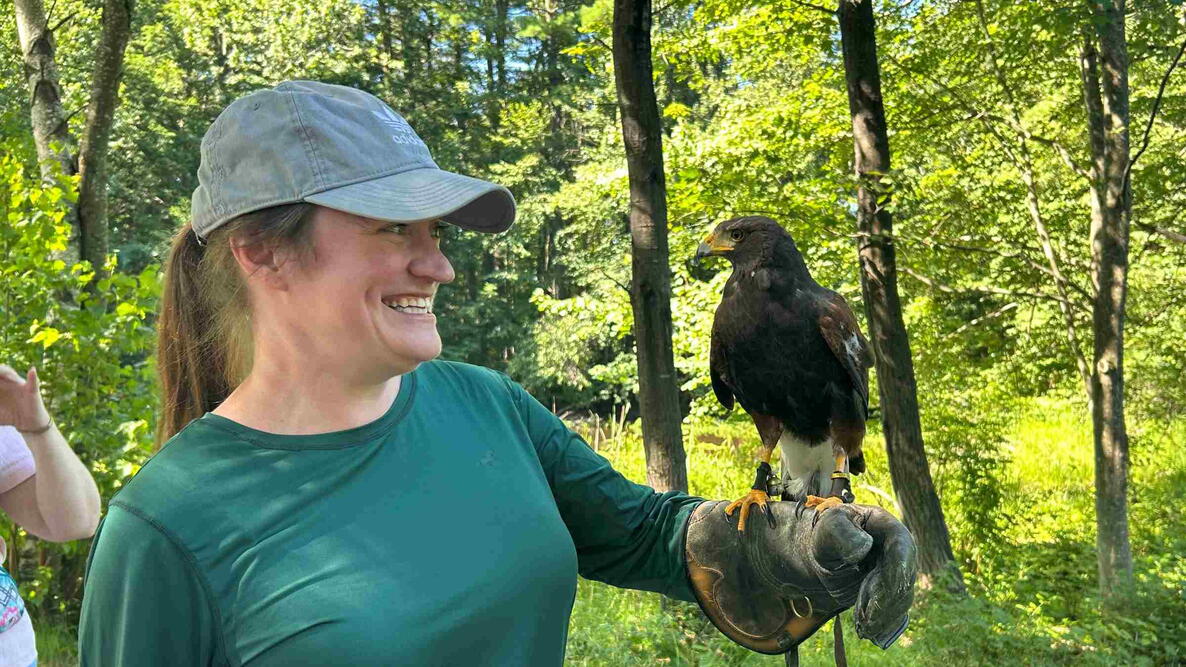
Caption
Despite Jenn’s winning smile, her new Harris’s hawk friend is all business.
One perfect summer morning in late July, your Almanac editors stepped away from pens, screens, and planting charts—and into the woods, with leather gloves and hawks overhead. What awaited us was something ancient and awe-inspiring: falconry.
Here at The Old Farmer’s Almanac, we write about the seasons—from growing cycles to weather calendars to Moon phases. Our work is rooted in nature’s rhythms. But this outing into the wild reminded us that nature doesn’t just guide—it teaches. And its lessons are the ones we’re honored to share with you—so that together, we may keep learning from the land and sky.

Meeting the Falconer
In a barnyard at the edge of the woods, we met Henry Walters of New Hampshire-based Monadnock Falconry. The roots of falconry, Henry explained, reach back thousands of years. And unlike most other human-animal relationships, falconry isn’t about domestication—it’s about partnership.
Henry’s journey began with a college Latin course that introduced him to De arte venandi cum avibus (“The Art of Hunting with Birds”), written by Frederick II in the 13th century. That spark led him to Ireland’s School of Falconry and apprenticeships with some of Europe’s finest falconers. Since his return to the U.S., Henry has earned the rank of Master Falconer, and it doesn’t take us long to see why.

Glove On, Eyes Up
Our visit started with introductions to a pair of brother Harris’s hawks: 4-year-old Mahood and 3-year-old Aengus. Unlike most hawk species, which are solitary, Harris’s hawks are highly social birds. They hunt in family groups, often referred to as “wolf packs of the sky.”
We took turns wearing leather falconer’s gloves and holding out our arms, hoping to offer an inviting perch. Sometimes, Mahood or Aengus would swoop onto the glove of their own accord, but when they hesitated, Henry encouraged them with a bit of meat tucked inside. Though it was our first visit, the birds knew the drill well. Every so often, it became clear that Mahood or Aengus was stalling before returning to a glove—creating just enough impatience to ensure the bribes kept coming.

While we were getting acquainted, Henry told us about the history of falconry and explained that these birds are not pets. In fact, they develop almost no emotional attachment to their falconers—or to us—which was particularly disappointing to learn so soon after I’d convinced myself that Mahood and I had really connected during his last visit to my glove. What we’re entering into here with the uniquely social Harris’s hawks, Henry explained, is not a friendship but a business relationship.

Into the Woods
Soon, we were walking forest paths as Mahood and Aengus flew from glove to glove, then off to distant branches. They were free to come and go, but they stayed close. Our job, Henry explained, was to create enough ruckus to flush out moles, voles, or chipmunks. At that moment, the hawks would dive with lightning speed—talons and beaks ready to play their part in this ancient collaboration.

Sometimes they’d spot something we couldn’t see and dive into the brush. Henry would follow, ready to trade a treat for their catch. But these clever birds weren’t above a little gamesmanship. They’d occasionally pretend they’d caught something, hoping Henry would offer a bribe before their bluff was called.

A Wild Gift
Truth be told, The Old Farmer’s Almanac crew will likely not be remembered by the birds as great hunting partners. Aengus and Mahood made multiple attempts, but by the time we returned to our starting point, they had killed just a single vole. We were politely informed they’d try again later—without us.

Before wrapping up, we met Pip, a young American kestrel—the smallest of the hawks—who more than made up for his size with constant chatter. Our final, dignified visitor was Pete, a Great Horned Owl, who made it clear he wasn’t in the mood for company in the middle of the day. As an apex night hunter, he had better things to do—like sleep. Fair enough.

In a way, Pete’s reluctance was the perfect reminder of the gift we’d just been given. These birds of prey weren’t performing for us. Nor were they domesticated pets or zoo animals. They allowed us to tag along, to witness their world, and to try—however clumsily—to participate. For those few hours, we were in the presence of wild animals, being wild.

That’s a rare gift. And it reminded us why we do what we do: to stay attuned to nature’s rhythms—and to share those rhythms with you.

Living the Almanac
Hawk migration is one of many subtle signals that the seasons are shifting—a cue farmers, foragers, and sky-watchers have followed for generations. It’s the kind of observation that underpins our long-range weather forecasts, our gardening guides, and our seasonal advice. These aren’t just traditions—they’re tools, grounded in centuries of experience and sharpened by moments like this.
Experiences like falconry keep us attuned to nature’s timing. They’re part of the living proof behind the pages of The Old Farmer’s Almanac.
And yes, we ended the morning as any wise editor would: with fresh local ice cream from Connolly Brothers dairy farm and a maple treat from the sugar shack down the road. Even hawk-watchers need fuel.
To the hawks, the woods, and the wisdom of the wild—thank you for reminding us that nature doesn’t just mark time. It teaches it.


Comments