

As the year 2025 approaches, relatively few people ponder the significance of the date’s digits or lose any sleep over it. Still, we’re accustomed to dividing stuff into quarters, which is why married couples celebrate 25- and 50-year anniversaries with far more fanfare than, say their 31st year. The year 2025, which marks the first quarter of the new century, has potential significance.
Thankfully, this has not yet translated into any numerology fears of impending Armageddon. Don’t dismiss that possibility. Back in 2012, many people succumbed to the extensive end-of-world publicity that revolved around the Mayan calendar, of all things.
It might be a good time to look even further back and consider the momentous changes brought by the year 2000, one quarter of a century ago. That year created a little-known momentous development that still affects us, which we’ll get to in a moment. But there was also a panic-producing development, so let’s indulge in a bit of nostalgia to remember that odd event.
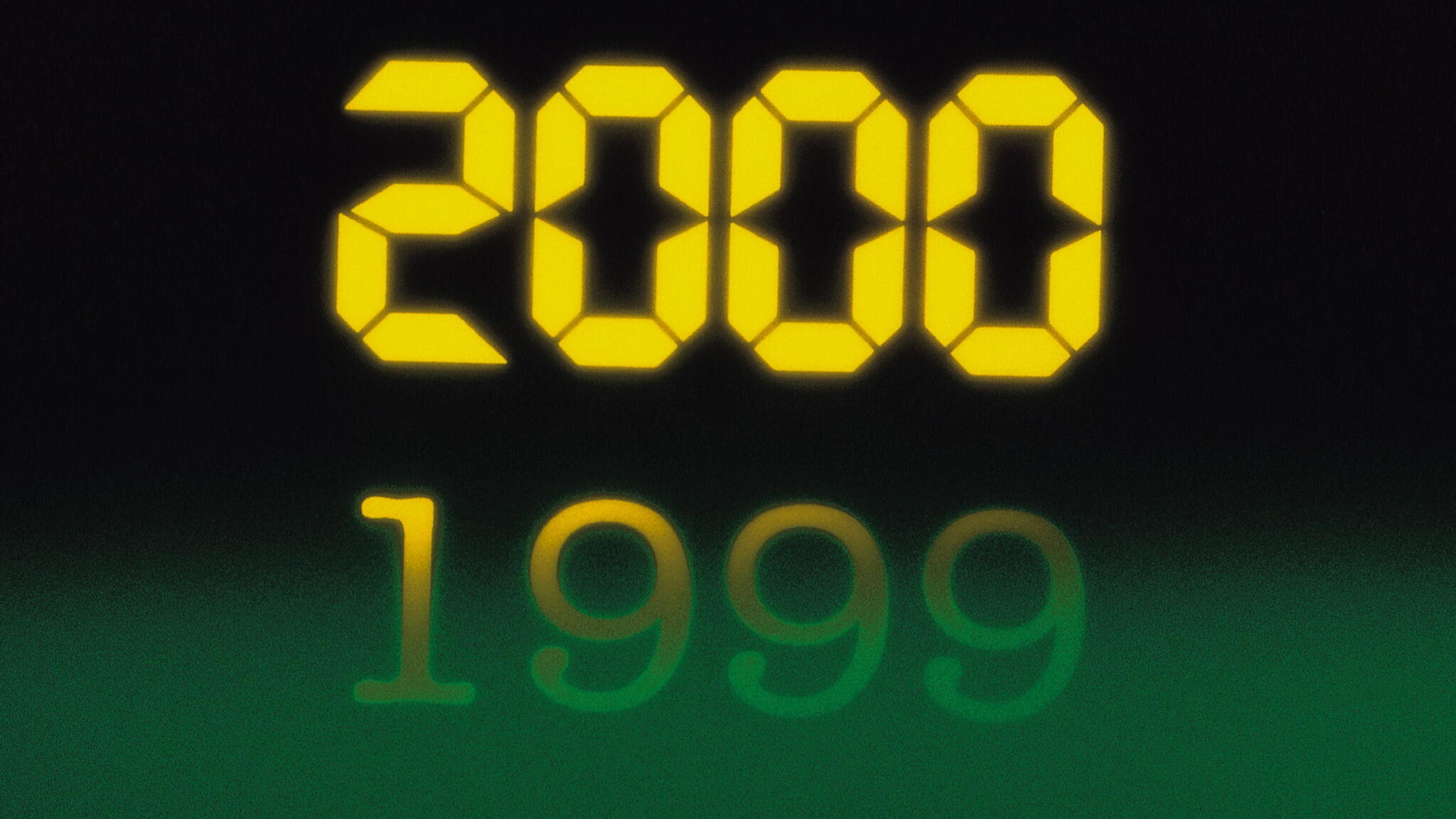
In 1999, everyone knew that the calendar’s numerals were about to change. Coming up was more than a novel century—it was the dawn of a new millennium. The last time this had occurred, it was the Roman Empire. This was big!
Then came the distress. There would surely have been Armageddon fears anyway, based solely on all those digits clicking over like a car’s odometer hitting 100,000 just as you’re pulling up your driveway. Now, suddenly, tech folks joined the nervous chorus. The issue this time was computers. Programmers realized that software codes were representing the current year as 99 rather than 1999. In that era of the 1990s, every byte of storage and memory was precious, and an MS-DOS 386 processor was an advanced machine. Why waste expensive extra bytes on a four-digit year code? If a policeman wrote 01-24-99 on your traffic ticket, would anyone mistakenly think it meant 1899? Two digits seemed adequate. Virtually overnight, the media ran numerous stories fearing the possibility that computers wouldn’t recognize the year 2000 if it was represented as 00, and that the digits could be interpreted as meaning the year 1900. And then what?
Computer programmers were now asked for their judgments of the peril, and their predictions were not reassuring. As soon as the silicon entities realized that a big mistake had unfolded, the general opinion went that all kinds of techno-smoke would probably seep from computer vents, followed by crashes and shutdowns. And since everything from stock transactions to jetliner engines was computer-controlled, the world’s electronics would freeze or at least mess up, and planes might even start falling from the sky.
It sounded like bedlam. Grocery and fuel deliveries would cease since distribution centers would no longer even know which routes should be taken—after all, they thought they were now delivering stuff in the year 1900. Modern life would grind to a halt. And the pandemonium would all commence at 12:00:01 on January 1, 2000.
As Time magazine explained in an apocalyptic 1999 cover story, “The bug at the center of the Year 2000 mess is fairly simple. In what’s proving to be a ludicrously shortsighted shortcut, many system programmers set aside only two digits to denote the year in dates, as in 06/15/98 rather than 06/15/1998. The trouble is, when the computer’s clock strikes 2000, the math can get screwy. Date-based equations like 98 -97 = 1 become 00 - 97 = -97. That can prompt some computers to do the wrong thing and stop others from doing anything at all.”
In the weeks leading to the predicted cataclysm, coverage grew more frenzied. When the feared midnight arrived, a surprising thing happened. It was an outcome no one had anticipated: Nothing happened. And “nothing” was indeed amazing because you’d think, given all the businesses, hospitals, planes, and all, something should have gone wrong. But nothing did. The year became 00, and life went on.
No one yet seems to have found any paranoia-inducing clickbait for the year 2025, and very soon, we’ll all be getting used to living at the quarter-century milestone. Let’s not quite leave the memory of the year 2000 without awarding it its positive contribution, which includes teaching us about the calendar system. It all begins with the simple fact that the number of times Earth spins on its axis does not fit evenly into the time we circle the Sun. If only we rotated 365.25 times in a year, we could simply tack on an extra day every four years to let those four fractional quarter-days even out, and that would be that. And that was exactly how the old Julian calendar worked. However, it didn’t really work because we only spin 365.2425 times in a year, which means that adding a leap day every four years is adding a bit too much. As a result, by the Middle Ages, the March equinox was happening more than a week too soon, and nature was visibly out of sync with the calendar.
That’s why Pope Gregory, aided by astronomers, fixed the whole thing. He shortened the year 1582 by 10 days and also slightly pared down the number of years that would have an extra day. His plan, which is the calendar used today, was to make every fourth year a leap year, just like in the old calendar. But now, years divisible by four would not be leap years if they were also divisible by 100. The years 1700, 1800, and 1900 were not leap years.
Unfortunately, if we continued like that, the calendar would again be inaccurate. What was needed was to skip three leap years every four centuries. The solution: If a century year was divisible by 400, it would be a leap year.
In case you thought we were never getting back to the year 2000, here is where it enters the picture. That was the long-awaited, once-in-400-years calendar tweak; it was a century-year divisible by 400. So, unlike 1700, 1800, and 1900, the year 2000 had a February 29 extra day. This tweak will keep calendars accurate to within one day every 3,000 years. But it does something else, too, and this is where we are still being affected.
The 400-year Gregorian calendar lets equinox and solstice dates creep slowly out of sync as each century wears on. But the once-every-400-year leap year addition we had in 2000 fixes that.
During this century, though you might not have noticed, the dates of equinoxes and solstices creep earlier year by year. When many of us were kids back in the 1900s, we remember spring usually starting on March 21, the vernal equinox. We haven’t had a March 21 equinox since 2007. These years, the spring equinox happens on March 20. And in just another 19 years, it’ll start happening on March 19.
That’s not a problem. It’s part of the plan. In the year 2100, we’ll skip the leap year, which will reset everything forward by a day, and—together with the further leap year skips of 2200 and 2300, people will be able to enjoy a spring-start date of March 21 again.

More Like This





Comments