Trailing Lobelia Care: Add Colorful Cascading Blooms to Your Garden

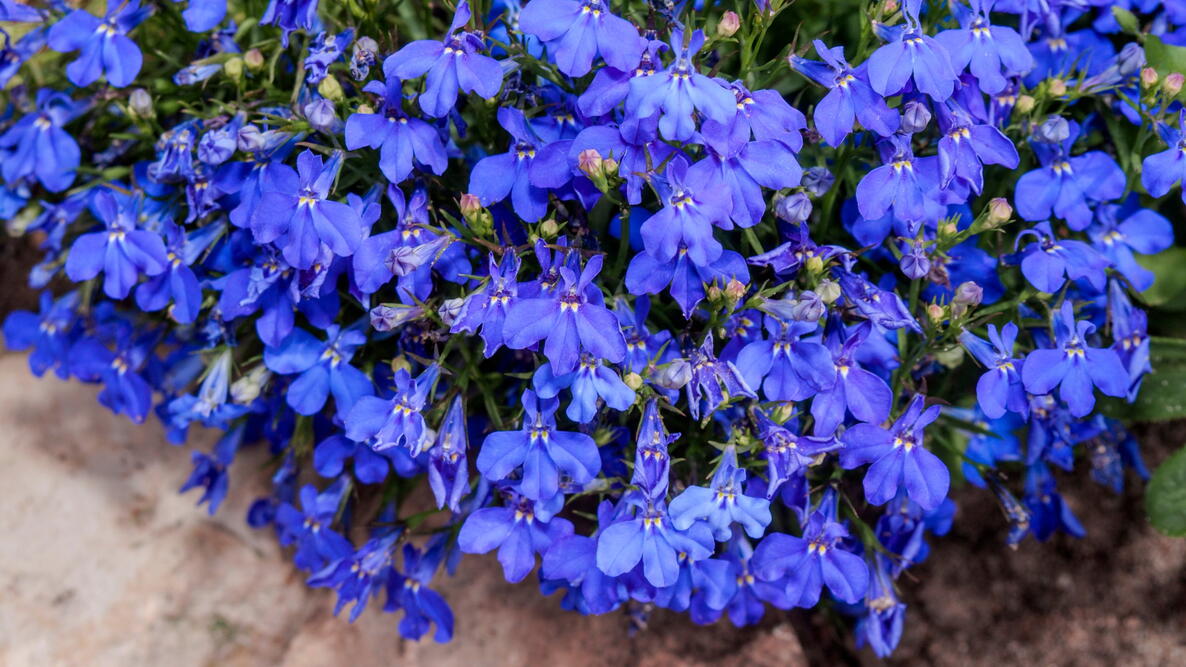
Edging Lobelia., Trailing Lobelia, (Lobelia erinus) in garden, Moscow region, Russia
Photo Credit
Nick Pecker
Botanical Name
Lobelia erinus var. pendula
Plant Type
Sun Exposure
Bloom Time
Flower Color
Hardiness Zone
Special Features
Subhead

Discover how to grow and maintain vibrant trailing lobelia for containers, hanging baskets, and garden edges

Written By: Tim Goodwin Senior Editor

If your garden could use a splash of color that literally drapes itself over the edges, meet trailing lobelia—nature’s version of a floral waterfall. With blooms in blue, pink, purple, red, or white, this cheerful charmer thrives in cooler weather and adds instant wow to hanging baskets, containers, or garden borders. Heat may slow it down, but a little pruning and TLC can get it back on center stage for a second act!

About Trailing Lobelia

Lobelia erinus var. pendula is a trailing cultivar that puts on its best show from late spring to early summer when temperatures are cool. It blooms in shades of blue, pink, purple, red, and white. When summer’s heat and humidity roll in, this beauty takes a break. Foliage and flowering decline significantly but, with pruning and relief from the heat, may return in early fall for an encore performance. Look for heat-tolerant cultivars.

Trailing lobelia is a tender perennial winter-hardy in Zones 9 to 11 and treated as an annual elsewhere.

Lobelia erinus flower (edging lobelia, garden lobelia or trailing lobelia) hanging on iron wall hanging flower plant pot bracket outdoors in garden in beautiful sunny summer evening.
Photo: HelinFoto

Planting

Purchasing seedlings is recommended. 

Starting from seeds can be difficult: Seeds should be sown in seed-starting mix 8 to 10 weeks before the last spring frost date. Do not cover with soil, as light aids germination. Water from the bottom to minimize the risk of damping off. Maintain a temperature of 70° to 75°F; seedlings emerge in 14 to 21 days, and blooms appear in 4 months.

Lobelia tolerates most slightly acidic soil types, but transplants will do well in potting mix amended with organic matter. Good drainage is essential.

Growing

In warm to hot and/or humid regions, provide partial shade; where summers are cool or hazy, trailing lobelia can take more direct sun.

Water to keep soil evenly moist. Apply a balanced liquid fertilizer every 2 to 3 weeks.

Pinch tips to keep plants bushy. Cut stems back by half after its first major flowering to encourage new blooms. To avoid midsummer dieback as heat and humidity set in, cut plants back to promote a fall bloom.

Pests/Diseases

Diseases: Botrytis blight, damping off, Pythium root and stem rot. 

Pests: none serious.

Wit and Wisdom

  • The genus name, Lobelia, pays tribute to Flemish physician and botanist Matthias de l’Obel (1538–1616), who (with Pierre Pena) in 1570 described a detailed new plant classification system based on leaves.
  • Do not confuse with L. cardinalis, aka cardinal flower, a native wildflower with a spike form.
  • The species Lobelia erinus is native to southern Africa.
  • Beware: If ingested by humans, lobelia foliage may cause serious health problems. Symptoms of Lobelia poisoning include: nausea, vomiting, diarrhea, salivation, exhaustion and weakness, dilation of pupils, convulsions, and coma.

About The Author
Tim Goodwin

Tim Goodwin

Senior Editor

Tim Goodwin joined the Old Farmer’s Almanac team as associate editor in October 2021. In this role, he is responsible for many aspects of the Almanac—proofreading, fact-checking, compiling data, editi...