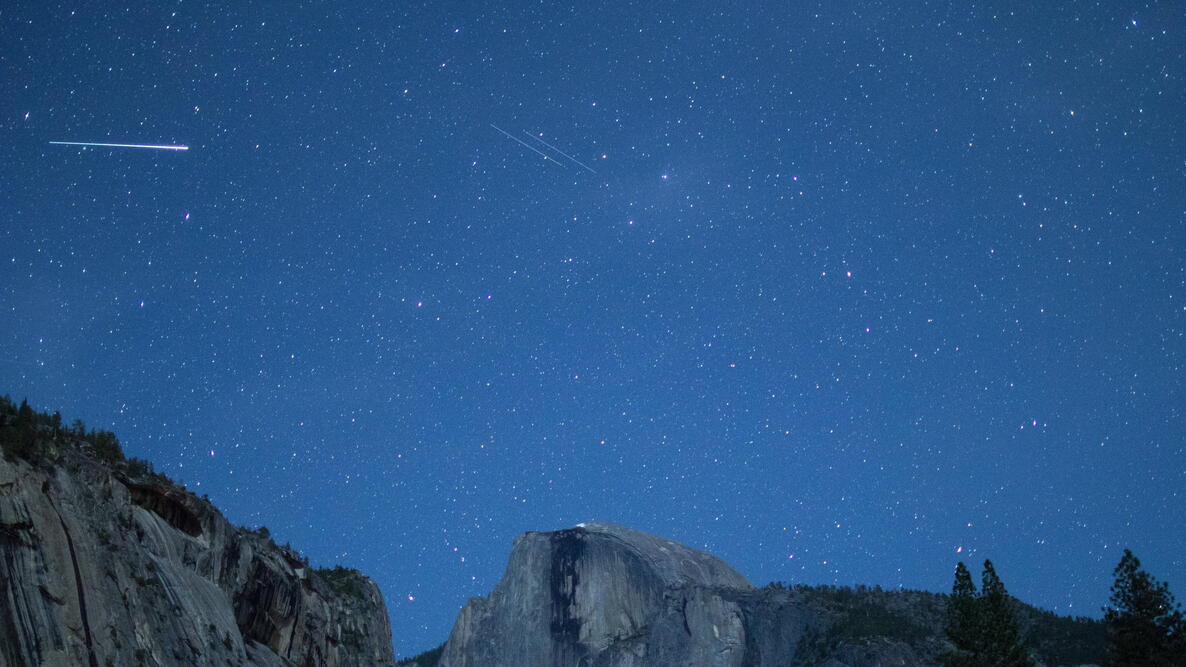
Caption
Eta Aquarids fireball and twin meteors over Half Dome, California, Yosemite National Park.

May offers skywatchers a delightful spectacle of celestial events! From dazzling planetary conjunctions to the vibrant Eta Aquarid meteor shower, this month has something for every astronomy enthusiast. Mark your calendars and get ready to witness the wonders of the night sky! Here are details from longtime Almanac astronomer Bob Berman.
Key Dates This Month
- May 1 - A May Day Full Moon (Flower Moon)
- May 4 - Eta Aquarid meteor shower
- May 18 - Venus makes a stunning conjunction with the Moon
- May 30 - The Moon meets up with red supergiant stat Antares
- May 31 - Full Moon (Blue Moon)
The Moon This Month
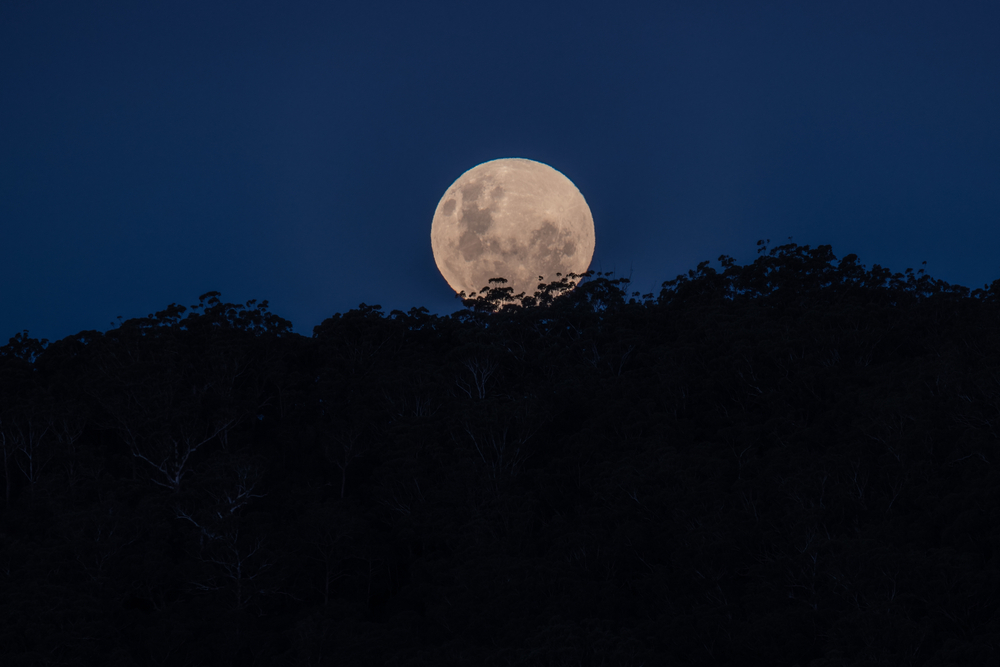
May with have not one, but TWO Full Moons, making this an extra special month. On May 1, the Full Flower Moon with reach peak illumination at 1:23 P.M. Then, on May 31, the Blue Moon will be at its peak at 4:45 A.M.
While traditionally the Full Moon in May is known as the Full Flower Moon, other names for this Full Moon point full speed ahead to warmer weather, including the Budding Moon, the Planting Moon, and the Shedding Pony Moon (one of my personal favorites!). Learn more about the Full Flower Moon.
You won’t want to miss a spectacular sight on May 30, when a nearly Full Moon, rising in the southeast at 10:00 P.M., will stand to the right of the red supergiant star, Antares in Scorpius.
See your local Moon phase calendar!
Planets to Watch
Venus and Jupiter will be visible for most of the month after sunset, around 8:15 to 8:30 P.M. to the west.
On May 1, Venus and Jupiter will form a perfect triangle with the bluish star Sirius, also known as the “Dog Star.” Then, in the middle of the month, the two planets (or the night’s brightest “stars) will move closer and closer to each other each evening.
On May 18, the Moon will form a stunning conjunction with Venus. On the next night, the Moon will hover between Venus and Jupiter. Then, on May 20, the Moon will stand about the giant planet, Jupiter. Each meeting will look best around 8:30 and 9:00 P.M.
Find out what planets are visible tonight from your location—and the best time to look.
Meteor Showers
The Eta Aquarids meteor shower, dust and debris from Halley’s Comet, occurs on the morning of May 4 during the predawn hours. According to NASA, “The Eta Aquarid meteors are known for their speed, with the meteors traveling at about 148,000 mph (66 km/s) into Earth’s atmosphere.”
The Moon will be in a waning gibbous phase, making it difficult to see the dimmer meteors. Unless you are an avid star watcher (or suffering from insomnia), it may not be worth waking up to watch these. See our Meteor Shower Calendar for details.
Enjoy the increasing sunlight! By the end of May, we’ll have 15 hours between sunrise and sunset! (It was 14 hours at the start of the month.) The days will get longer until the summer solstice on June 21.
See the sunrise and sunset times (and the changing day length) where you live.

More Like This

Yes, Mars is defined as an inner planet. The inner planets, or terrestrial planets, are the four planets closest to the Sun: Mercury, Venus, Earth, and Mars. They orbits are within the asteroid belt and rocky. The outer planets are further away, larger and made up mostly of gas.
Learn more: https://solarsystem.nasa.gov/planets/overview/

Comments