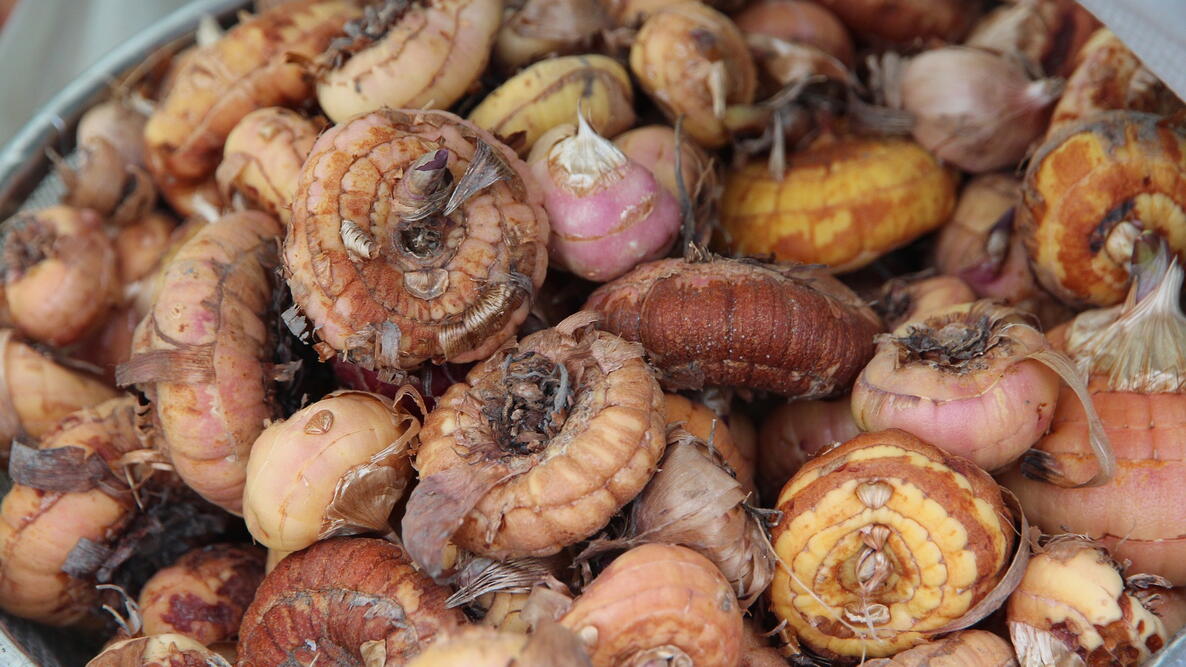

Some flower bulbs will not survive cold winters and need to be dug up and stored indoors over winter. Among these are cannas, elephant ears, gladiolus, tuberous begonias, dahlias, and other summer favorites. Many of these bulbs are expensive, yet they’re easy to keep, so it is worth it! Here’s how to store bulbs over winter.
What Are Tender Bulbs and Why Save Them?
Unlike spring bulbs, your summer-flowering favorites all grow from a type of underground storage structure—be it a corm, tuber, rhizome, bulb, or root.
We call them all tender bulbs even if they’re not all technically bulbs. What they have in common is needing a little special treatment to save for the next growing season. The most important thing is to keep them dry and cool and not to let them get too cold before or during storage.
By mid-fall, many of us have had at least one light frost, so it is time to remove those tender bulbs from the garden and pack them away for next season!
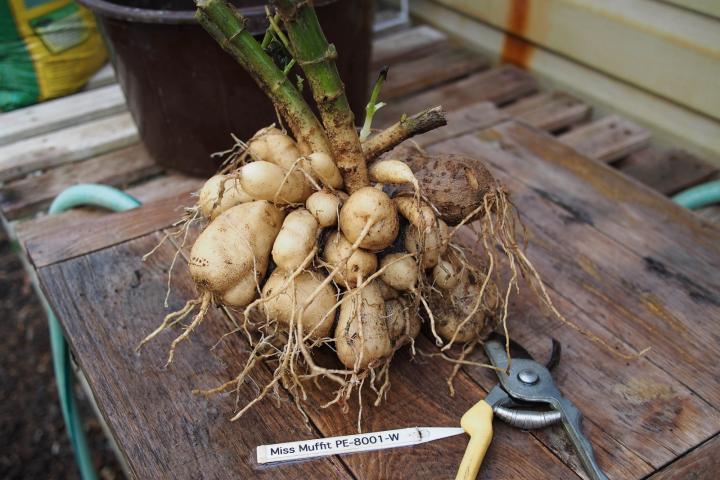
Which Bulbs Need to Be Dug Up Before Winter?
Popular tender bulbs that may need winter care include:
- Amaryllis (Hippeastrum, bulb): Hardy to Zone 9 (blooms indoors in winter)
- Caladium (Caladium sp., tuber): Hardy to Zone 9
- Calla Lily (Calla sp., rhizome): Hardy to Zone 7
- Canna Lily (Canna sp., rhizome): Hardy to Zone 7
- Dahlia (Dahlia sp., tuberous root): Hardy to Zone 8
- Elephant Ear (Alocasia sp., tuber): Hardy to Zone 9
- Gladiolus (Gladiolus sp., corm): Hardy to Zone 8
- Tuberous Begonia (Begonia x tuberhybrida, tuberous root): Hardy Zone 10
Overwintering Pots
I grow many of these as potted plants so that they can be easily overwintered by hauling them inside, cutting back the foliage, letting the pots dry out to simulate the dry season conditions of their native lands, and storing them out of the sun in a cool, dry spot where they will not freeze.
Digging and Lifting Flower Bulbs
If they are growing in the ground, they will need a few more steps to get them ready for their winter nap. Generally, they need to be dug after the foliage begins to die back, usually after the first frost. Note: If the foliage is killed by frost, the bulb needs to be dug within a few days to make sure rot doesn’t set in.
Dig carefully so as not to injure the bulbs. Wounds on the outside of bulbs may encourage rotting. A digging fork can be helpful (versus a shovel). Dig several inches away from the plant to avoid injury, and then loosen the roots gently. Lift the clump.
Wash the soil off the bulbs with a gentle stream from the water hose, and put them in a warm, dry place to cure. Most need only 1 to 3 days of curing time before they can be packed away. Gladiolus and callas, however, need to be cured or dried for about 3 weeks.
How to Store Bulbs Over Winter (By Type)
You’ll pack away your bulbs in a cool, dry place. An unheated garage that does not freeze can work well. Just keep in mind the ideal location has temperatures between 35° and 45ºF and a relative humidity of about 50%.
You’ll pack the bulbs in a cardboard box (NOT an airtight container) or some other type of ventilated container. Store the bulbs between 2-inch layers of sand, sawdust, coir, or vermiculite. Ensure none of the bulbs touch each other.
Here are some specific digging and storing tips for each plant:
- Gladiolus: Don’t wash gladiolus corms with water before curing; let them dry in the sun for 1 to 2 days, cut the stems down to a few inches, brush off the soil, and put in a warm (60°–70°F) airy spot out of the direct sun for 3 weeks to cure. Remove any leftover dried pieces of the flower stalk, snap the old “mother” corm off from the bottom of the new corm, and discard it. Take the baby cormels off, too, saving only those that are the size of a quarter or larger. You can keep the cormels to raise if you want. (They need 2–4 years of growth to reach flowering size.) Gladiolus corms need a dry, cool spot, around 40°–45°F. We hang them up in the pantry in old mesh onion bags. If you think thrips may be a problem, soak the corms in a solution of 1 tablespoon of Lysol to 1 gallon of water for about 6 hours in the spring, then plant right away.
- Callas are another that doesn’t need to be washed. Just dry the bulbs for about a week in a warm location, remove the old stems, brush off the loose soil, and pack in layers of slightly moist peat moss or vermiculite in a cardboard box or paper bag so the bulbs are not touching. Store at 45°–55°F. Check for rotting or dehydration. If they start to shrivel, lightly moisten the packing material.
- Dahlias: After washing the clumps, let them dry overnight and then pack away in slightly moist cedar chips or peat moss or in a black plastic bag with lots of holes punched in it. They should not dry out completely, but they will rot if kept too wet. Store in a dark, cool spot, around 50°F. Check them a few times over the winter for rotting or shriveling. Wait until spring to divide the clumps. Each piece needs to have a section of the stem attached where the buds for next year’s plant will form.
- Cannas don’t like to dry out completely either. Just dry the roots for 1–2 days to get most of the soil off. Like dahlias, pack in barely moist vermiculite, peat moss, or cedar chips and store at 40°–50°F.
- Tuberous begonias are too pretty to lose to cold weather. Once the tops have died back, remove the dead stems, dig the tubers, and spread them out in a sunny, dry place for about two weeks to cure. Store uncovered, in a single layer, at about 45°–55°F.
- Caladiums like it a little warmer in winter storage. Remove the old foliage, dry the tubers in a warm location for about 1 week, then store in vermiculite or peat moss at 60°F.
- Colocasia and alocasia—the elephant ears—grow from huge (and often expensive) bulbs, so it is nice to be able to carry them over from season to season. They also prefer warmer storage temperatures. After the tops die back, dig them and leave them in the sun to dry for a few days. Brush off the soil and store in peat moss at about 70°F.
Check all the sleeping beauties a few times over the winter to ensure none are rotting or dehydrating. Remove any that have spoiled to keep them from ruining the whole lot. If the packing material seems too wet, replace it with dry material. If they show signs of shriveling, mist them lightly. Like Goldilocks, they need it to be just right!
Frequently Asked Questions
Can I leave dahlias in the ground over winter?
Only in mild climates (Zones 8–10). In colder regions, dig and store them indoors.
What’s the best temperature to store bulbs over winter?
Between 35° and 50°F, depending on the bulb type.
How do I know if my stored bulbs are rotting?
Check monthly—discard any soft, moldy, or shriveled bulbs to prevent spread.
Can I store bulbs in the fridge?
Not recommended unless the fridge is dedicated—ethylene from produce can harm bulbs.
When should I replant stored bulbs?
Replant in spring after the last frost when soil temperatures warm up.
Read more about bringing outdoor plants indoors for late fall and winter!

More Like This



We are sorry to here that. Stay strong.
You can store up to one year if stored correctly.
Hi Amanda,
It really depends on the variety because some are winter hardy to Zone 8 and possibly even 7b given the right conditions. Given the fact they are growing wild along the river, and if you see them year after year, it is probably likely that they will survive your winter conditions, but nothing is a guarantee because of the variables that come with transplanting and moving to a new growing area.
You also want to be careful about digging up plants on property that does not belong to you. If the river is not located on your property, the best thing to do is to contact the landowner or the state/county/town to get permission before taking any plants.

Comments