
Photo Credit
Myroslava Bozhko/Shutterstock
Subhead
A Beginner-Friendly Houseplant That’s Nearly Impossible to Kill

Read Next
Planting
How to Plant Snake Plants
- Choose a pot with a drainage hole in the bottom. Terracotta pots work well for snake plants since they allow the soil to dry out more quickly than plastic pots.
- Use a well-draining potting mix. A potting mix designed for cacti and succulents is ideal, as it will be more resistant to becoming oversaturated with water.
- When repotting snake plants, don’t bury them too deep. The plant should be planted as deep as it had been in its prior container.
Choosing a Location in the Home
- Snake plants prefer bright, indirect light and can even tolerate some direct sunlight. However, they also grow well (albeit more slowly) in shady corners and other low-light areas of the home.
- Tip: Avoid moving your plant from a low-light area to direct sunlight too quickly, as this can shock the plant. Whenever you move plants from a darker to a lighter spot, gradually expose them to brighter and brighter light over a week or so. Also, be sure to adjust watering habits accordingly; plants will use more water in warmer, brighter areas.
- Keep the plant in a warm spot with temperatures above 50°F (10°C). In the winter, protect it from drafty windows.
Types
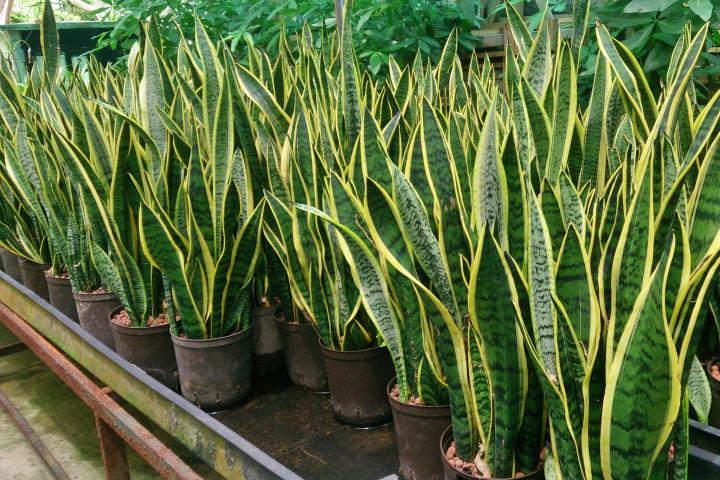
- Dracaena trifasciata (aka Sansevieria trifasciata) is the most common species of snake plant. It has tall, dark-green leaves with light grayish-green horizontal stripes.
- ‘Bantel’s Sensation’ — Narrow leaves have white vertical stripes and grow to about 3 feet long. This variety can be hard to find.
- D. hahnii:
- ‘Bird’s Nest’ — Short, wide leaves of dark and light green form a tight nest shape like a bromeliad. Leaves only grow 6 to 8 inches long. This variety does need much light to grow well.
- ‘Golden Hahnii’ — Like the standard ‘Bird’s Nest’ but with leaves variegated along the edge in yellow.
- D. cylindrica:
- ‘Cylindrical Snake Plant’ — As its name suggests, this species of snake plant has cylindrical leaves that end in a fierce point.
- ‘Starfish Snake Plant’ — The starfish snake plant has cylindrical leaves that fan out from its base, giving it a starfish-like shape.
- D. masoniana:
- ‘Whale Fin’ — These interesting snake plants have large, wide leaves that resemble the fin of a whale breaching the water’s surface.
Gardening Products

More Like This




Comments
From this paragraph
Water from the bottom of the pot, if possible. This encourage the roots
Please correct to read
encourages the roots
Thank you so much!
Why are the leaves of my snake plant curling?

Some snake plants' leaves have a natural curl or ripple to them, so make sure that that's not the case with yours before making any changes to your care habits. Severely curling leaves can indicate that the plant is not getting enough water—this is the snake plant's version of shriveling up from dehydration. It can also be caused by lighting issues; with too little light, the plant doesn't have the strength to hold up its firm leaves.
I tried propagating Snake Plant cuttings through the water method. The cuttings, each 2 inches long, were allowed to callus for a day & then the cut ends were placed in water. It is over 40 days and I see no root formation. But the cuttings are fine and have not rotted. Do I have to wait longer for roots to form? How long does it normally take to root using this method? I live in the south of India & it's summer time now. Pls suggest.
My leaves are about 2.5 to 3 feet. Why are they starting to droop?
Sometimes older leaves that get tall just happen to start leaning—the snake plant's dense leaves aren't necessarily the most structurally sound past a certain height! That said, if the leaves are soft or are starting to really bend in half, then that points to an issue, potentially.
- Assess your watering habits. If you're watering too much and not letting the plant dry out a bit between waterings, then the leaves could start to rot; they'll get soft and start to droop. On the flip side, if you're watering too little, this can weaken leaves as well. Make sure that you're watering deeply (meaning that the water reaches the roots of the plant) and letting the soil dry out a bit between these deep waterings.
- Another cause could be lighting. Too little light can weaken the plant over time. However, it sounds like the plant has large leaves, which suggests that it has had sufficient light to grow.
- Finally, it could have to do with nutrients in the soil. Plants need nutrients to maintain and grow their leaves, roots, and so on, so consider purchasing and using a cacti and succulent fertilizer or a diluted 10-10-10 general purpose liquid fertilizer. Follow instructions on the packaging.
I wish it would add in the description if these plants are safe to have around your dog and cats. I only buy, both for outdoor and indoor, plants that are safe for my fur babies. Does anyone know if this one is ok to have with animals around?
I've always heard it called mother-in-law's tongue, and I bought a pot of it for my husband shortly after we got married :-)
There were 3 or 4 plants in the pot, and they've always done just OK; once in a long while a new crown erupts. I've always kept it in moderate light, not too near windows. We moved a couple of years ago, and I installed it in a niche in the master bath near a western window. After about a year it suddenly took off. I guess it likes this particular indoor environment!
I didn't even know the plant could bloom, but a few months ago it surprised me. I didn't notice much fragrance, but FYI, the blooms were extremely sticky, which spread to all the nearby leaves. One of these days I'll set it in the bathtub and give it a shower.
I mistakenly thought it was a Bromeliad, so I've always watered into the center of the crowns. Doesn't seem to have hurt it!
I have a plant that I received at my fathers funeral in 1996 which I have transplanted into larger pots and it is now about five tall. Every spring I set it outside in a semi sunny area and every fall I bring in back into the house. I water it about once every ten days and do nothing more to it - should I be feeding it? Since I have never seen it flower does that mean it is not root bound?
- « Previous
- 1
- 2
- …
- 10
- Next »
📣The Gardening Club Just Got Better! 3 Deliveries, 10% Store Discount, and more!

Give it some time to recover on its own. Refrain from watering for a bit and prune off leaves that turn yellow. Consider moving it into brighter light (but not direct sunlight) as well, since drooping leaves can be a sign of weakness due to lack of light.