
Growing Spider Plants: Watering, Lighting, Propagation, and Pests

Read Next
Growing
- During initial growth, water occasionally; once fully developed (within one year), water moderately.
- In the spring and summer months, keep the soil moist to encourage growth. Do not let the soil dry out too much.
- Maintain average room temperature and humidity. Spider plants prefer temperatures between 55° and 80°F (13° to 27°C), which makes them a great indoor houseplant.
- Fertilize twice a month in the spring and summer; however, avoid overfertilization.
- See more Houseplant Growing Tips.
Types
- The most common varieties are the variegated forms:
- ‘Vittatum’ has green foliage with a single off-white stripe down the center of each leaf.
- ‘Variegatum’ is the inverse of ‘Vittatum’, with an off-white stripe running along the edge of each green leaf.
- Solid green varieties are also available.
Gardening Products

More Like This



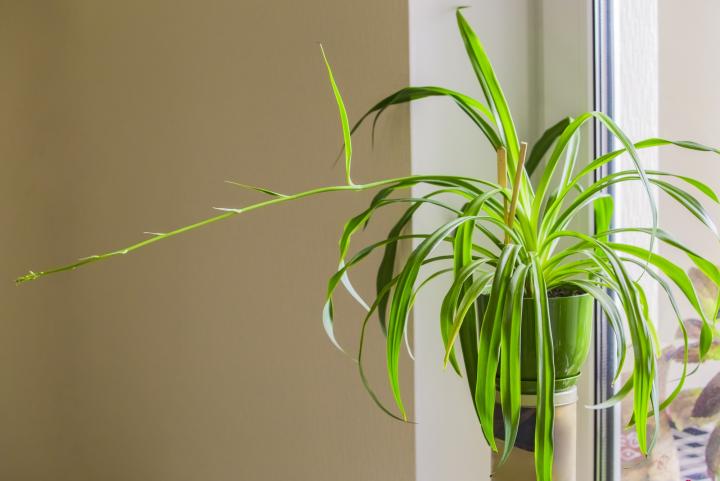
In their native habitat, in southern Africa, spider plants spread along the ground. When they form a flowering stalk, a baby plant forms on top with tiny roots; eventually, the stalk (or scape) will bend over and the baby will root in the soil. Eventually, there will be a mass of spider plants forming a groundcover. The spider plant does not have tendrils or other features to help it cling to vertical surfaces. However, you can certainly attach the scape (or "runner") to a vertical surface with ties.
Another option is to remove some of the babies--cut the "runner" off close to the base of the mother plant, as well as just before the baby. Plant the baby in soil or place in water until it develops strong roots and then transplant to a pot filled with soil. Once the babies have established, you can keep them or give them to friends.
Spider plants tend to form babies if the mother plant is potbound. If you'd like to stop or slow the formation of new plants, check to see if the mother plant needs repotting.
Spider plants do need access to sunlight. It's not important if it's direct or indirect light, but the Sun needs to brighten the room. It also needs real sunlight because growth responds to length of day. Hope this helps.

Comments