
DIY Potting Soil Recipe to Save Money

Learn how to make your own soilless potting mix at home! Commercial bagged soils are pricey, and if you use a lot, can add up to significant costs. They also vary greatly in quality and, in some cases, their fertilizer strength can be toxic to plants and cause burns to plant roots. It’s satisfying to make your own mix to give your plants a healthy start—and it leads to fewer headaches. Here’s our basic DIY potting mix recipe.
Containers are great for several reasons—they’re versatile and space-saving, and they allow you to be more efficient in your use of resources. If you have a small garden space or live in an apartment with a balcony or rooftop, containers are for you.
What Is Potting Mix?
For containers, you’ll often read that you need to buy or make a good potting mix. But what does this mean?
Potting mix is not garden soil—which is heavy and includes sand, clay, and other cheaper additives that won’t work for containers. Some people may refer to it as potting soil, yet potting mix is soilless. It’s lighter and fluffier than ground soil to allow enough air and water for healthy root growth and also provides enough anchorage for roots. These soilless mixes are sterile, so there is no chance of introducing pest or disease problems.
Potting mix can certainly be bought in bags at garden stores. Look for “Soilless Potting Mix,” which generally includes three ingredients: 1) peat moss or coconut coir for moisture and nutrient retention, 2) pine bark for anchorage, and 3) either perlite or vermiculite for air space, which makes the texture light and fluffy. Some potting mix also includes fertilizer or moisture-retaining treatments. If you use a potting mix with fertilizer, you’ll need to adjust the fertilizer you provide. (Think of salted butter versus unsalted butter in a recipe!)
But many gardeners who plant a LOT of containers or raised beds or start seeds indoors will mix up their own potting mixes! For the number of containers I use in my garden, I learned long ago that it’s much cheaper to make my own potting mix and store it in an extra trash can rather than pay for several big sacks of premade potting mix. Plus, I can customize the mix for a variety of different plants.
Before Making Your Own Potting Mix
Before we go any further, note that if you only need a few small containers’ worth of potting mix, you may actually be better off buying a premade mix! Making your own is usually only economical on a large scale. Here are a few things to keep in mind before creating your own mix:
- When it comes to any potting mix, the lighter it is, the better. Loose and porous mixtures not only make a container lighter to move, but they also transport water, fertilizer, and air to plant roots more quickly and allow for good drainage, which is important for container gardening.
- Start with the basic recipe below and then add soil sulfur to lower the pH or lime to raise the pH, according to the needs of your plants. Both additives can typically be found at garden centers. Plants such as lettuce, Russian sage, and marigolds prefer sweet soil with a pH of about 7.5, while others are acid lovers, like ferns, asters, and strawberries. They need a pH of about 5.5 to 6.0. Here’s a list of more plants’ pH preferences.
- If rapid drainage is needed, as is the case for cacti, succulents, and lavender, add extra sand and perlite.
- If greater moisture retention is needed, as is the case for ferns and woodland flowers (like primrose) add extra vermiculite or coconut coir.
My Basic Container Potting Mix Recipe
Ingredients
- 1 bucket (10 quarts) coconut coir
- 1/2 bucket (5 quarts) perlite
- 1/2 bucket (5 quarts) vermiculite
- 1/2 bucket (5 quarts) screened compost or composted cow manure
- 2 cups fine sand
- 2 cups pelleted time-release fertilizer
Instructions
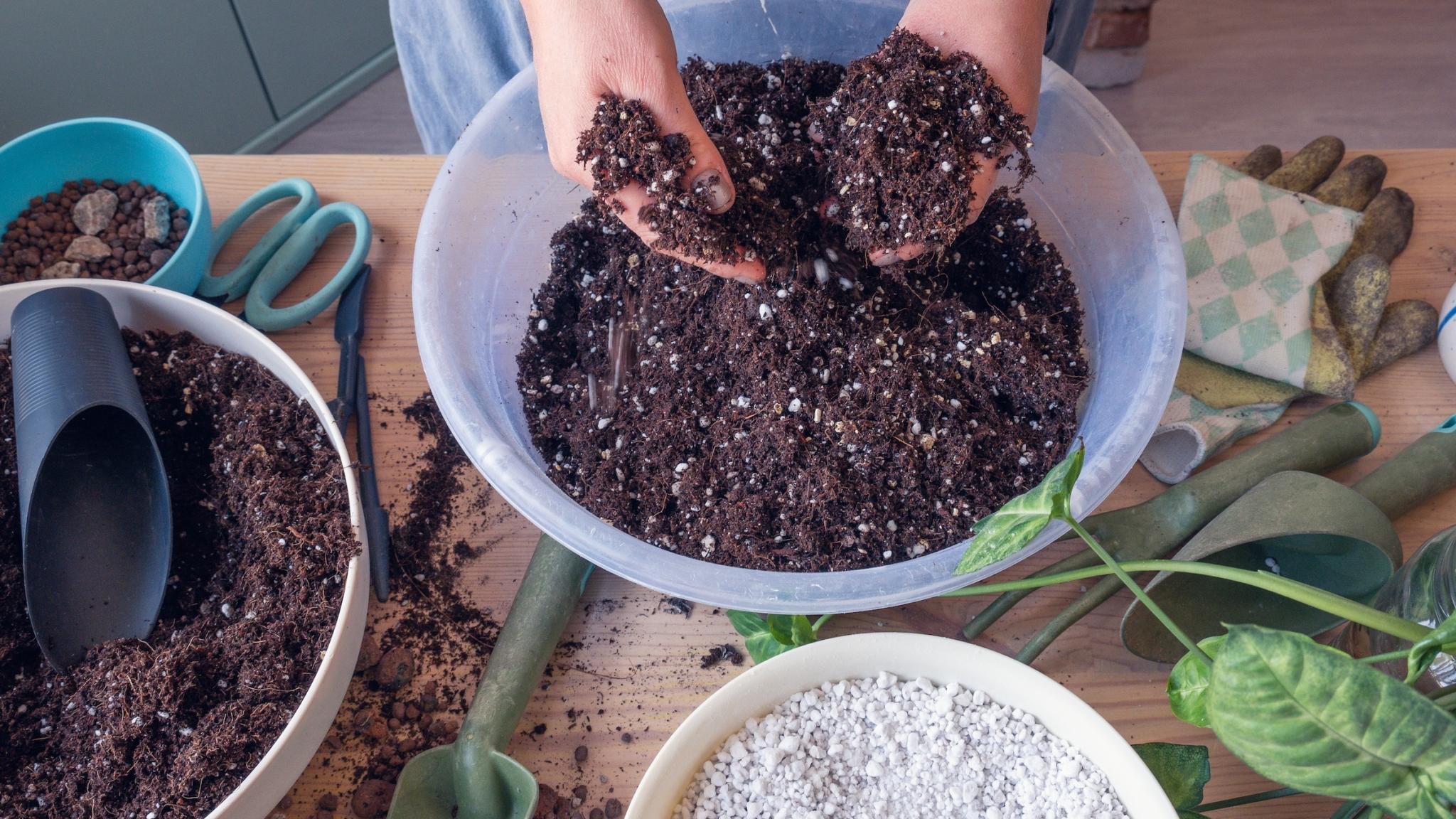
Mix thoroughly. It makes enough to fill two 14-inch tubs or five 12-inch hanging baskets—double or triple the recipe for bigger containers.
Credit: Cem Selvi
How Much Potting Mix Do I Need?
Take out the guesswork and use our soil calculator for containers.
Potting mix is sold by volume (typically measured in quarts), and most pots are measured by their diameter. To translate quarts of mix into various pot sizes, use this quick reference:
Pots & Tubs | |
|---|---|
| Container Size | Amount Needed |
| 8-inch | 3 quarts |
| 10-inch | 6 quarts |
| 12-inch | 8 quarts |
| 14-inch | 12 quarts |
| 16-inch | 20 quarts |
| 20-inch | 24 quarts |
| 24-inch | 28 quarts |
| 30-inch | 72 quarts |
| 36-inch | 96 quarts |
Hanging Baskets | |
| 12-inch | 6 quarts |
| 16-inch | 10 quarts |
Window Boxes | |
| 24 inches by 6 inches | 12 quarts |
| 36 inches by 6 inches | 20 quarts |
Learn More
Here’s another potting mix recipe for seed-starting—with a video demonstration!
See our Plant Growing Guides for advice on planting and growing popular vegetables, fruits, and flowers!
Do you make your own potting mix? Share your recipe in the comments below!
More Like This



Comments
This recipe won't work in the garden. You can augment your soil with compost or manure, peat (if you need more acid) and shredded leaves. Simply layer the materials over the existing ground and mulch with the leaves or finely shredded bark. All are organic and will break down into nutrients during the growing season. BTW, roses love peat, as they flourish in a slightly acid soil. So do raspberries, blueberries and strawberries. Also spread your coffee grounds around them. Some rose experts suggest burying banana peels at the base of rose bushes to supply magnesium.
Nothing is missing, Jennifer. I left out the peat in the initial posting of the blog. We corrected that error after readers brought it to our attention. The recipe, as written above, is correct. Sorry for the confusion.
As a number of readers noticed, I left out the first ingredient in the potting mix recipe. Please add this to the mix: 1 bucket (2-1/2 gallons) peat moss. My apologies for not proof-reading the post thoroughly.
Shamrocks (oxalis) are bulbs. The foliage dying naturally is part of the cycle after blooming. Let the plant die, the container dry out and then dig up the little bulbs. Store them in dry peat moss in a dark area. Plant bulbs about 2 inches deep in pots at the end of August or in September. Water well and place in a sunny window. Bulbs will sprout and the cycle will begin again.
- « Previous
- 1
- 2
- …
- 10
- Next »

Multiply 6 by 2 by .5, which is 6. That's how many quarts you need.