
Planting, Growing, and Harvesting Sweet Potatoes

Ready to grow something sweet in your garden? Sweet potatoes aren’t just tasty and nutritious—they’re garden rock stars! With their tropical vibes, sprawling vines, and vibrant orange roots, these heat-loving plants thrive with minimal fuss. Whether you’re in the sunny South or giving them a go up North with raised beds and clever hacks, we’ll show you how to turn a humble root into a delicious harvest.
This nutritious, sweet-tasting root vegetable is heat-tolerant and pest-resistant. Here is everything you need to know about growing sweet potatoes.
Though commonly grown in the South because they require warm weather, sweet potatoes can be successfully grown in northern regions, too. See our advice on which varieties to choose below.
About Sweet Potatoes
The sweet potato is a tropical plant and is actually a member of the Morning Glory family. Compare a sweet potato vine’s foliage and flowers to those of morning glory, and you’ll see the family resemblance! Despite their name, they are not related to potatoes, which are in the nightshade family. Another difference between sweet potatoes and “standard” potatoes is that the edible portion of the sweet potato is a tuberous root, not a true tuber (which are technically modified plant stems).
This root vegetable has deep-orange flesh and a coppery skin jacket. Sweet potatoes are commonly served cooked in mashed form or roasted whole. They may also be used as pie filling.
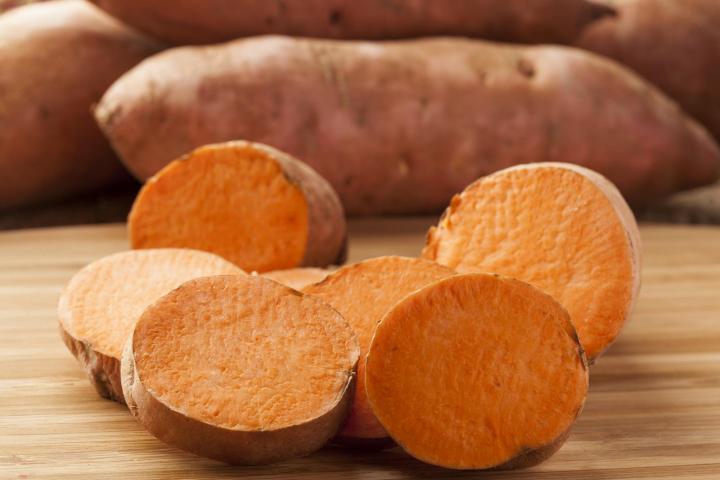
This tropical crop needs at least 4 months of warm weather and warm soil, but they are drought- and heat-tolerant and have few pests or diseases. Although traditionally a southern crop, many short-season sweet potato varieties exist today. They will grow in the North (even parts of Canada!) when grown in sandy soil or raised beds mulched with black plastic to keep the soil warm.
Sweet Potato Slips
Note that sweet potatoes are not grown from seed. Instead, they’re grown from slips, which are sprouts from existing sweet potatoes. Slips are often available at local garden centers and nurseries, from local farmers (such as farmers’ markets), or mail-order companies. Or you can start your own (see below).
Before you order slips, please make sure that you have a long enough growing season to grow sweet potatoes. Most varieties will take about 90 to 120 days to mature. See your frost dates and length of growing season. Also, ensure you time your order with your planting dates in mind!
Read Next
Planting
Where to Plant
Choose a sunny spot with well-draining soil. Sweet potatoes aren’t too picky, but they do prefer soil on the sandier side. They need plenty of air space for their roots to reach down. If your soil is clayey, rocky, or compacted, consider growing in raised beds.
Add compost, perlite, and/or coconut coir to the growing area to build fertile, loamy soil down to 8 to 10 inches. Avoid adding animal manure, including pelleted chicken manure; it can result in spindly and/or stained roots. Also, avoid heavy nitrogen fertilizers, which produce lush leaf growth at the expense of the edible roots!
If you ordered slips from a mail-order source, unpack them right away. Stick the roots in water for a day or so, and they’ll perk up. Plant them as soon as conditions are right.
When to Plant Sweet Potatoes
- Transplant sweet potato slips outdoors, 3 to 4 weeks after your last spring frost or once the soil has warmed to at least 65°F (18°C). Nighttime temperatures should be at least 55°F (13°C). The trick is to plant them early enough to have time to mature fully, but not so early that they get killed by a late spring frost.
- Young sweet potatoes are very tender, so they must be protected from late frosts or cool nights (lower than 55°F/13°C). Cover them with plastic milk jugs or row covers, removing the covers during the day.
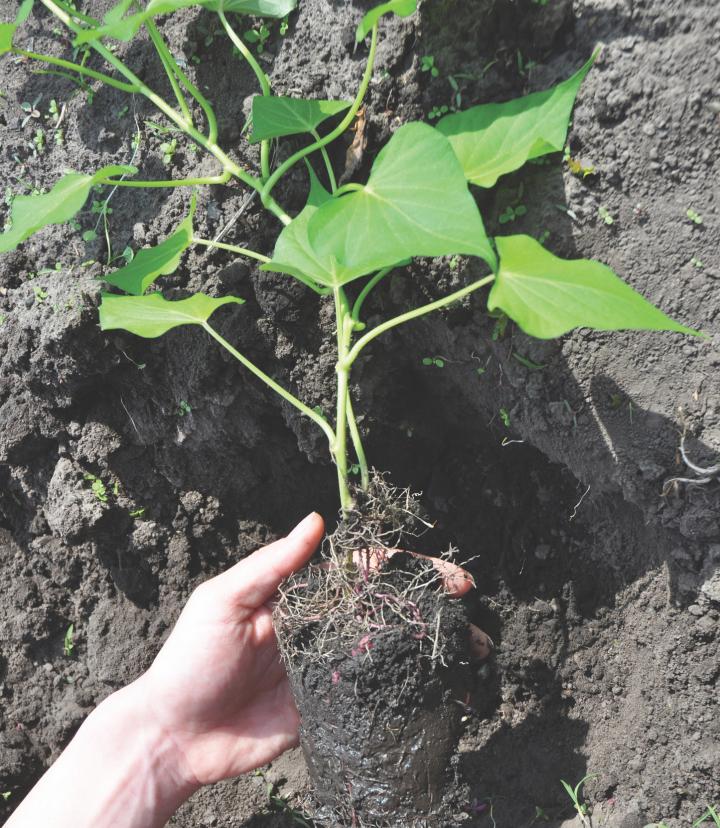
Credit: Lex20/Getty Images.
How to Grow Your Own Sweet Potato Slips
You can start your own slips instead of buying them, but it’s more work. Here’s how:
- About 8 weeks before your last spring frost date, look for unblemished, smooth, organic sweet potatoes at the store or farmers’ market. Be sure to ask about the variety and check that it’s one you want to grow.
- Place whole sweet potatoes in pots or bins that contain at least 3 inches of light, organic, well-draining soil. Leave an inch or two of space between each sweet potato.
- Lightly cover with a few inches of additional soil. Water now and as needed to keep soil damp but not soggy.
- Maintain the soil and the room at 75°F to 80°F in sunlight or under artificial lights. Use a heating mat if necessary; sweet potatoes respond well to warm temperatures.
- Soon, slips (shoots) will emerge from the soil.
- After about 6 to 8 weeks, the slips should be between 6 and 12 inches long, with a number of leaves and roots.
- Remove the slips from the sweet potatoes with roots attached. (If no roots have formed on the slip itself, remove the slip and place it in water; roots should appear in 1 to 2 weeks.)
- If it is still too soon to plant outdoors, stand the slips in potting mix or sand and keep them moist until the right planting time (3 to 4 weeks after the last frost).
- Harden off the slips (before planting outdoors) for 1 to 2 weeks by exposing them to filtered sunlight outdoors during the day.
How to Plant Sweet Potatoes
- Create raised mounds 6 to 8 inches tall and about 12 inches wide.
- Plan 3 feet between mounds so there is enough space for vines to run.
- Plant the slips on a warm, overcast day when the soil temperature has reached 60°F (15°C).
- Break off the lower leaves, leaving only the top ones.
- Set the slips deep enough to cover the roots and the stem up to the leaves. Sweet potatoes will form on the nodes.
- Water with a high-phosphorus liquid fertilizer, then water generously for 7 to 10 days to make sure that the plants root well.
Growing
- Side-dress the sweet potato plants 3 to 4 weeks after transplanting with 5-10-10 fertilizer. If you have sandy soil, use more.
- Weed the sweet potato beds regularly, starting 2 weeks after planting.
- Avoid deep digging with a hoe or other tool that disturbs the delicate feeder roots.
- Water regularly, especially during midsummer. Deep watering in hot, dry periods will help to increase yields.
- Do not prune sweet potato vines; they should be vigorous.
- Late in the season, reduce watering to avoid cracking of the sweet’s skin—a problem in storage.
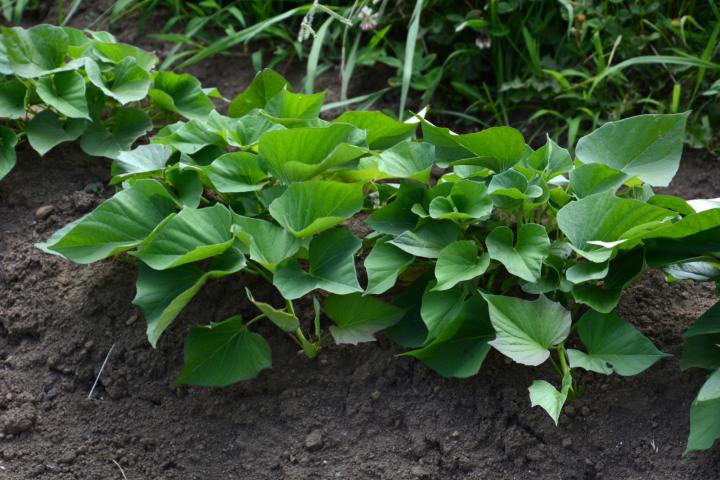
Credit: Getty Images.
Growing Sweet Potatoes in Containers
Bush-type sweet potato plants are ideal for container growers. The vines that they produce are short and compact, not sprawling like typical sweets—but the roots are full size, not miniatures.
While slips mature, prepare a large container or tub. (A too-small container can result in small, curly sweets or fewer than hoped for.) A 10-gallon container can support two or three sweet potatoes; a 20-gallon, four to six. A half-barrel container (20 to 25 gallons) is ideal. Place the container where it will receive full sunlight every day. (It will be heavy to move once filled and planted.)
Sweets like moist but not wet soil; the medium must be well-draining and rich; sweets are also heavy feeders. Provide potting mix amended with compost, sand, bonemeal (for potassium), and wood ash (for potash). Minimize nitrogen or risk producing heavily leafy tops and spindly roots. If you purchase a bush variety, soak the roots in water for a few hours before planting.
Plant slips 3 to 4 weeks after the last spring frost, when the soil has warmed to 65°F and nighttime temperatures are at least 55°F. Mulch with black plastic before and during the season, if necessary, to capture or retain heat. Set slips 4 inches deep on a bed of compost, then cover up to their bottom leaves. Water with a high-phosphorus liquid fertilizer (5-10-10) for 7 to 10 days to ensure that the plants root well.
Types
The fastest-growing sweet potato varieties have orange flesh, but you might also consider varieties with white, yellow, or even purple flesh. Note that orange-flesh varieties cook up moist; white and yellow sweet potatoes become creamy; purple sweets are dry and starchy.
- ‘Beauregard’ (90 days) originally comes from Louisiana, but grows well in the North, too. It has dark red roots, dark orange flesh, and stores well.
- ‘Bush Porto Rico’ (110 days) is good for small gardens and for baking.
- ’Centennial’ (100 days) is the leading variety in the U.S. It is carrot-colored and has a good storage life; good producer for northern growers.
- ‘Georgia Jet’ (90 days) has red skin that covers moist, deep orange flesh. It is an extremely fast-growing type; good for the North.
- ‘Jewel’ (120 days) has copper-colored skin and orange flesh; disease-resistant; stores well.
- ‘Stokes’ (120 days) offers a vibrant purple color and is full of extra health benefits; cooks well in savory dishes and mashes.
- ‘Vardaman’ (110 days) is a bush type and good for small gardens; it has unique blue/purple foliage, golden skin, and reddish-orange flesh; stores well.
- ‘White Yam’ (aka ‘White Triumph’)(100 days)has white skin covering dry white flesh; one of the oldest sweet potato varieties; has compact vines.
Harvesting
- You can start digging up the roots when they are big enough for a meal.
- Harvest when the leaves and ends of the vines have started turning yellow or about 100 days from planting.
- Loosen the soil around each plant (18 inches around, 4 to 6 inches deep) to avoid injuring the roots. Cut away some of the vines.
- Pull up the plant’s primary crown and dig the roots by hand. Handle the sweet potatoes carefully, as they bruise easily.
- Shake off any excess dirt; do not wash the roots.
- Complete harvesting by the first fall frost.
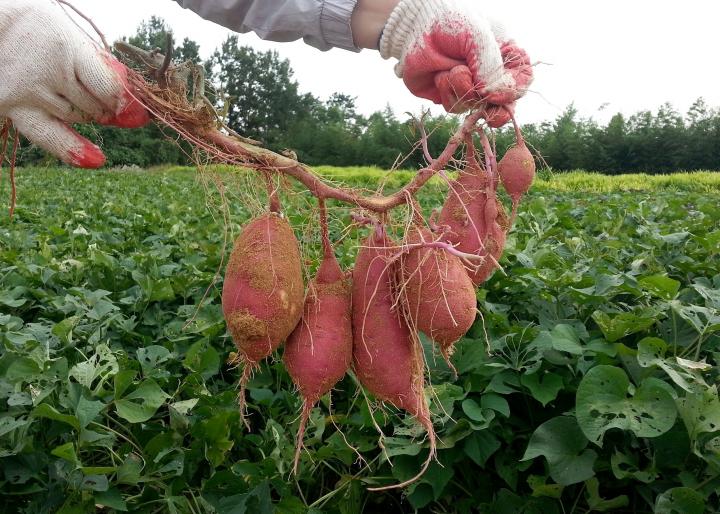
How to Cure and Store Sweet Potatoes
- Curing sweet potatoes gives them a sweet taste and also allows a second skin to form over scratches and bruises.
- Handle sweet potatoes carefully; they bruise easily.
- To cure, store roots in a warm place (about 80°F) at high humidity (about 90%) for 10 to 14 days. A table outside in a shady spot works well. Arrange sweet potatoes so that they are not touching.
- After curing, discard bruised sweet potatoes, then wrap each one in newspaper.
- Carefully pack in a wooden box or basket. Store in a root cellar, basement, or the like with a high humidity at 55° to 60°F.
- The roots should last in storage for about 6 months.
Gardening Products
Cooking Notes
Relatively low in calories, sweet potatoes are very nutritious, a top source of beta-carotene, and contain some protein, calcium, iron, vitamins A and C, and other minerals. They can be stored longer than winter squash.
To cook, sweet potatoes are easier than pie (or sweet potato pie!).
- They can be scrubbed, poked with a fork in a few places, and baked at 400°F for 35 minutes to 1 hour, until they give a bit when you squeeze them in your pot-holder–protected hand.
- In the microwave, a whole sweet potato baked on high should be ready in 4 to 6 minutes. It may still feel firm when done; let it stand for about 5 minutes to soften.
- Sweet potatoes can also be steamed whole (cleaned and unpeeled) for about 40 minutes or until tender or cooked whole (cleaned and unpeeled) in boiling salted water for about 35 minutes. (Boiling reduces the flavor considerably.)
- Immerse cut raw sweet potatoes in water until you’re ready to cook them; they will darken otherwise.
As a general rule, don’t substitute sweet potatoes for regular potatoes in recipes; the two aren’t related. Sweet potatoes don’t hold together the way potatoes do, and their strong flavor can overwhelm a dish meant for a milder potato taste. Sweet potatoes are also not related to yams. But they make a fine substitute for pumpkin, especially in desserts.
Check out our ten best sweet potato recipes!

More Like This



Just leave the vine as is, no need to cut anything off. You can harvest as soon as the leaves turn yellow, but some gardeners wait until after the first frost to dig the potatoes. The longer the potatoes are left in the ground, the higher the yield and vitamin content.
Hi, Helen, Lots to talk about here. First, the sweets on your counter, presumably from a grocery store, may have been treated with a sprout inhibitor (some potatoes are, too). You might seek out organic ones, ideally something that has started to send out slips—roots. If you can't find one of those, choose the freshest, least blemished one/s you can find.
Here's one option: Put the sweets into a warm, dry paper bag and see if any roots develop.
Or try this: Do not cut a sweet into pieces to plant. Instead, plant the entire organic tater (this step you could try concurrently with the bag, if you have enough sweets) in potting soil. It should sprout slips. When these reach several inches in length, you can cut them and a piece of the "mother" tater and plant separately.
You can also put the narrow end of the tater into a glass of water, holding the sweet in place on the rim by prodding it with toothpicks. Put it in the sun, and in about 10 days you should see growth at the bottom. For long green foliage to develop, cut off all of the weak slips/roots, leaving 2 or 3 strong ones, and plant it in potting soil.
Sweets indoors or out like warmth.
Good luck!
Sweet potatoes grow under the ground. In most areas, you dig up the potatoes around the time of the first frost in the fall. Some varieties flower though it's not common in most U.S. regions. The flowers attract pollinators which are a good thing!
Hi, Grace, Sources tell us that the best control of grasshoppers for a small crop such as your is hand picking, that a variety of natural enemies—bee flies, blister beetles, ground beetles, spiders, rodents, birds and disease—should keep them in check.
The last two pages of this Cochise CountyMaster Gardener newsletter from Nov 1999 describes the problem in particular in your vicinity:http://ag.arizona.edu/cochise/mg/pdf/Nov99.pdf You might also contact them for specific information.
You might also read and contact the source quoted, as he is in your area. According to this, your sweets should be thriving. We don't know what might be the challenge (in addition to the 'hoppers). http://post.uanews.arizona.edu/blog/sweet-potatoes-vs-yams
Finally, hope for a very cold winter. That would destroy the eggs.
- « Previous
- 1
- 2
- …
- 10
- Next »

Comments