
Identification
How to Identify Weevils
If you’ve ever fed waxworms to birds or used them as bait for ice fishing, you might think weevil larvae look the same. They are soft-bodied, creamy-white, grubby-looking worms with a hard, orange bit at the head. They are legless, or at least functionally legless, and are often described as C-shaped.

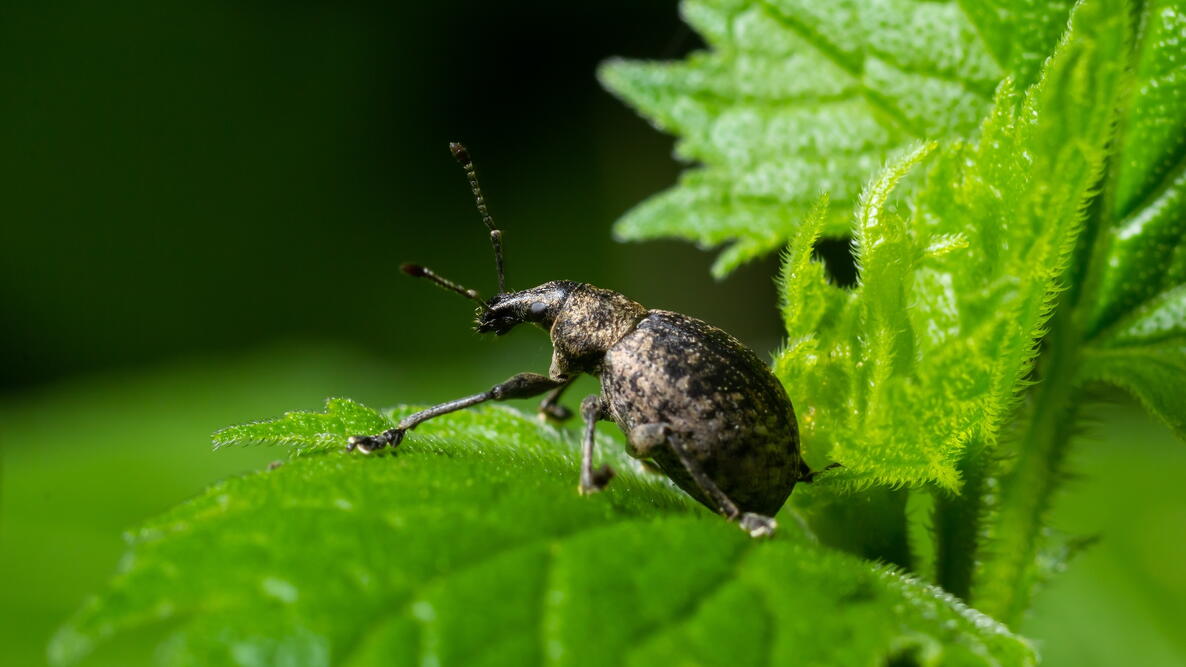
Adult weevils vary in appearance, based on which species you are viewing, but all of them share the characteristic beetle shape, although smaller, with a pronounced snout or “nose.”

Weevil adults are nocturnal and can be hard to spot. To scout for them, you’ll have to go out after dark. Spread a light-colored sheet under the plant, then give the plant a good shake and see what falls out. Gather up the bugs and head into the light for a closer look.
Root weevils can’t fly, but don’t let them walk off.
Identifying Weevil Damage
Adult weevils normally begin feeding from the edge of the leaf and leave notches, sometimes like the teeth on a saw, although not necessarily that well-spaced. A few munched leaves aren’t much cause for concern, and you might not even notice.
Weevil larvae feed on the roots of their preferred host plants. Higher larval populations can eat most of the fine feeder roots, reducing the plant’s ability to take up water and nutrients. You may also spot girdling of larger roots and even the crown.
Wilting and yellowing foliage are typical above-ground signs, consistent with the root damage to the plant.
| Symptom | Action |
|---|---|
| Notching of the leaf margins | Head out an hour after dark with a headlamp and handpick them from the plants. |
| Wilting and yellowing foliage | Reduce thick mulch and debris at the crown of ornamentals. |
| Girdling of larger roots | Any plants purchased should always be carefully inspected, not just for weevils, but for all manner of pests. |
Control and Prevention
How to Get Rid of Weevils
If you’re wondering how to get rid of weevils in the garden, start by confirming they’re the cause of the damage—then target them when they’re most active.
In the garden, head out an hour after dark with a headlamp and handpick them. They’ll be up on the plants, instead of down, hiding in the soil. They hide in the soil or debris on top of the soil during the day, and climb up on plants at night. Usually, they hide on the underside of the leaf.
For ornamentals, you can lay an old sheet down, knock them off, then gather and remove them.
In the garden, weevils are not often a serious pest, but they can cause issues during high population periods.
Any plants purchased should always be carefully inspected, not just for weevils, but for all manner of pests. When looking for weevils, check for notching of the leaf margins. If you see symptoms of adult weevil feeding (or the adult weevils themselves), put that plant back on the shelf. There may already be larvae in the soil.
How to Prevent Weevils
- Reduce thick mulch and debris at the crown of ornamentals. It’s good practice anyway to keep mulch away from the stems of shrubs and young trees, and in this case, it reduces hiding spots for the weevils.
Weevils Inside Homes
- If you find weevils in your house, grab the broom and dustpan, or suck them up with the vacuum.
- Weevils are known for invading our homes, but they don’t cause any damage, other than the ick factor. They don’t chew wood, make nests, bite, harm us or our pets, or do any of the other things we hate. They just temporarily appear and make us wonder what they are and how they got there.

What Are Weevils?
There are so many weevils, where does one begin? Well, to reuse the old joke, one should choose the lesser of two weevils.
Weevils are small beetles, and most have a noticeable snout, so much so that they’re sometimes called snout beetles. Like other beetles, they have a hard exoskeleton, six legs, and a segmented body with a head, thorax, and abdomen. They can be many colors, depending on the species, but they are rarely visible outdoors because most feed nocturnally.
Types of Weevils
There are thousands of species of weevils, but as gardeners, we mostly encounter a few vine weevil species, and sometimes a bean weevil, too.
It is the root weevils, also called vine weevils, that are most often a pest in the yard. Adults normally cause aesthetic damage to leaves, but the larval stage can cause damage when feeding on plant roots and crowns.
Other weevils
- Black vine weevils (Otiorhynchus sulcatus) were introduced to the U.S. from Europe. One of the root weevil groups, they commonly feed on yews, rhododendrons, and other broad-leaved evergreens, but also bother our fuchsias, impatiens, and begonias.
- Strawberry root weevil (Otiorhynchus ovatus) commonly crawls inside our homes looking for shelter. When outdoors, the larvae feed on the roots of strawberries, hence the name, as well as on the roots of raspberries, grapes, and evergreens, including yews and arborvitae.
- Raspberry or rough strawberry root weevil (Otiorhynchus rugostriatus) also attacks strawberries, bramble fruits like raspberries and blackberries, as well as grapes, lilacs, and roses.
- Bean weevils are the famous insects that infest stored agricultural crops, namely beans and peas. The infestation begins as crops mature in the field or garden. The adult beetles don’t feed on the seeds, but female beetles lay eggs on the beans or peas.
FAQs
Can Weevils Fly?
Vine weevils cannot fly, but they do walk around. The main way they get introduced to our gardens is by hitching a ride on potted plants and their root balls.
Are Weevils Harmful to Humans?
No. Although weevils do no damage, who wants weevils crawling around? Indoors, you may find them crawling around damp areas like sink drains and showers.


Comments