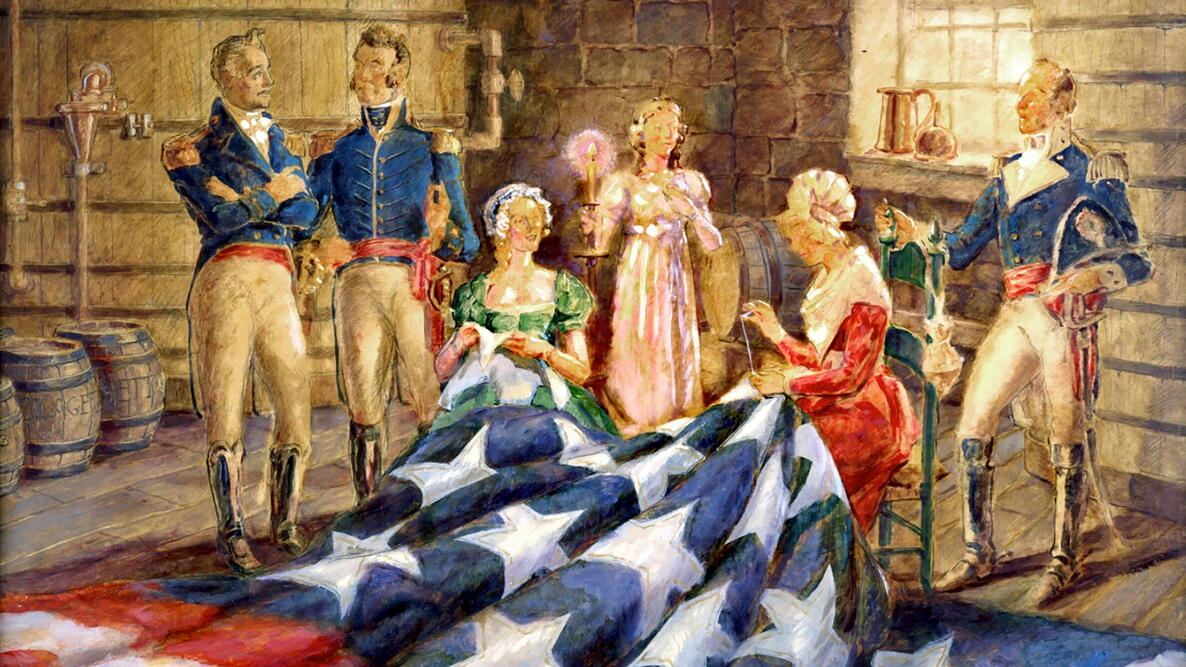
Caption
Mary Pickersgill and her helpers sewing the Star‑Spangled Banner in 1813.

Most Americans know Betsy Ross. Far fewer know Mary Pickersgill—the woman behind one of the most famous flags in American history. As the United States approaches its 250th anniversary, her story deserves the spotlight.
In 1813, Pickersgill stitched a massive American flag that flew over Fort McHenry during the War of 1812. That flag—later known as the Star-Spangled Banner—inspired Francis Scott Key to write the poem that became the national anthem and turned Pickersgill’s work into an enduring American symbol.
Who Was Mary Pickersgill?
Mary Pickersgill was a skilled Baltimore flag maker who learned the craft from her mother, Rebecca Young—a talented maker of military flags and a contemporary of famed flag-maker Betsy Ross. Pickersgill carried that expertise into her own business, sewing flags for the U.S. Army, the Navy, and merchant ships in Baltimore’s busy harbor.
In 1813, she received one of the largest commissions of her career: to sew a massive 15-star, 15-stripe American flag for Fort McHenry. This wasn’t a special design—it was the official U.S. flag of the time, used before the country returned to the familiar 13-stripe pattern we know today.
Pickersgill sewed the enormous 15-star flag that became famous after the Battle of Baltimore—the very flag Francis Scott Key saw “by the dawn’s early light” and later wrote about in what became the national anthem.

Broad Stripes, Bright Stars: Creating the Fort McHenry Flag
The commission for Fort McHenry was enormous—literally. The U.S. Army wanted a garrison flag so large that the British could see it from miles away. Pickersgill was asked to sew a 30‑by‑42‑foot flag with 15 stars and 15 stripes, matching the official U.S. flag design of 1813.
Pickersgill didn’t work alone. She enlisted her daughter, Caroline; her nieces, Margaret and Eliza; and Grace Wisher, a young apprentice in her household. Together, they cut and stitched more than 400 yards of wool bunting, working long hours to meet the tight deadline.
The flag was so large that Pickersgill had to rent space in a nearby brewery to spread it out on the floor. Estimates suggest the women made more than 350,000 hand stitches to complete the project in just six weeks.
On August 19, 1813, Pickersgill delivered the finished flag to Fort McHenry. No one could have guessed that this single commission—one of many she completed in her career—would become one of the most famous flags in American history.
The Perilous Fight and the Birth of the National Anthem
For more than a year, the huge flag flew over Fort McHenry. On September 12, 1814, British forces advanced on Baltimore—5,000 strong and supported by a fleet of 19 ships. By the morning of the 13th, they had reached the defenses surrounding the fort.
In heavy rain, the British bombarded Fort McHenry for 25 hours. Rockets and mortar shells lit up the night sky as the fort endured wave after wave of fire. Many feared it would fall.
At dawn, the sight of that enormous flag—still flying over the fort—proved that the young nation had survived the attack.
In that moment, Pickersgill’s work became more than a flag. It became a symbol of endurance.
Francis Scott Key, a lawyer and occasional poet, witnessed the bombardment from a British ship, where he had been detained during negotiations. At sunrise, the sight of the flag inspired him to begin a poem, “Defence of Fort M’Henry,” which would later become “The Star-Spangled Banner.”

As it turned out, the flag Pickersgill made would be the only official U.S. flag ever to carry 15 stripes. Realizing that adding both stripes and stars for each new state would quickly become unwieldy, Congress passed a law in 1818 establishing the modern flag design.
The Legacy of Mary Pickersgill
After the Battle of Baltimore, the giant Fort McHenry flag remained with Major George Armistead, who had commissioned it. The flag stayed in the Armistead family for decades, brought out for patriotic events and carefully passed down through generations. Over time, small pieces were clipped and given as keepsakes—a common practice then—which gradually reduced its size.
In 1912, Armistead’s grandson, Eben Appleton, donated the flag to the Smithsonian Institution so it could be cared for and shared with the nation. Today, the Star‑Spangled Banner is one of the museum’s most recognized and visited artifacts.
In her later years, Pickersgill devoted much of her time to philanthropy. From 1828 to 1851, she served as president of the Impartial Female Humane Society, a charitable organization that supported needy families and elderly women. She helped establish one of the first homes for aging women in Baltimore—a cause she championed long before formal social services existed.
Her legacy lives on at the The Star-Spangled Banner Flag House in Baltimore, her longtime home and workshop, now a museum and National Historic Landmark. Visitors can stand in the very rooms where she and her helpers stitched the flag that would become part of America’s story.
As the United States approaches its 250th anniversary, Mary Pickersgill’s story reminds us that some of the nation’s most enduring symbols were not forged on the battlefield but crafted by skilled hands at home. She made the flag that proved the nation would endure.

More Like This





Comments