For daily wit & wisdom, sign up for the Almanac newsletter.
Body
The black walnut tree (Juglans nigra) is one of North America’s most valuable and beautiful native trees, but it does have a “dark side.” Here’s what you should know before planting a black walnut in your yard—and how to harvest and eat the tasty black walnuts, too!
Facts About the Black Walnut Tree
The easily worked, close-grained wood of the black walnut has long been prized by cabinet- and furniture-makers for its attractive color and exceptional durability. Its logs are in such demand for veneer that “walnut rustlers” have made off with trees in the dead of night and even used helicopters in their operations.
Early settlers discovered black walnuts growing in mixed forests from Canada to northern Florida and west to the Great Plains. They found that their rich-brown heartwood was exceptionally resistant to decay and used it as fence posts, poles, shingles, and sills.
When surrounded by other trees in the forest, black walnuts grow straight and tall with few, if any, lower branches.
When planted in the open, the tree will branch out closer to the ground, developing a spreading shape that makes it easier to harvest its sweet, round, 2- to 3-inch nuts.
Settlers snacked on the nutritious walnuts out of hand, added them to soups and stews, and ground them into a meal for baking; the hard shells provided a perfect package for storing the nuts over winter.
What Is Juglone?
Although the black walnut has many uses and benefits, the tree does come with a caveat: the black walnut’s roots, which may extend 50 feet or more from the trunk, exude a natural herbicide known as juglone. This substance is also found in the tree’s leaves and fruit husks.
Juglone does serve a purpose, though. It inhibits many plants’ growth under and around the tree, thereby limiting the tree’s competition and leaving more water and nutrients for itself.
Tomatoes, potatoes, apples, pears, berries, and some landscape plants such as rhododendrons, azaleas, and lilacs may be killed or stunted if grown close to black walnut roots or within the tree’s drip line (i.e., under the tree’s canopy). Plan your landscaping accordingly!
Juglone Plant Susceptibility Chart
Highly Susceptible (Avoid Planting Near Black Walnut)
Tolerant (Safe to Plant Near Black Walnut)
Tomato
Corn
Potato
Beans
Eggplant
Carrots
Peppers
Beets
Apple Trees
Onions
Pear Trees
Cherry Trees (some varieties)
Blueberries
Black Raspberry
Rhododendrons
Pawpaw Tree
Azaleas
Red Maple
Lilacs
Hickory
Mountain Laurel
Oak (most species)
Hydrangea
Dogwood
A Great Shade Tree
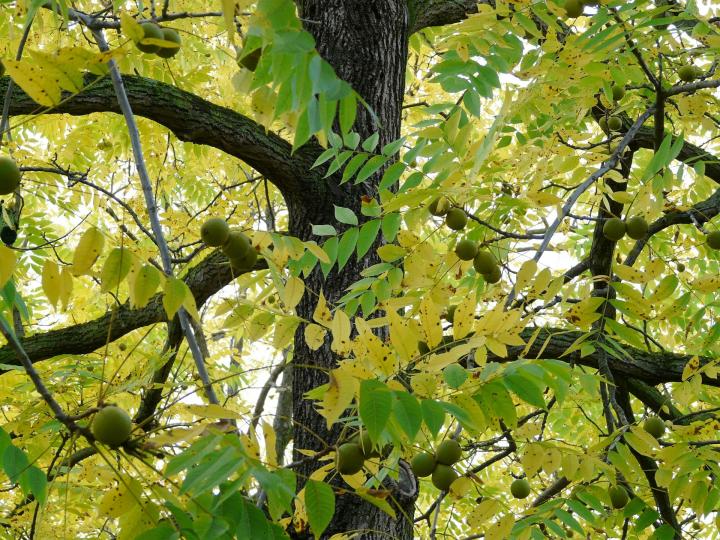
Despite this, black walnuts make great shade trees for larger properties. They commonly grow to 50 feet or taller and about as wide, but specimens of more than 100 feet have been recorded.
Black walnut’s large, fernlike foliage provides light, airy shade for those grasses and ground covers unaffected by juglone. The leaves turn bright yellow in autumn, contrasting nicely with the tree’s rugged, dark bark.
Black walnuts require deep, fertile soil with a near-neutral or slightly acidic pH. They are pretty much disease-free and are threatened by a few pests.
How to Harvest Black Walnuts
Thud! Thud! Most walnut tree owners have a love/hate relationship because of the fruit the tree drops in late summer through October. The fruit is quite heavy, the size of a baseball, and lime green in color. It makes quite a mess and can be viewed as a nuisance.
Walnut tree owners will spend hours picking up the fruit in some years. If you don’t remove the nuts, you’ll trip over them in the dark for the rest of the year (while they rot and mold on your lawn). Hire the kid down the street to pick up those dropped walnuts (just be careful not to pay per nut—you’ll go broke)!
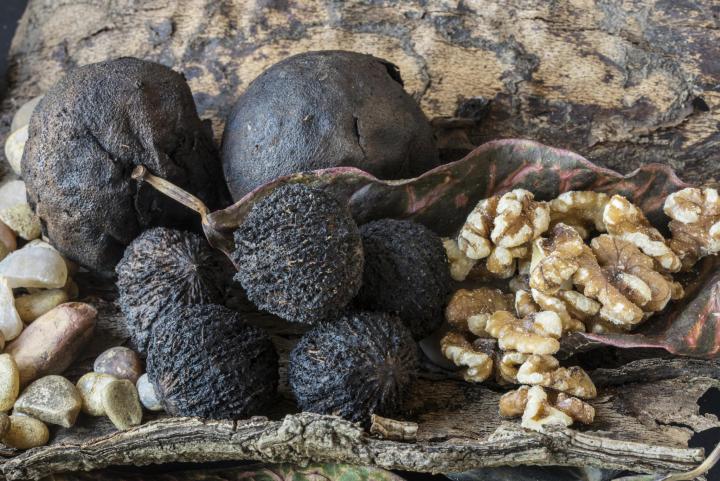
Photo Credit: John A. Anderson
If you’re willing to crack the outer shell, the “meat” inside is edible, as the squirrels will attest; squirrels have little problem chewing through the shells. (Note: Black Walnuts are different from English Walnuts, which are more commonly sold in stores and shown in the photo above.)
The sweet, earthy nutmeat inside is well worth the effort. Your grandparents may have harvested walnuts, which can be eaten raw or added to baking (cookies and bars). They can also be used as toppings on ice cream and cakes, enjoyed as a sweetened candy nut, or ground into a meal for a unique flour.
How to Harvest Black Wanuts
To harvest, collect the nuts as soon as possible to avoid mold and remove the husks immediately.
Wear gloves as the husks stain your hands (and anything they touch). If the nut is too hard, wait a few days, and it will brown and soften up.)
To remove the husk, you can step on them gently with an old pair of shoes. Hose down the nuts in a large bucket to remove any remaining husk.
Dry the walnuts for a couple of weeks on a screen, drying rack, or in a hanging mesh bag. You can store them unshelled for up to a year.
Crack the shell with a hammer to get to the nut meat. (Strike at a 90-degree angle to the seam until the nut cracks). Use pliers to easily clip away the shell to release the nutmeat.
Allow the freshly removed nutmeat to dry for a day before storing.
Do you have a black walnut tree? Please share your comments, questions, and advice!

George and Becky Lohmiller shared their gardening knowledge and enthusiasm with Almanac readers for more than 15 years, writing Farmer’s Calendar essays and gardening articles in previous editions of ...
We just purchased some land that is covered in black walnut trees. We will be taking some down to plant grass and do landscaping. How long are the roots toxic after they ate cut down?
Thanks!
Reply to comment
<a title="View user profile." href="/author/editors">The Editors</a>Wed, 02/11/2015 - 15:44
Hi, Susan: The duration of the toxicity of juglone, the poisonous agent of black walnut trees, really depends in some part on the type, density, and drainage of the soil (although juglone is not very soluble). Still, it can last for 5 or 6 years or even longer -- and it can be much shorter, too. There are two things to do: (1) When you "stump" (pull up the stumps on) your land, try to get as much of the big roots as possible, even if it means a little more work. They have a massive root system, but every little bit that's not there helps. (2) Research online or at your library what plants are tolerant of juglone -- there are quite a few: Kentucky blue grass, for example. Good luck!
Reply to comment
<span>Corinna</span>Tue, 10/14/2014 - 09:01
I have a few acres of black walnut trees. Unfortunately they were planted about 10 feet apart so they have grown tall and thin. They are about 50 feet tall with trunk diameters of 6-12inches. I'd like to thin some areas in hopes that the trees will branch out and spread at the crown. Is it too late for them or will opening the area encourage them to branch out?
Thanks!
Reply to comment
<a title="View user profile." href="/author/editors">The Editors</a>Wed, 10/15/2014 - 10:08
Hi, Corinna: This is a good question, with answers so complicated that we dare not go there. Some of this depends on the purpose of the trees (harvest anything? shade? beauty?). In any event, walnut trees with this extremely tight spacing are best thinned when their diameters are 3 to 4 inches, not 6 and up. Your local climate and soil conditions might come into play, too, not to mention the extensive root systems. We recommend consulting with a professional arborist. Good luck!
Poison ivy vines are growing exclusively on all my walnut trees in the unkept, mature woods of the older home I just bought in northern MD. Wild grape, oak, and rosa flora vines are grwing on all the other trees but never on the walnuts. Why? I love and hate it. How agressive can I get with herbicides and not hurt the trees?
Reply to comment
<a title="View user profile." href="/author/editors">The Editors</a>Tue, 09/02/2014 - 11:03
Hi, Mary: This seems to be a question not only of arboriculture, but also of semantics. Why poison ivy is not growing on your other trees, we don't know. Why the grape, etc., are not growing on your black walnuts is because b-w's produce an herbicidal substance called juglone (see our intro above) that is toxic to many plants. It is not toxic to poison ivy, which is why p-i will grow on black walnuts. In and of itself, a good (p-i specific, if possible), organic herbicide is not going to kill the trees. In and of itself, it is also not going to kill the p-i vines. The thing to do is first to thoroughly cover every inch, nook, and cranny of yourself with protection from p-i's urushiol oil. Let us repeat that: Cover yourself totally. Then carefully remove (cut out) sections (a foot long is good) of the vines, which will kill what is above (but the oil will still be potent for a year or two). Then, focus on spraying what is below the cut. Carefully discard the cut sections in a way that no one can touch them or what they have touched. By the way, though: Poison ivy leaves are edible by quite a range of wildlife. It's a complicated situation, and no doubt this reply has just scratched the surface.
Reply to comment
<span>Imstunned</span>Sun, 08/17/2014 - 20:27
I just recently found out I have a black walnut tree in my next door neighbors home right on my fence line. It drops these green balls onto my roof and scares the crap out of me lolz...I grabbed one today threw it on my cement patio it broke the green ball and I seen it was a walnut shell on the inside. Now I live in northern illinois and my neighbors never planted the tree. How the heck is it surviving?
Reply to comment
<a title="View user profile." href="/author/editors">The Editors</a>Tue, 08/19/2014 - 07:16
Normally, you need a special tool to crack a black walnut shell (that is stronger than a common nut cracker) but I guess you found a creative solution! :-) Inside is a sweet nut that you can eat or make into pies. The tree may have seeded itself; it's hard for us to know. Just keep in mind that the area near the tree can be toxic to other plants and vegetables, so something to keep in mind when you consider whether you want to keep it.
Reply to comment
<span>Timtim</span>Tue, 11/11/2014 - 09:45
I have a whole yard full of black walnut trees and a garden right next to one and my plants don't get toxic as a matter of fact I had more tomatoes than I knew what to do with.
Reply to comment
<span>Debb85</span>Sat, 07/19/2014 - 21:18
We have a Black walnut tree in our front yard in Lincolnton, N.C. My question is we have been living here 5 years, and this is the first year it is not bearing nuts. Do they have a non-bearing year like the Pecan tree. Thank you
Comments